ZebPay Warns Customers of Data Exposure Following Security Breach at MoEngage
Key Takeaways
- •An unauthorized party accessed MoEngage's cloud infrastructure using compromised credentials, and the vendor traced the breach to one of its own third-party service providers, making it a supply-chain incident rather than a direct attack on ZebPay.
- •ZebPay stated that its own servers, databases, wallets, and trading systems were not affected and that customer funds were not at risk.
- •The exposed information reportedly includes names, contact details, device data, app settings, event data, and recent account activity, which could enable convincing phishing and social engineering attacks against ZebPay users.
- •MoEngage notified its clients of the breach on November 20, 2026, with ZebPay warning customers the next day, while some MoEngage clients lost platform access for nearly a week before partial service was restored.
- •As of November 21, 2026, ZebPay had not confirmed how many of its customers were affected, and no figures on the total number of extracted records had been publicly disclosed.
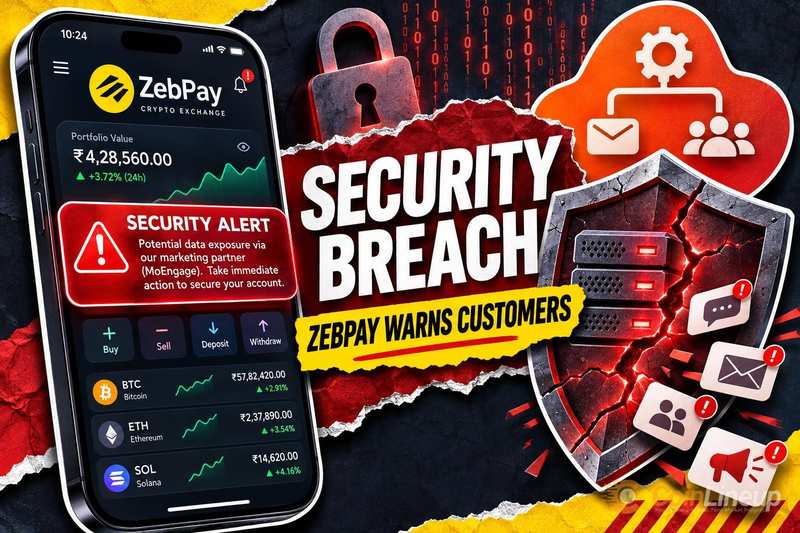
Indian cryptocurrency exchange ZebPay has warned its customers that their personal data may have been exposed following a security breach at MoEngage, a customer engagement platform that ZebPay uses to send communications, according to reporting by crypto.news. The exchange issued the warning on November 21, 2026. Although the breach originated outside ZebPay's own systems, it affected data belonging to ZebPay users, potentially exposing customers to phishing and social engineering attacks.
How the Breach Occurred
An unauthorized party used compromised credentials to access MoEngage's cloud infrastructure, according to crypto.news. The attacker extracted data belonging to customers of multiple MoEngage clients, including ZebPay users. MoEngage traced the breach back to a compromise at one of its own third-party service providers, making this a supply-chain security incident rather than a direct attack on ZebPay's own environment. Incidents in which attackers use stolen vendor credentials to reach data across many downstream companies at once are a recognized pattern in supply-chain security, because customer engagement platforms hold contact and activity data for their entire client base by design.
ZebPay Says Core Systems and Funds Were Not Affected
According to crypto.news, ZebPay said on November 21, 2026 that its own servers, databases, wallets, and trading systems were not affected and that customer funds were not at risk. The report said the data that was exposed in the breach consisted of information held by MoEngage on behalf of ZebPay.
What Data Was Exposed
According to thecurrencyanalytics.com, the data taken in the breach included the information MoEngage holds to run customer engagement campaigns: names, contact details, device data, app usage patterns, and customers' recent account activity. Descriptions of the exposed categories also included basic identifiers, contact details, online and device data, app settings, event data, and customers' most recent account activity.
Taken together, this type of information can give attackers enough detail to craft convincing impersonation messages. Names and contact details allow direct outreach to affected users, while event data and recent account activity provide the timing and context that can make a fraudulent message feel authentic. App settings and device data can further help a fake message appear technically consistent with a user's actual usage.
Notification Timeline and Service Disruption
According to crypto.news, MoEngage sent breach notification emails to its clients on November 20, 2026, and ZebPay issued its warning to customers the following day, on November 21. The report also said some MoEngage customers lost access to the platform for nearly a week, from approximately November 13 to November 19, before partial service was restored. That roughly week-long loss of access illustrates how a single vendor incident can interrupt operations for many businesses at the same time.
According to crypto.news, ZebPay reported the incident to the appropriate authorities in India and directed affected customers to file reports with the National Cyber Crime Helpline at 1930 or through cybercrime.gov.in.
Why This Type of Breach Is Worth Taking Seriously
A breach at a customer engagement platform might sound less alarming than a hack of a crypto exchange's core systems. But the exposed data—contact details combined with account activity patterns—is precisely what scammers use for targeted attacks. A fraudster who knows a customer's name, email address, and the fact that the customer recently used ZebPay can send a highly convincing fake security alert or account verification request. Because the stolen data includes evidence of recent activity on the exchange, such messages can also arrive at moments that make them seem more credible. Phishing is a common attack vector in the crypto industry, with fraudulent messages typically designed to capture login credentials or seed phrases, either of which would give a fraudster direct access to an account or wallet.
The incident illustrates the supply-chain risk described in the reporting: a third-party platform can expose data connected to an exchange without any direct compromise of the exchange's own core systems.
ZebPay's Warning About Scam Communications
According to crypto.news, ZebPay warned customers that company staff will never ask for passwords, one-time passwords (OTPs), two-factor authentication codes, seed phrases—the master key to a crypto wallet—or fund transfers through any message or call. Any communication that makes these requests should be treated as a scam attempt.
What ZebPay Customers Should Do
The most immediate risk from the breach is targeted phishing. Attackers may already have enough information to craft messages that look like they come from ZebPay. Customers should verify any communication that asks them to log in, confirm their account, or take urgent action by going directly to the official ZebPay app or website rather than clicking links in messages.
Reviewing account security settings is a sensible precaution. Customers who have not already done so should enable the strongest available multi-factor authentication on their ZebPay accounts. Multi-factor authentication (MFA) requires a second form of verification beyond a password, making it significantly harder for an attacker to access an account even if they know the associated email address.
Customers should not share their password, OTP, 2FA code, seed phrase, or any financial credentials with anyone claiming to represent ZebPay, over any channel including email, SMS, or phone. According to crypto.news, these are the items ZebPay said its staff will never request.
Anyone who believes they have been targeted, or who has shared sensitive information, should contact ZebPay through its official support channels immediately and report the incident to the National Cyber Crime Helpline at 1930 or through cybercrime.gov.in.
For anyone newer to crypto who is still setting up account security practices, the incident serves as a reminder that the risks to a crypto account often come from outside the exchange itself.
Unanswered Questions
According to crypto.news, ZebPay had not confirmed how many of its customers were affected, and no details about the total number of records extracted had been publicly disclosed as of November 21, 2026. Any subsequent disclosure from ZebPay or MoEngage about the number of affected customers and records would be the key detail to watch, since those figures would define the breach's actual scope.

