Zcash risks slide toward $1,000 as inflation fears outweigh ETF inflows
Key Takeaways
- •Zcash fell to roughly $1,094 on Thursday, breaking beneath the $1,115 level that had marked last week's low and prolonging a correction from its late-September peak of $1,698.
- •US CPI data showing 3.7% annual inflation, above the expected 3.6%, intensified concerns about further Federal Reserve rate hikes and weighed on the broader cryptocurrency market.
- •Grayscale's ZCSH fund attracted $3.68 million in inflows on Wednesday, ending two consecutive days of withdrawals that had followed two weeks of net outflows.
- •Technical indicators remain bearish, with ZEC trading below the 50-period EMA near $1,242 and the 200-period EMA around $1,264, while the RSI at roughly 34 signals subdued momentum.
- •A confirmed four-hour close below $1,115 would strengthen the bearish case, with downside references near $1,050 and then $1,000, and a potential extension toward $888 if intervening supports fail.
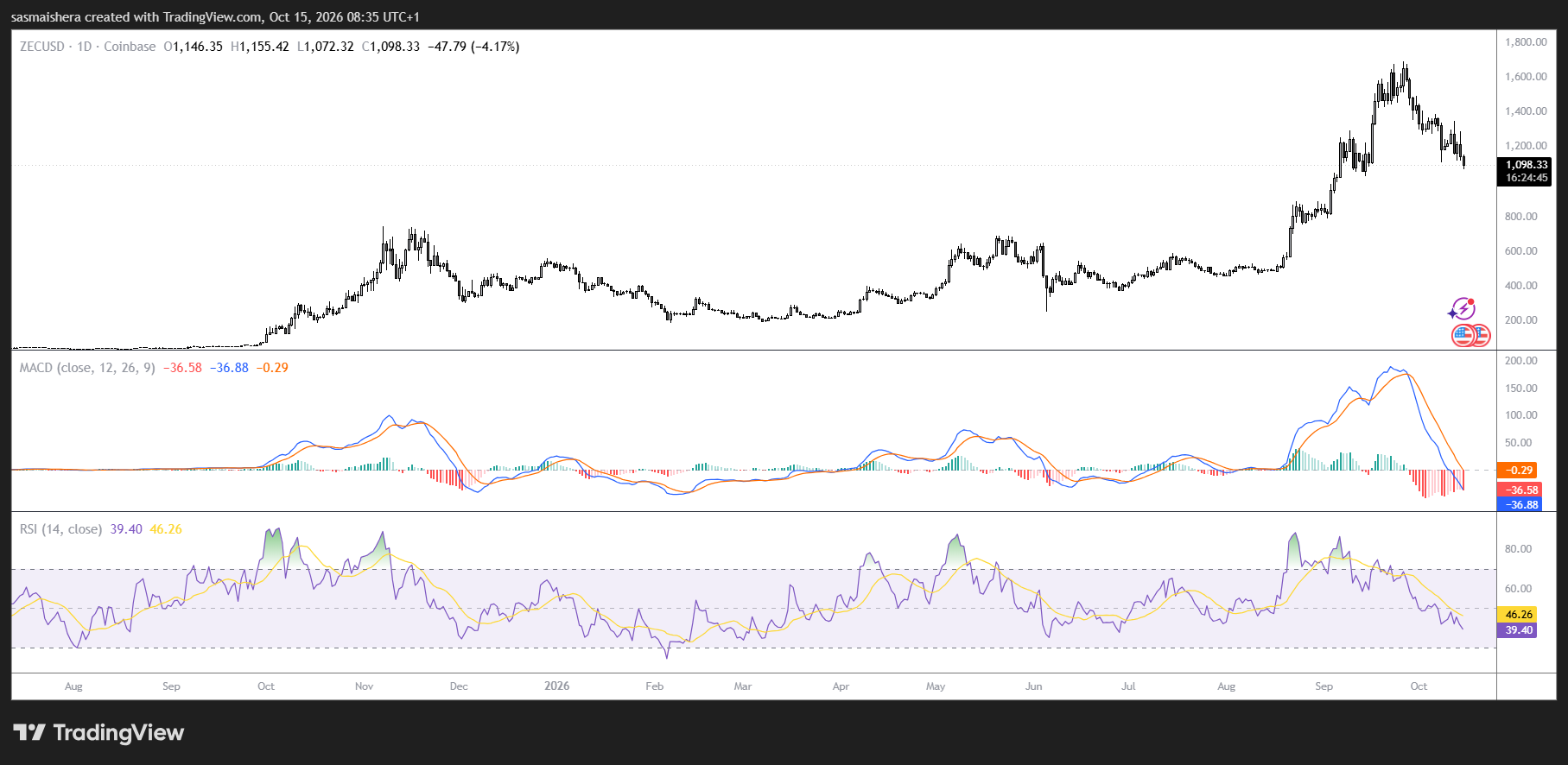
Zcash (ZEC) extended its slide on Thursday, with the price falling below last week's low near $1,115 as inflation concerns weighed on the broader cryptocurrency market and overshadowed a return to inflows into Grayscale's Zcash-focused exchange-traded fund.
The token traded near $1,111 on Thursday before slipping to around $1,094 at the time of reporting, extending the previous session's roughly 6% loss. A sustained four-hour close beneath $1,115 remained the key condition for confirming a breakdown. The latest selling prolongs a correction from Zcash's late-September peak of $1,698, and with momentum indicators still pointing lower, attention has shifted to whether buyers can prevent a deeper retreat toward $1,000.
Zcash is a privacy-focused cryptocurrency whose ZEC token has traded publicly since 2016. The protocol supports shielded transactions built on zero-knowledge proofs, a cryptographic technique that can conceal transaction details, and ZEC has long ranked among the most prominent privacy-oriented digital assets.
Hot inflation print pressures cryptocurrencies
The renewed pressure followed the release of US Consumer Price Index data showing annual inflation of 3.7%, exceeding expectations of 3.6%, according to the report. The CPI is one of the most closely watched gauges of US price pressures and a key input into Federal Reserve rate decisions, so the stronger reading heightened concerns about persistent inflation and the possibility of further interest rate hikes, weakening appetite for cryptocurrencies. Financial markets have been sensitive to the inflation trajectory, as sustained price growth could encourage policymakers to maintain restrictive monetary conditions.
Bitcoin's vulnerability around $80,000 added to the cautious backdrop. Further weakness in the largest cryptocurrency could intensify selling across altcoins, including Zcash.
These macroeconomic pressures have limited the impact of improved demand through ZEC investment products, leaving the token under pressure despite Wednesday's positive fund flows.
Grayscale's ZCSH attracts $3.68 million
Grayscale's Zcash-focused fund, ZCSH, recorded $3.68 million in inflows on Wednesday, according to SoSoValue data. The inflows ended two consecutive days of withdrawals, which had followed two weeks of net outflows, offering an early indication of renewed demand through the product. Grayscale, one of the largest digital asset managers in crypto, provides exposure to ZEC through the fund without requiring investors to hold the token directly, which makes its daily flow figures a widely cited gauge of demand via ZEC investment products.
However a single positive session does not establish a sustained recovery in investor appetite. Zcash's continued spot-market decline suggests the buying was insufficient to overcome broader selling pressure, and whether ZCSH can attract further inflows will help determine if Wednesday's improvement develops into a more durable trend.
Zcash tests support below $1,115
Zcash's four-hour chart retains a bearish bias, with the price trading well below two important moving averages. The 50-period Exponential Moving Average stands near $1,242, while the 200-period EMA sits around $1,264. Together, they form an overhead resistance zone that could complicate recovery attempts.
Momentum indicators reinforce the weak outlook. The Moving Average Convergence Divergence (MACD) indicator and its signal line remain below zero, accompanied by deeply negative histogram bars. Meanwhile, the Relative Strength Index (RSI) hovers around 34, indicating subdued momentum while remaining slightly above the conventional oversold threshold of 30. The reading suggests downside momentum remains dominant but has yet to reach levels typically associated with exhausted selling.
The immediate technical question is whether ZEC confirms a sustained break below $1,115. A four-hour close beneath that level would strengthen the bearish case and raise the risk of further losses. If the breakdown holds, the September 4 high near $1,050 becomes the next downside reference, followed by psychological support at $1,000. A failure to defend $1,000 could expose the August 23 high around $888, though that deeper target remains conditional on Zcash losing the intervening support levels.
For buyers, the first significant recovery hurdle is the 50-period EMA at $1,242, with the 200-period EMA near $1,264 presenting another barrier. Reclaiming this resistance zone would help ease downside pressure. Until then, weak momentum and broader market uncertainty leave Zcash exposed to further selling, with the $1,115 level central to its immediate direction. How ZCSH flows develop from here and whether Bitcoin can steady near $80,000 will round out the picture in coming sessions.
Originally published by CoinJournal.

