Zcash Price Tests October Wall at $1,343 Ahead of NU7's 3x Faster Block Upgrade
Key Takeaways
- •Zcash developers proposed block 3,543,405 as the NU7 activation height, implying a mainnet upgrade around November 5, though the change must still be merged into ZIP 259 and node software must ship the new height.
- •NU7 will cut the target block interval from 75 seconds to 25 seconds while reducing per-block rewards to one third, leaving total new supply and the halving schedule unchanged.
- •The new Network Sustainability Mechanism will route 60% of transaction fees out of circulation into a reserve scheduled to be paid to miners as extra subsidies starting around February 2031, with the 21 million $ZEC cap untouched.
- •ZIP 2003 will disable version 4 transactions, making funds left in the original Sprout shielded pool unspendable unless holders move them to the Sapling or Orchard pools before activation.
- •$ZEC has failed repeated intraday attempts to break the $1,343 Fibonacci resistance this month, and only a daily close above that level would change the current trading structure.
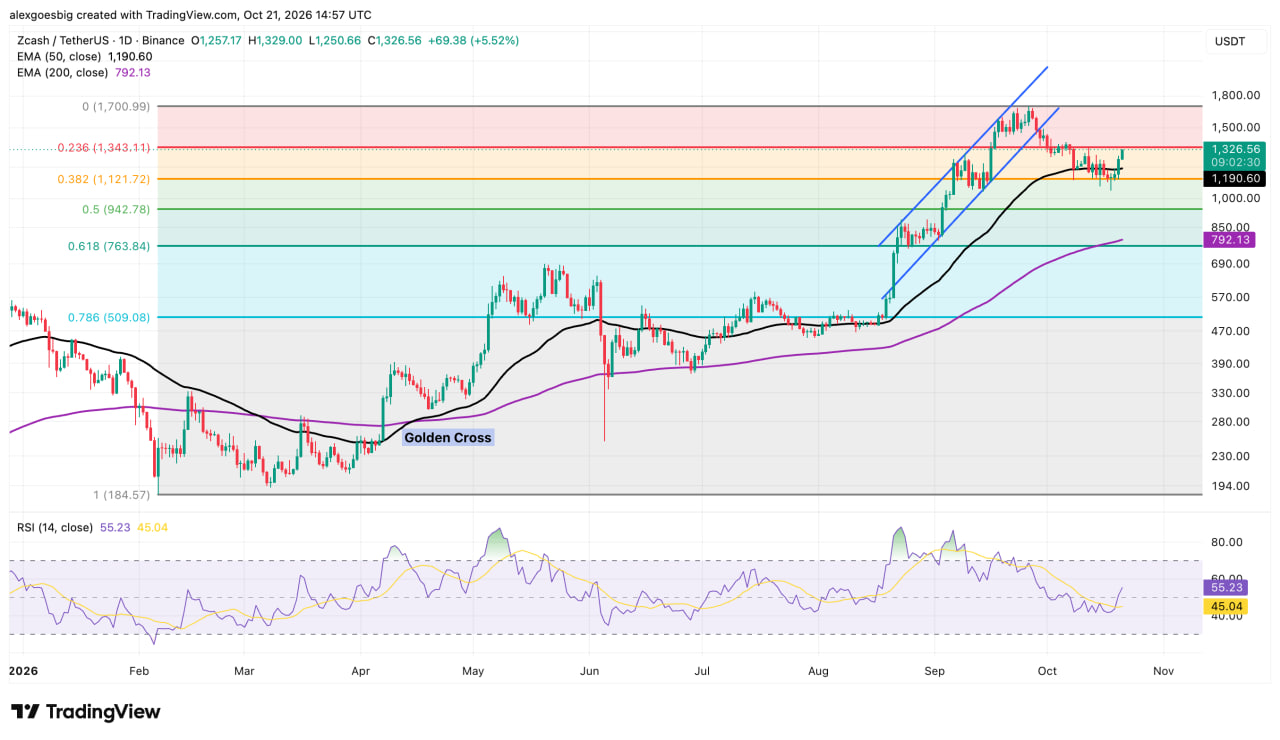
Zcash climbed about 8% over the past 24 hours to $1,313.75, lifting the privacy coin's market value to roughly $22.23 billion after its developers settled on a concrete mainnet height for Network Upgrade 7 (NU7). The upgrade cuts block times, defers most transaction fees to future miners, and retires Zcash's original privacy pool. The proposed activation block, 3,543,405, should arrive around November 5, and on the chart $ZEC is pressing against the $1,343 level that has rejected every rally attempt this month.
What Is Still Needed Before NU7 Goes Live
On October 20, longtime Zcash protocol developer Sean Bowe opened pull request #1405 on the project's specification repository, proposing block 3,543,405 as the activation point. The proposal followed a meeting of the Zcash Improvement Proposal (ZIP) editors, the group that maintains the network's formal rulebook; ZIPs are the numbered documents through which the project changes its consensus rules. Fellow contributors ValarDragon and str4d approved it the same day, although the change still has to be merged into ZIP 259, the document that defines how NU7 is deployed, and node software must carry the new height before the network can switch over. Activation by block height gives every network participant a fixed, pre-announced switch-over point, which is why the remaining work here is software readiness rather than protocol design.
The activation date follows a rollout timetable published on the community forum in mid-September. Testnet, parallel network where upgrades are rehearsed without real funds at stake, already runs the new rules: the Zcash Foundation shipped the Zebra 7.0.0-rc.0 release candidate on October 2, and NU7 went live at testnet block 4,465,026 a few days later.
Triple the Blocks, Same Supply
The headline change comes from ZIP 218, which cuts the target gap between blocks from 75 seconds to 25 seconds. Zcash would produce about 3,456 blocks a day instead of 1,152, and a payment waiting for three confirmations would settle in roughly a minute and a quarter on average, compared with almost four minutes today. The specification names everyday payments and integrations such as NEAR Intents as the main beneficiaries.
Faster blocks would normally mean faster issuance, so NU7 trims the scheduled reward per block to a third of its current size, leaving both the total supply of new $ZEC and the halving schedule where they were. In effect, the network would issue new coins at the same overall pace despite producing three times as many blocks. ZIP 218 also caps the number of shielded actions per block to keep the cost of verifying and syncing private transactions in check, which means tripling block frequency does not triple the network's sustainable capacity.
60% of Fees Head for a 2031 Vault
ZIP 235 creates the Network Sustainability Mechanism (NSM), which pulls 60% of the transaction fees in every block out of circulation and leaves miners with the remaining 40%. Those coins sit in a pool that is scheduled to come back: ZIP 237 starts paying the accumulated balance to miners as an extra block subsidy from block 8,939,664, expected around February 2031. The deployment specification confirms that the 21 million $ZEC cap stays untouched.
The design targets Zcash's long-term security budget, because each halving cuts what miners earn from new coins, and the NSM builds a reserve from present-day usage to top up their income later. Unlike Ethereum's EIP-1559, which burns each block's base fee permanently, Zcash's mechanism parks the funds for future redistribution, so value exits circulating supply only temporarily. How large that reserve grows depends entirely on fee volume, which stays modest on a network where individual transactions cost very little, so the mechanism only affects circulating supply in a noticeable way if activity rises considerably.
Sprout Funds Freeze at Activation
ZIP 2003 disables version 4 transactions, the format required by Sprout, the shielded pool Zcash launched with in 2016. Funds still sitting in Sprout addresses will become unspendable under the new consensus rules, so holders of old wallets need to move them to the newer Sapling or Orchard pools before activation. The newer pools run on lighter proving systems that make private transactions faster and cheaper to create, which is why day-to-day activity migrated away from Sprout long ago. Version 5 and version 6 transactions remain valid, and ordinary transparent and modern shielded balances are unaffected. The change effectively freezes the network's oldest shielded pool once the upgrade locks in.
$ZEC Stuck Below the 0.236 Fibonacci Level
$ZEC rallied about 820% from its February low of $184.57 to a September peak of $1,701 before slipping out of a steep rising channel around the start of October. Since then it has traded between the 0.236 Fibonacci retracement at $1,343, measured across that entire rally, and the 0.382 level at $1,122, with the 50-day exponential moving average (EMA) at $1,190 catching every dip, including a brief wick below it last week that buyers reversed almost immediately. Fibonacci retracements are fixed ratios of a prior move that traders watch as potential support and resistance, which is why the same $1,343–$1,122 band has framed every session this month, and an EMA weights recent prices more heavily than a simple average, so it tracks an ongoing trend more closely.
Wednesday's bounce lifted the 14-day relative strength index (RSI) to about 55, above its own average near 45 for the first time since early October. The indicator cooled from readings above 80 in September to the low 40s without ever reaching oversold territory, a pattern typical of a market absorbing a large gain while buyers remain active underneath. The daily candle is still open, however, and intraday pushes through $1,343 have failed several times this month, so only a daily close above that level would change the structure.
Half the Checklist Still Open
The Zebra 7.0.0 build that runs NU7 is still a release candidate — a near-final build that must clear stabilization testing before production use — and the Zcash Foundation has told mainnet operators to wait for a stable release carrying the activation height, with the current 6.4.x series of the Zebra node set to be retired before the switch. Nodes that miss the update would end up on an incompatible chain, and exchanges, wallets, explorers, and indexers all have to adjust to a block arriving every 25 seconds, so brief deposit and withdrawal pauses around activation would not be unusual for an upgrade of this scope.
A daily close above $1,343 would end October's run of lower highs and bring the $1,500 area into play, with $1,701 behind it, though traders who bought before the channel broke may use that zone to exit. Another rejection would point back to $1,190 and then $1,122, and a close below the range floor would expose $943, leaving the band between $764 and $792, where the 200-day EMA meets the 0.618 retracement, to decide whether the uptrend that began in April survives.
The 50-day EMA climbed steeply through August and September but has gone almost flat during October, which means the level buyers keep defending has stopped rising with price. With NU7 roughly two weeks away, the upgrade is the most likely catalyst to break the range, and any slip in the activation schedule would leave $ZEC leaning on a moving average that offers less protection with each passing week.
Source: CryptoNewsNet

