Zcash Coinholders Back 25-Second Blocks and Existing Halvings in NU7 Vote
Key Takeaways
- •Nearly 2.4 million ZEC, about two-thirds of the roughly 3.6 million eligible at the snapshot, participated in the NU7 coinholder vote, exceeding the one-million-ZEC threshold for treating the result as representative.
- •At least 99% of participating ZEC favored reducing the target block interval from 75 seconds to 25 seconds via ZIP 218, which also caps shielded actions per block and adjusts block subsidies so daily ZEC issuance stays roughly unchanged.
- •A 98.9% majority backed keeping the existing halving schedule inherited from Bitcoin, rejecting ZIP 234's proposal for gradually declining rewards even though mining difficulty fell after the 2020 and 2024 halvings.
- •Approximately 97.3% of voting weight supported disabling Sprout's version 4 transactions at NU7 activation, while the poll explicitly left undecided what happens to the funds affected by the retirement.
- •Voters approved launching NU7 without unfinished components by 99.3%, setting a September 30 readiness deadline that is not an activation date, as ZIP 218 remains a draft with undecided testnet and mainnet heights.
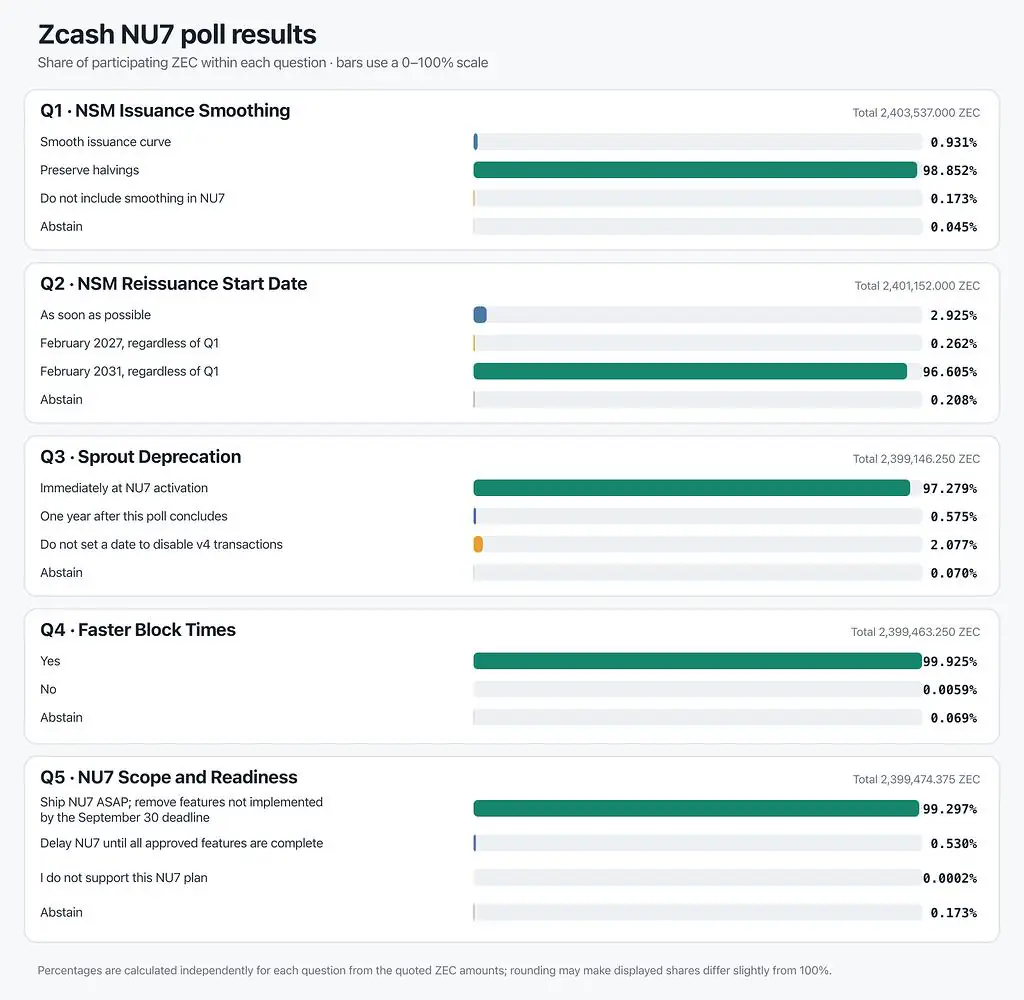
Nearly 2.4 million ZEC took part in the coinholder vote on Network Upgrade 7 (NU7), out of roughly 3.6 million ZEC eligible at the snapshot — a turnout well above the one-million-ZEC threshold organizers had set for treating the outcome as representative of Zcash coinholders.
According to the published results, at least 99% of participating ZEC favored cutting the target block interval from 75 seconds to 25 seconds, while 98.9% backed keeping Zcash's existing halving schedule rather than moving to a gradually declining issuance curve.
Voting weight was proportional to eligible ZEC instead of one-person-one-vote, so a wallet holding more ZEC carried more influence. The system was nonetheless designed to keep individual balances and choices private.
A shorter block time changes what users wait for
A block holds the transactions the network has accepted into its shared record. Under the current 75-second target, a person making a payment waits about 75 seconds on average for the next block and a first confirmation; a 25-second target would cut that expected initial wait to roughly 25 seconds.
The gain would be most visible in flows that depend on one or two confirmations — smaller payments, exchange deposits and some cross-chain operations among them. It would not, however, guarantee that every service credits a transaction within 25 seconds: exchanges and merchants set their own confirmation requirements, and actual block times fluctuate around the target.
The technical proposal behind the change, ZIP 218, also caps how many shielded actions each block may contain. The caps are meant to keep the faster schedule from imposing excessive processing and synchronization burdens on wallets and network nodes.
Shorter intervals also raise the likelihood that two miners produce competing blocks almost simultaneously. ZIP 218 estimates the stale-block rate — the share of valid blocks that fail to remain in the accepted chain — could climb from about 0.4% to approximately 3.26%. Its action limits would cut worst-case light-wallet synchronization bandwidth from roughly 271 MB to 169 MB per day.
Three times as many blocks will not triple ZEC supply
Shortening the interval from 75 to 25 seconds would produce roughly three times as many blocks over the same period. Left unadjusted, that could accelerate miner rewards and pull future halvings forward.
ZIP 218 forestalls that outcome by lowering the subsidy attached to each block and stretching the halving interval when measured in blocks. Three smaller rewards would be issued in about the time the network now issues one larger reward. Daily ZEC creation would therefore remain approximately unchanged: the faster schedule alters when transactions are recorded, not how many coins can ultimately exist.
By preserving the halvings, coinholders kept the reward model Zcash inherited from Bitcoin, under which the mining subsidy falls by half at roughly four-year intervals.
Holders rejected a smoother reward curve for miners
ZIP 234 proposed replacing the large reward cuts with a gradual decline while retaining the 21-million-ZEC ceiling, aiming to shield miner revenue from a sudden 50% reduction at each halving. The proposal notes that Zcash mining difficulty fell after the 2020 and 2024 halvings, which is consistent with some miners switching off equipment once their rewards dropped. Coinholders nevertheless chose to retain the established schedule.
The planned Network Sustainability Mechanism would provide a separate source of future miner rewards. Under the proposal, it would remove funds from circulation — including at least 60% of transaction fees — before recycling the ZEC through later block subsidies. On the timing of that recycling, 96.6% of participating ZEC supported waiting until February 2031, allowing the collected funds to accumulate for several years before they begin returning to miners.
The vote counted ZEC without exposing individual balances
Only spendable shielded ZEC held in the Ironwood pool at the snapshot could participate, letting voting power reflect actual holdings without requiring voters to publish their balances or publicly tie them to a chosen answer. Under the voting design, each vote was encrypted and split into 16 unlinkable ballots. Validators could calculate the combined totals, but the system was built to prevent them from reconstructing any individual voter's balance and choices.
The vote also backed retiring Zcash's oldest privacy pool
Approximately 97.3% of participating ZEC supported disabling the version 4 transactions associated with Sprout when NU7 activates. Sprout was Zcash's original shielded system, but deposits to it have been disabled since 2018. When the poll was prepared, it held fewer than 23,000 ZEC and accounted for less than 0.1% of volume.
The vote addresses only when the old transaction format should stop being accepted. It does not determine what should happen to funds affected by the retirement — a question explicitly left outside the poll.
September 30 decides what can enter NU7
Coinholders voted 99.3% to launch NU7 without waiting for every proposed feature: anything not implemented by the September 30 readiness deadline could be removed from the upgrade rather than delaying components that are complete.
That deadline is not an activation date. ZIP 218 remains a draft, and the document governing NU7 deployment still lists its testnet and mainnet activation heights as undecided. Supported features must be completed, reviewed, tested and included in the final package before nodes can enforce them.
Until that package is tested and assigned an activation height, Zcash will continue producing blocks on its existing 75-second schedule. The practical milestones to watch are therefore the September 30 readiness decision, completion of the relevant implementation and testing work, and publication of activation heights for the final NU7 package.
This article is provided for informational purposes only and does not constitute financial or investment advice. NU7 features remain subject to implementation, testing, final inclusion and mainnet activation.
Source: Coindoo

