Zcash Dev Fund Debate Divides Top Investors as 'Encrypted Bitcoin' Identity Takes Hold
Key Takeaways
- •The Zcash Dev Fund routes 20% of every block reward into grants for ecosystem development, and whether it should continue is the core unresolved question in the dispute.
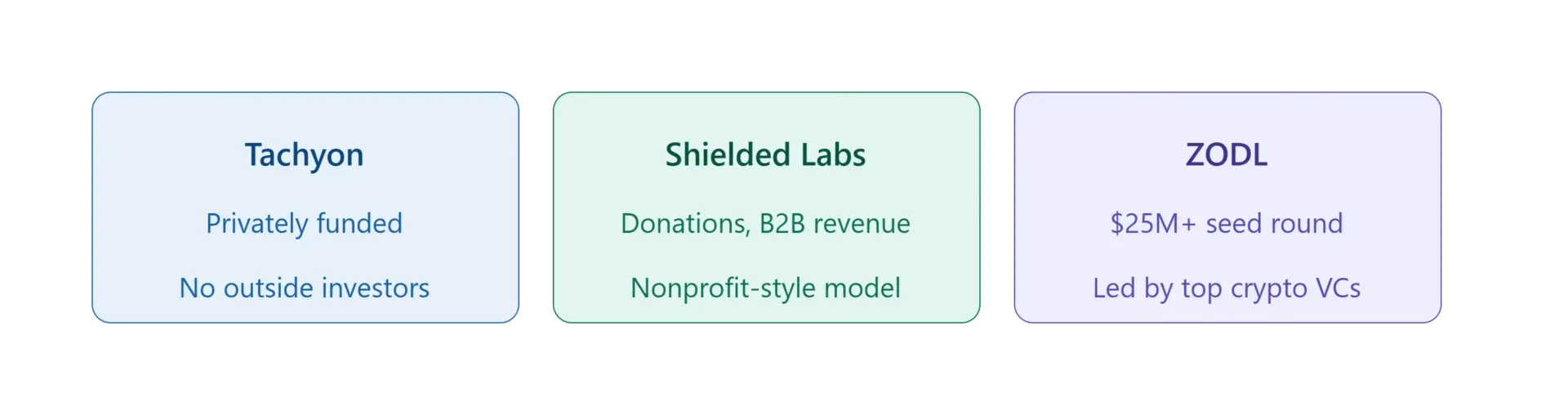
- •Developer Maxime Desalle argued the fund drains resources from miners and fosters dependency and bureaucracy, pointing to Tachyon, Shielded Labs, and ZODL as evidence that private capital funds projects without protocol subsidies.
- •Paradigm-founder Matt Huang defended inflation-funded developer support as an elegant mechanism for long-term public goods, while economist Alex Tabarrok acknowledged merit in concerns about weak governance.
- •Haseeb Qureshi proposed that tokenholders elect delegates or council members on a regular schedule, warning that lifetime appointments harm governance since ZIP 1016 places no restriction on coin voting, including by grantees.
- •Developers target November 5 for the NU7 upgrade, which cuts block spacing from 75 to 25 seconds, after holders voted 98.9% to keep the halving schedule and 99.9% to back faster blocks.
A public dispute over how Zcash funds its own development has drawn some of the industry's most active investors and cryptographers, with participants taking sides on the 20% tax applied to block rewards and a growing push for ZEC to behave more like a conventional store of value. The dispute turns on a question that runs across the industry: whether a protocol should direct a share of its own issuance toward development, or leave that funding to private capital.
The Zcash Dev Fund is a mechanism that routes 20% of every block reward the network earns into a pool that funds grants to teams working on ecosystem development. The debate has landed just as developers set a November date for the protocol's next major upgrade. ZEC, meanwhile, remains in the middle of an epic run that has pushed its price close to $1,500 after a 20% uptick on Thursday.
Why the Zcash Dev Fund is being debated
Developer Maxime Desalle shared a September 9 essay titled “Contra the Zcash Fund”, arguing that every ZEC token used to fund grants is money that never reaches the miners responsible for network security. In the same essay, Desalle called out the dependency, bureaucracy, and political selection tendencies that a miniature welfare state like the Dev Fund can breed.
If Zcash is already paying for its own development, he argued, there is no urgency for anyone to explore alternative funding channels. Teams looking for funding, in turn, will simply learn to sell better to grant reviewers rather than build user-facing products. Desalle said he even canceled a ZCG grant he had raised about six months earlier, arguing that holding the money just “seemed wrong.”
Desalle pointed to marquee ecosystem projects such as Tachyon, Shielded Labs, and ZODL as evidence that private capital shows up without a protocol subsidy.
Matt Huang, co-founder of Paradigm — an investor in both ZEC and ZODL — disagreed. Huang argued that developer backing funded by inflation is “an elegant mechanism” for the long-term funding of public goods.
Economist Alex Tabarrok straddled the fence on the “perennial debate,” conceding that Desalle's point about weak governance made sense even though the public goods issue complicates the picture.
Who should control the Zcash Dev Fund?
While the question of whether a developer fund should be maintained is still being debated, Haseeb Qureshi is already talking about how the fund should be controlled, arguing that allocation should not run on pure token voting.
Rather, Qureshi is proposing a system “akin to representative democracy,” with tokenholders electing delegates or council members on a regular schedule. He added that delegates should stay accountable to holders and warned that “lifetime appointments are usually not conducive to good governance.”
On that concern, Qureshi and Desalle see eye-to-eye. Under coinholder grants, recipients are paid in the same ZEC that decides the next funding round, meaning an influential grantee's voting power compounds with every win. ZIP 1016 places no restriction on anyone voting their coins.
The 'encrypted Bitcoin' turn
The funding fight is inseparable from a shift in what Zcash holders say they want the coin to be. Qureshi argued that the community has settled on an identity as “encrypted Bitcoin,” rejecting extra protocol features and accepting that a dependable store of value must eventually ossify.
Starknet co-founder Eli Ben-Sasson, writing on September 17, tied ZEC's rally partly to the opposite fear about its larger rival, saying part of the move reflects worry “that Bitcoin has become too ossified,” even as he professed to love Bitcoin.
The comparison also frames the funding fight itself: Bitcoin carries no protocol-level development fund, with work on its protocol typically financed by donations and company-backed teams, while ZEC dedicates a fixed share of every block reward to grants.
While the funding argument plays out, Zcash developers are targeting November 5 for activation of the NU7 upgrade after teams reached “unanimous agreement” on its contents, with testnet activation set for October 6 and a final mainnet decision due October 20.
NU7 would cut target block spacing from 75 seconds to 25 seconds and fold in the Network Sustainability Mechanism while preserving the halving schedule.
Holders have already weighed in on the direction. In a vote reported on Wednesday, 98.9% supported keeping the halving schedule, and 99.9% of the ZEC-weighted vote backed the faster blocks, developer Sean Bowe said. Those votes addressed the halving schedule and faster blocks; whether the dev fund itself should continue is the question the debate has yet to settle.

