ZachXBT Fronted $350,000 to Pose as Client of Lazarus-Linked Laundering Network
Key Takeaways
- •ZachXBT reportedly committed $350,000 of his own money to pose as a real client seeking laundering services from a network described as linked to North Korea's Lazarus hackers.
- •The upfront financial commitment carried a genuine risk of total loss, setting this operation apart from ZachXBT's earlier investigations, which involved no comparable direct financial exposure.
- •Key details of the operation, including the assets used, the wallets involved, and the fate of the funds, have not been independently verified against primary on-chain data and trace to a single published report.
- •The 'Lazarus-linked' label indicates a reported association rather than a formal attribution finding, although the FBI has formally attributed the $1.5 billion Bybit theft to North Korean cyber actors.
- •US authorities have sanctioned crypto mixing and conversion services for handling North Korea-linked stolen funds, making the laundering infrastructure an enforcement target independent of the original thieves.
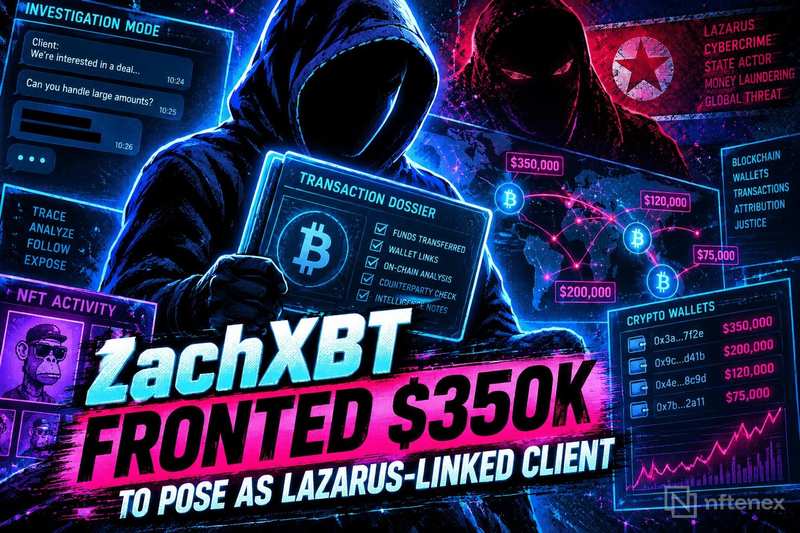
On-chain investigator ZachXBT reportedly put $350,000 of his own money on the line to pose as a genuine customer of a cryptocurrency money laundering network described as linked to North Korea's Lazarus hacking apparatus, according to a report published by NFT Plazas.
ZachXBT is a pseudonymous on-chain researcher known for publicly tracing stolen funds from exchange hacks, bridge exploits, and NFT thefts — work that has made him one of the most visible independent figures in crypto investigations.
Posing as a Client to Reach the Network's Core
The reported operation required ZachXBT to commit the $350,000 upfront to establish credibility as a real client seeking laundering services. Acting as a customer, rather than a passive observer, was what gave him direct visibility into the network's methods and the people involved.
The financial exposure was genuine. Had the operation collapsed, or had the funds simply been taken, that capital would have been lost. That degree of risk is what sets the reported approach apart from ZachXBT's earlier work in on-chain investigation, which included documenting cases such as Circle freezing wallets tied to hacks while missing real exploits — work carried out without any comparable direct financial commitment.
Notably, details about which assets were used, which wallets were involved, and how the funds were recovered or retained have not been independently verified against primary on-chain data. Every specific claim in this story traces back to a single published report, and on-chain verification of transaction hashes and fund recovery has not yet been completed. Those open questions are exactly the kind that primary on-chain data can settle once supporting transaction evidence is published, which makes independent corroboration the natural next detail to watch.
What “Lazarus-Linked” Does — and Does Not — Establish
The launderers targeted in the operation are described as “Lazarus-linked,” a qualifier that signals a reported connection to North Korea's state-sponsored hacking apparatus while falling short of a formal attribution finding. The FBI has formally attributed the $1.5 billion Bybit theft to North Korean cyber actors, establishing that Lazarus Group actively relies on laundering networks to move stolen crypto at scale.
That laundering layer is a recognized enforcement target in its own right: US authorities have repeatedly sanctioned crypto mixing and conversion services for their role in processing North Korea-linked stolen funds, treating the infrastructure that obscures fund flows as actionable independently of the original thieves.
Under that framing, a “Lazarus-linked” designation means the network reportedly shares infrastructure, methods, or personnel associated with Lazarus operations — not that the group itself was the direct counterparty in ZachXBT's operation. That distinction matters for understanding how independent blockchain investigators fit into the broader enforcement ecosystem alongside agencies that track state-level actors.
The sheer volume of funds moving through such networks in the aftermath of the Bybit theft may have made a new client presenting $350,000 unremarkable inside the pipeline, which could explain why the posed identity held. Large-scale crypto market disruptions tend to draw public attention to price effects, while the laundering layer underneath remains largely opaque. Independent researchers like ZachXBT have moved to fill that gap, operating in a space where formal enforcement moves more slowly.
Whether the intelligence gathered through this operation reaches regulators or stands as public documentation will shape its significance for NFT market participants and creators whose stolen assets pass through networks of this kind. Those outcomes may also inform how regulators weigh crypto oversight priorities going forward.
Disclaimer: This article is for informational purposes only and does not constitute financial or investment advice. Cryptocurrency and digital asset markets carry significant risk. Always do your own research before making decisions.

