XRP Ledger Becomes First Public, Permissionless Layer 1 to Pass GL1 Compliance Verification
Key Takeaways
- •The XRP Ledger became the first public, decentralized, and permissionless layer-1 network to complete a self-attestation under the Global Layer 1 Market Infrastructure toolkit.
- •The GL1 toolkit was created by the Monetary Authority of Singapore and is backed by major financial institutions including HSBC, Kinexys by J.P. Morgan, and Standard Chartered, building on CPMI-IOSCO principles for financial market infrastructures.
- •The XRPL Foundation was assessed against the toolkit's ten principles covering governance, settlement finality, legal considerations, data privacy, and resilience, with equivalent controls cited where principles do not directly apply to public blockchains.
- •Blockchain security firm CertiK issued an independent verification report on November 13 validating the Foundation's self-attestation.
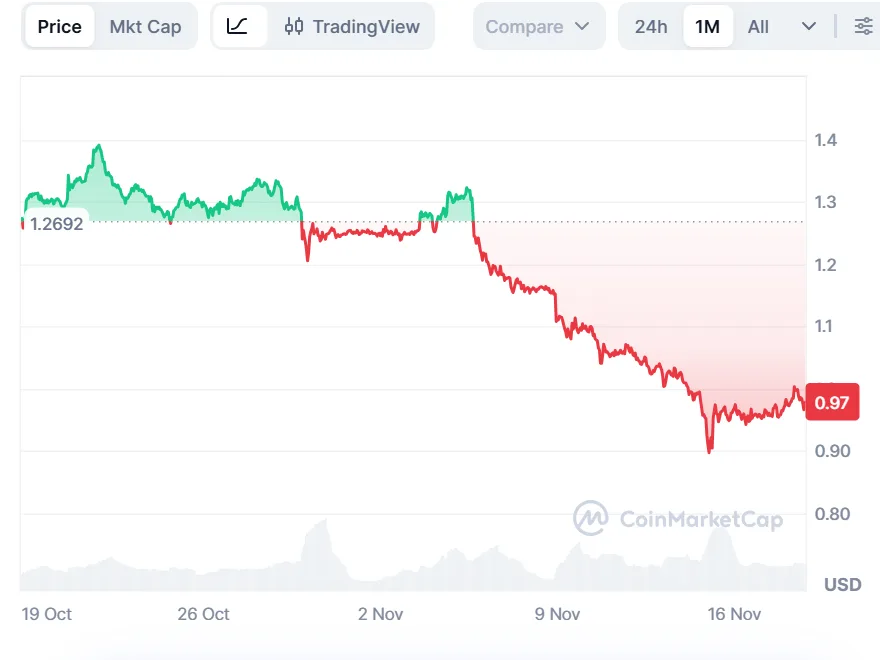
- •The planned XRPL Lending Protocol still requires 29 of 35 validator approvals, with the SingleAssetVault amendment at 25 and the LendingProtocol amendment at 24, while XRP gained over 2% to briefly exceed $1 before settling at $0.977 amid a broadly bearish market.
XRPL Completes GL1 Self-Attestation
The XRP Ledger (XRPL) has completed a self-attestation under the Global Layer 1 (GL1) Market Infrastructure (MI) toolkit, and the XRPL Foundation announced today that it is the first public, decentralized, and permissionless layer-1 network to reach this milestone. The Foundation has made the self-attestation available on its official GL1 page.
The GL1 MI toolkit is a framework for assessing digital finance infrastructure. Built on the CPMI-IOSCO Principles for Financial Market Infrastructure and other global frameworks, it evaluates networks to determine their suitability for tokenized assets. It was created by the Monetary Authority of Singapore (MAS) and is backed by major financial institutions including HSBC, Kinexys by J.P. Morgan, and Standard Chartered. The CPMI-IOSCO principles underpinning the toolkit are internationally recognized standards for financial market infrastructures, including payment, clearing, and settlement systems, and are widely used as a reference point when regulators and financial institutions assess market infrastructure.
The XRPL Foundation assessed the network against the toolkit's ten principles, which cover governance, settlement finality, legal considerations, data privacy, and resilience. Because some of these principles do not directly apply to public, decentralized blockchains, the Foundation explained how XRPL addresses the underlying risks through equivalent controls.
To validate the self-attestation, the Foundation shared its attestation report with blockchain security firm CertiK, which issued an independent verification report on November 13.
A Formal Due Diligence Reference for Institutions
According to the XRPL Foundation, the attestation underscores XRPL's suitability for institutional users looking to deploy tokenized financial products on a public blockchain, giving them a formal due diligence reference for building on the network. It noted that institutions require a way to evaluate a network using established standards consistent with the operating frameworks of traditional financial infrastructure, and that the GL1 toolkit is expected to show how XRPL meets those standards. Tokenization refers to recording financial assets as digital tokens on a ledger so they can move and settle using blockchain infrastructure.
XRPL Foundation executive director Brett Molin said evidence of how a public blockchain meets traditional compliance standards is more convincing for institutional users than any whitepaper.
"(Institutions) need evidence, organised against the standards their risk and compliance teams already recognise," he said. "The GL1 MI Toolkit gives us a shared language to provide that evidence."
Institutional Roadmap and the Lending Protocol Vote
XRPL's validation for institutional use cases aligns with Ripple's broader positioning of the network for that audience, including the planned XRPL Lending protocol.
The lending protocol proposal requires approval from 29 of the network's 35 validators for its amendments to pass. According to the XRPL amendment dashboard, 25 validators have so far approved the SingleAssetVault amendment, while 24 have approved the LendingProtocol amendment. That leaves the SingleAssetVault amendment four approvals short of the threshold and the LendingProtocol amendment five short. Both proposals must pass for the protocol to become active.
XRP Edges Higher as the Broader Market Slides
The announcement appeared to have a positive effect on XRP's price, with the token gaining more than 2% today. It briefly climbed above $1 before settling at $0.977.
Even after that pullback, XRP was among the few major-cap assets to post gains while the rest of the market fell further. Bitcoin moved close to falling below $63,000, and ETH slipped to $1,765. Other major altcoins, including BNB, HYPE, XMR, and ZEC, also lost value during the day, reflecting broadly bearish conditions. The Crypto Fear & Greed Index currently stands at 12/100, a level signaling extreme fear.
XRP's gain under these conditions stands out and reflects comparatively better sentiment. Market watchers had speculated about a possible XRP selloff after $270 million worth of XRP moved to two wallets. However, on-chain data suggests the transfer was a planned custody arrangement, with the receiving addresses having received test transfers weeks in advance.
This article provides cryptocurrency, infrastructure, and regulatory information, not investment advice. The GL1 self-attestation does not constitute regulatory approval. Cryptocurrency prices remain volatile, and technical or adoption forecasts cannot guarantee future performance.
Source: The Market Periodical

