XRPL DEX Volume Climbs 26% in Q3 2026 Amid Institutional Shift: US Session Roundup, Nov. 24, 2026
Key Takeaways
- •XRPL decentralized exchange order-book volume averaged 4.51 million XRP daily in Q3 2026, rising 26% quarter-over-quarter, while the top 10 accounts accounted for 65% of volume, a pattern consistent with institutional rather than retail trading.
- •Ripple scheduled a reset of the XRPL Testnet and Devnet for November 25, 2026, after a full-history server crashed and could not be recovered, with the mainnet unaffected and storage upgrades planned to reduce future resets.
- •BNB Chain added $128.9 million in tokenized stock market capitalization in the week ending November 22, 2026, more than five times Arbitrum One's gain, and hosts roughly 1.8 million unique wallet addresses holding tokenized equities.
- •Cardano's registered stake pools climbed to 2,823, a 14.9% year-over-year increase described as the fastest validator growth among the top-10 proof-of-stake networks, though only about 1,230 pools were actively minting blocks.
- •A Protos investigation found that Bravemorning Limited, controlled by Justin Sun's father, sold TRON Inc. shares to three buyers each at exactly 4.9% for $1.60 per share, a structure kept below the 5% SEC disclosure threshold that has raised governance concerns.
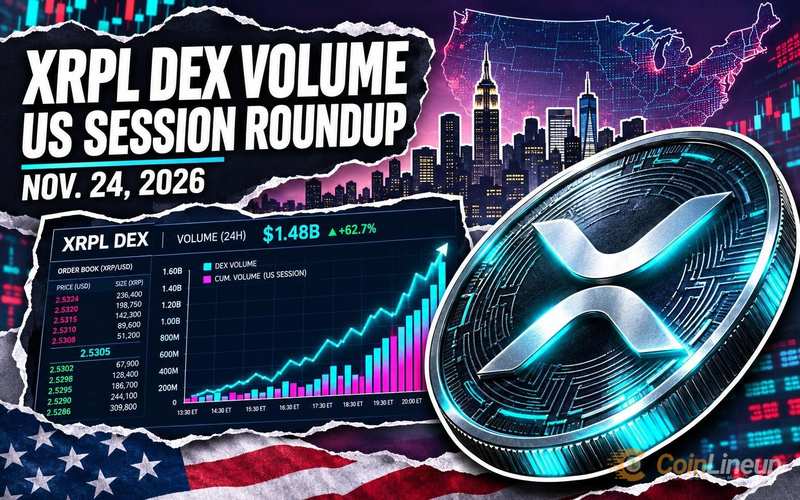
The Major Altcoin Ecosystems US Session Roundup for November 24, 2026 covers the reporting window from 12:00 UTC to 23:59 UTC, in which five stories were published. The lead item: the XRP Ledger's decentralized exchange averaged 4.51 million XRP in daily order-book volume during Q3 2026, according to a report from Evernorth — a figure that reveals a sharp shift toward institutional trading on the ledger.
Key Takeaways
- XRPL DEX daily order-book volume averaged 4.51 million XRP in Q3 2026, up 26% quarter-over-quarter, with the top 10 accounts controlling 65% of volume.
- BNB Chain added $128.9 million in tokenized stock market capitalization in a single week ending November 22 — more than five times Arbitrum One's gain.
- Cardano's registered stake pool count reached 2,823, a 14.9% year-over-year increase described as the fastest validator growth among the top-10 proof-of-stake networks.
- Justin Sun's father sold TRON Inc. shares via Bravemorning Limited to three buyers, each acquiring 4.9% at $1.60 per share, in a structure kept below standard SEC disclosure thresholds, according to Protos.
- Ripple scheduled an XRPL Testnet and Devnet reset for November 25, 2026 after a full-history server crashed, while XRP traded at approximately $0.92.
XRPL DEX Activity Deepens as Testnet Reset Nears
The XRP Ledger's built-in decentralized exchange — a trading platform coded directly into the blockchain — averaged 4.51 million XRP in daily order-book volume during Q3 2026, up 26% from Q2 and 2.8 times the level recorded a year earlier. The figures come from a report published by Evernorth, an XRP-focused company listed on Nasdaq under the ticker XRPN since October 2026. Evernorth completed a SPAC merger — a path to a public listing through a combination with a blank-check shell company — and holds approximately 473 million XRP, according to The Block's reporting on the same study. For related coverage, see XRP Long Unwind: Asia Session Roundup, Nov. 21, 2026.
The growth numbers tell only part of the story. The top 10 accounts on the XRPL order book controlled 65% of volume in Q3 2026, while the average swap size nearly doubled to roughly 35 XRP and the daily count of swaps fell 37%, according to the Evernorth report as cited by The Block. That pattern — fewer but larger trades executed by a small group of accounts — is characteristic of professional or institutional trading rather than retail activity. Context on this theme: Dogecoin $0.054 Support: US Session Roundup, Nov. 22.
At the same time, automated market maker (AMM) pools, which allow anyone to supply liquidity rather than placing individual orders, saw their share of XRPL exchange volume fall from 38% to 13%, per the same Evernorth report. The order book — favored by traders who want precise pricing control — gained strongly relative to the AMM model.
Tokenized assets on XRPL, excluding stablecoins, averaged roughly $5 billion in Q3 2026, up 34% from Q2, and included a fund from Aviva Investors, the asset-management arm of UK insurer Aviva. The RLUSD stablecoin — Ripple's dollar-backed token — averaged $937 million on XRPL, up 74% quarter-over-quarter, and US spot XRP exchange-traded funds recorded $308 million in net quarterly inflows during Q3 2026, the report added. More on this theme in UAE PASS to Avalanche Chain: Asia Session Roundup.
Separately, Ripple scheduled a reset of the XRPL Testnet and Devnet for November 25, 2026, between 5 and 6 PM Pacific time (01:00 to 02:00 UTC on November 26), after a single full-history server — a node that retains the ledger's complete transaction record — crashed and could not be recovered. Testnet and Devnet are sandbox environments where developers trial applications with test-only funds before deploying to mainnet. The reset will delete all test accounts, transactions, balances, settings, offers, AMMs, and escrows on both environments. The Crypto Basic reported that XRPL Mainnet, where real transactions take place, is entirely unaffected. Ripple acknowledged that the reset stemmed from a single-server dependency and said it is upgrading storage capacity to reduce the frequency of future resets.
XRP was trading at approximately $0.9233, down 1.61% over the prior 24 hours, as of the session close, according to CoinGecko data as of November 25, 2026. The Q3 DEX data and the testnet reset are separate events, but together they illustrate a ledger where institutional on-chain activity is growing while developer infrastructure still runs into the reliability challenges that affect any maturing blockchain network. Earlier sessions this week covered XRP's 2022 historical pattern and the XRP long unwind that played out in the Asia session on November 21.
BNB Chain and Cardano Post Ecosystem Growth Metrics
BNB Chain, the blockchain network associated with the Binance crypto exchange, added $128.9 million in tokenized stock market capitalization in the week ending November 22, 2026, according to Crypto Briefing, citing Token Terminal data. Arbitrum One, the second-largest network for tokenized stocks that week, added $23.3 million, and Base added $3.2 million. Tokenized stocks are blockchain-based representations of shares in companies such as Apple or Tesla that can be traded around the clock without a traditional brokerage.
BNB Chain crossed $1 billion in tokenized stocks and ETFs in early October 2026 — the first blockchain to reach that milestone, per the same Crypto Briefing report. The chain holds between 30% and 42.6% of the entire tokenized equity sector. As of September 2026, approximately 1.8 million unique wallet addresses held tokenized equities on BNB Chain, representing about 45% of all such addresses across all blockchains. The primary driver is Binance bStocks, launched June 11, 2026, with Ondo Global Markets also active on the chain.
On Cardano, registered stake pools — the network's equivalent of validators, which confirm transactions and earn rewards — reached 2,823 as of November 22, 2026, a 14.9% increase over the prior year, according to Crypto Briefing. That growth rate was described as the fastest among the top-10 proof-of-stake networks. However, only about 1,230 of those 2,823 registered pools were actively minting blocks in recent epochs; the gap between registered and active pools is a standard measure of network participation health. Cardano's staking participation rate stands at roughly 58%, and five distinct node software implementations are currently producing blocks on mainnet — a multi-client setup that reduces reliance on any single piece of software.
Protocol version 12 for Cardano is in testing but has not yet reached mainnet, and the 3,000 registered validator milestone is being watched by the community, per the Crypto Briefing report. The Cardano governance vote covered in the November 23 Asia session adds further context to the network's expanding on-chain participation.
TRON Inc. Share Sales Raise Governance Questions
Bravemorning Limited, a company controlled by Weike Sun, the father of TRON founder Justin Sun, sold shares in TRON Inc. (Nasdaq: TRON) to three buyers, according to an investigation published by Protos. The three buyers — Core Tide Limited, Digital Century Technology, and Digital Zentech Limited — each acquired 4.9% of TRON Inc. shares at $1.60 per share. Protos reported that the allocations were structured so that each buyer stayed below the standard 5% threshold that triggers a public disclosure filing under US Securities and Exchange Commission rules — a mechanism designed to make sizable ownership stakes visible to other market participants.
TRON Inc. stock closed at $1.39 as of November 20, 2026, meaning the $1.60 sale price was above the recent market close. The stock is down approximately 87% from its peak of $11.04, reached on June 20, 2025, per Protos. It is worth noting that TRON Inc. is a publicly traded company on Nasdaq; it is distinct from the TRON blockchain itself, which operates independently as a public network.
Protos reported that the name of a director at Digital Century Technology, Jinmei Li, matches a name appearing as Justin Sun's mother in prior filings. The connection is based on a name match only and is unconfirmed, according to Protos. TRON Inc. did not respond to inquiries from Protos at the time of publication. Protos also noted that Jinmei Li is reportedly associated with Techteryx, the company behind the TrueUSD stablecoin — a connection Justin Sun has denied. These alleged family relationships should be treated as unconfirmed.
The structured nature of the transactions — three separate buyers each acquiring exactly 4.9% — raises governance questions about transparency in TRON Inc.'s shareholder base, as Protos framed it. TRON blockchain activity and on-chain metrics are separate from these equity-level corporate transactions.
Session Outlook: What These Stories Add Up To
Outlook as of 23:59 UTC on November 24, 2026, based on reports published between 12:00 UTC and 23:59 UTC the same day.
Overall read: Mixed. Three of the session's five stories show expanding on-chain infrastructure and real-world asset adoption across XRP Ledger, BNB Chain, and Cardano, while two — the TRON Inc. governance concern and the XRPL developer environment reset combined with XRP's price below $1 — pull against that positive structural picture.
- XRPL DEX volume and institutional concentration (Nov 24, 14:00 UTC): Positive for major altcoin ecosystems. Daily order-book volume averaged 4.51 million XRP in Q3 2026, up 26% quarter-over-quarter, backed by $5 billion in tokenized assets and $308 million in ETF inflows.
- BNB Chain tokenized stocks growth (Nov 24, 14:59 UTC): Positive. BNB Chain added $128.9 million in tokenized stock market cap in a single week and leads the sector with 1.8 million unique holders.
- Cardano validator growth (Nov 24, 15:26 UTC): Positive. Registered stake pools reached 2,823, the fastest year-over-year validator growth among the top-10 proof-of-stake networks.
- TRON Inc. share sales (Nov 24, 13:07 UTC): Negative. Three buyers each acquired 4.9% of TRON Inc. shares in a structure that stayed below SEC disclosure thresholds, raising unresolved governance questions.
- XRP price and XRPL testnet reset (Nov 24, 16:48 UTC): Negative. XRP traded at $0.9233, below the $1 level, as Ripple scheduled a testnet reset following a server failure, adding developer disruption alongside a soft price environment.
That leaves two negative items against three positive ones in this session.
Connecting the dots: the session suggests a widening gap between on-chain ecosystem fundamentals and near-term market conditions. XRPL, BNB Chain, and Cardano all reported growth metrics tied to real usage — institutional DEX trading, tokenized equity adoption, and validator participation respectively. At the same time, XRP's spot price remained under pressure below $1, and TRON's corporate layer showed signs of internal repositioning that the market may interpret cautiously. The pattern points to a market where structural adoption is advancing even as price action lags.
What could happen next: if the XRPL Testnet and Devnet reset scheduled for November 25 proceeds smoothly and developers return to testing without extended disruption, the incident may fade quickly in coming sessions. If TRON Inc. responds formally to Protos's governance questions, or regulatory bodies take notice of the structured share allocations, that story could develop further over the next few weeks. If BNB Chain's tokenized stock weekly growth rate holds above $100 million per week, the chain may cross further milestone thresholds in the near term, reinforcing its dominant position in the sector. This outlook is editorial analysis based on the reports above and is not financial advice.
What to Watch Next
XRPL Testnet and Devnet reset: scheduled for November 25, 2026, between 5 and 6 PM Pacific time (01:00 to 02:00 UTC on November 26), per AltcoinBuzz. Developers with active test environments should back up any configurations before that window.
This roundup summarizes reporting published from 12:00 UTC to 23:59 UTC on November 24, 2026. Source: CoinLineup, XRPL DEX Volume: US Session Roundup, Nov. 24, 2026.
Disclaimer: This article is for informational purposes only and does not constitute financial or investment advice. Cryptocurrency and digital asset markets carry significant risk. Always do your own research before making decisions.

