XRP Whales Accumulate $2.2 Billion in 96 Hours as Analysts Watch These Key Levels
Key Takeaways
- •XRP whales purchased about 1.54 billion tokens, worth roughly $2.2 billion, within 96 hours, lifting large-holder balances to 9.81 billion XRP, approximately one-tenth of the total supply, according to Santiment data.
- •XRP was trading at $1.38 at publication, down 4.20% over 24 hours but up 2.70% on the week, with daily trading volume near $2.46 billion.
- •Analyst Ali Charts identified an inverse head-and-shoulders pattern with neckline resistance at $1.55, where a confirmed breakout could project a measured move toward $2.
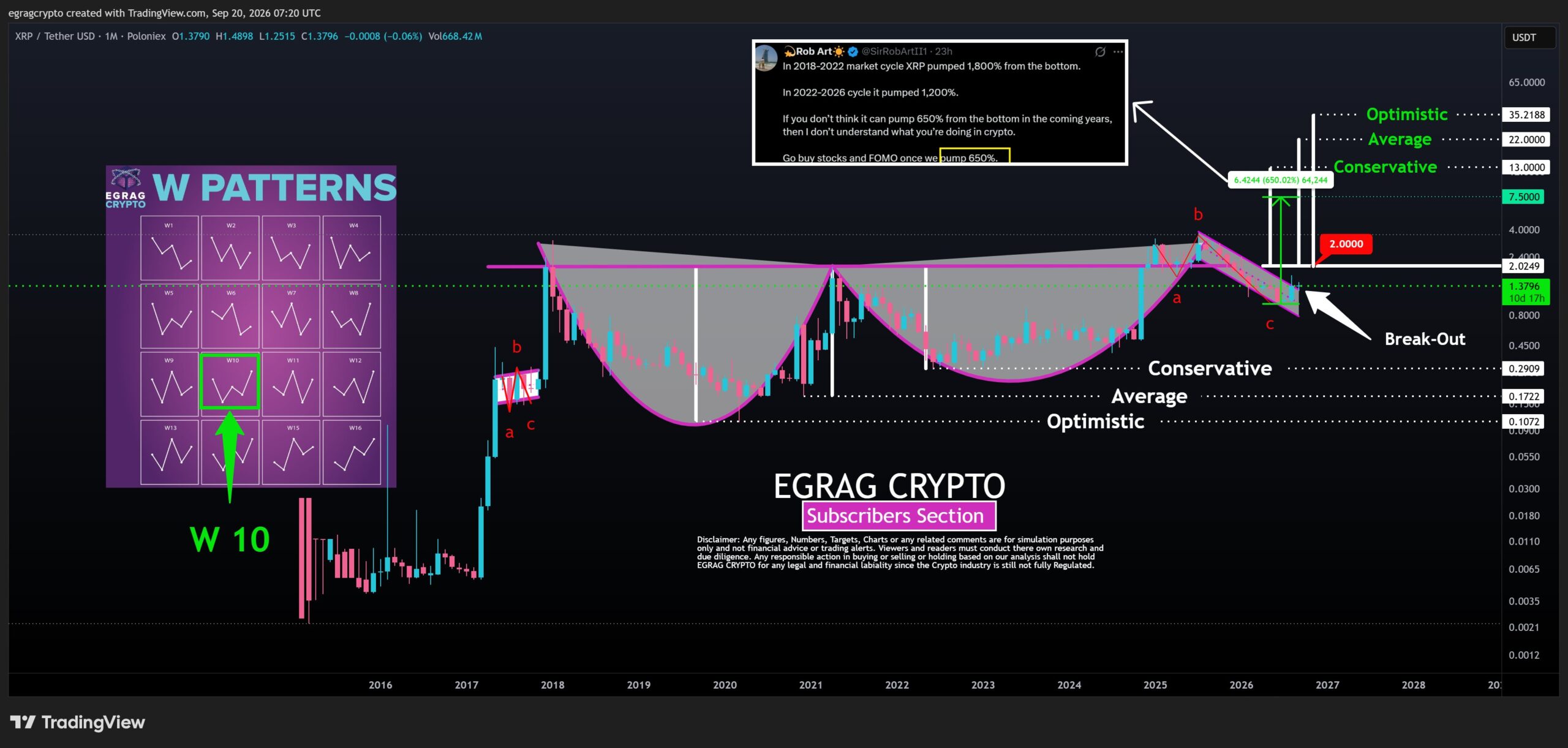
- •Longer-term analysts have mapped conditional targets including EGRAG CRYPTO's Macro W projections of $13, $22, and $35, and Sir Robert's more aggressive estimate near $7.50.
- •Per ChartNerd, holding the 0.236 Fibonacci support at $1.34 is critical, since a breakdown could drive XRP toward the 20-week EMA at $1.28, while reclaiming the $1.45 resistance would invalidate the near-term bearish case.
XRP whales have purchased approximately 1.54 billion tokens over the past 96 hours, an accumulation worth roughly $2.2 billion at current prices. The scale of the buying has drawn close attention from market analysts, who are now weighing whether the large-holder demand can fuel a breakout past the resistance levels that have capped the token's recent price action.
At publication, XRP trades at $1.38, according to CoinGecko data. The token is down 4.20% over the past 24 but up 2.70% over the past week, and daily trading volume sits near $2.46 billion.
Whale Accumulation Builds During Recovery Phase
Market analyst Ali Charts flagged the surge in whale activity, citing data from Santiment, an on-chain analytics platform, showing large-holder balances climbing to 9.81 billion XRP — roughly one-tenth of XRP's 100 billion token total supply. The buying came as the XRP price recovered from lower levels, with the token trading between roughly $1.33 and $1.40 over the period.
Accumulation of this scale can indicate that larger investors are positioning ahead of a potential price move. Whales — holders whose wallets are large enough to move liquidity in a token's market on their own — tend to build positions near technical support zones rather than chase strength.
$2 BILLION IN XRP BOUGHT BY WHALES
Whale activity on the XRP network has surged over the past 96 hours.
Large holders appear to have accumulated roughly 1.54 billion $XRP, worth around $2.2 billion.
That's a significant accumulation spike that could soon translate into price… pic.twitter.com/Ty3ukakDvi
Beyond the on-chain data, Ali Charts points to an inverse head-and-shoulders pattern — a chart formation technical traders commonly read as a potential reversal setup after a downtrend — forming on the daily chart. The pattern shows a right shoulder near $1.33 and neckline resistance at $1.55. A confirmed break above that neckline would open a measured move toward $2, a projection technique that estimates a target from the height of the pattern itself. The whale buying at current levels suggests some traders expect that breakout to hold.
Analysts Share Long-Term Targets
Separately, analyst EGRAG CRYPTO has tracked a long-term Macro W pattern on XRP for months. The pattern points to conservative, average, and optimistic targets of $13, $22, and $35. A monthly close above the pattern's handle would need to confirm first. From there, EGRAG CRYPTO says, a breakout above $2 followed by a retest and hold could trigger expansion. Long-term targets like these function as conditional roadmaps: each level only comes into play if the confirming closes actually materialize.
A separate analyst, Sir Robert, has floated a more aggressive target near $7.50, which would mark a move of roughly 650% from current prices. EGRAG CRYPTO notes that different analysts favor different targets, but that chart structure still outweighs any single opinion.
The Levels That Will Decide XRP's Next Move
Short-term technicals paint a tighter picture than the long-term charts. Analyst ChartNerd notes that XRP has repeatedly failed to reclaim the 0.5 Fibonacci retracement near $1.45 since early September, with multiple daily attempts falling short. Fibonacci retracements — ratio-based levels derived from a mathematical sequence — are among the most widely watched support and resistance markers in technical analysis.
The 0.236 Fibonacci support at $1.34 is now the level to watch. A break below it could send XRP back toward the 20-week EMA around $1.28, a level that has acted as a floor during prior pullbacks this year. Exponential moving averages weight recent prices more heavily than simple ones and are often treated as dynamic support in trending markets. Conversely, reclaiming the 0.5 Fib at $1.45 would invalidate the near-term bearish thesis and open a path toward the 50-week EMA, according to ChartNerd. Traders watching XRP are likely to treat these two levels as the clearest signal of direction.
$XRP has been battling the 0.5 FIB and failing to reclaim it since early September ($1.45). After multiple failed daily attempts at breaking through, the 0.236 support ($1.34) now rests below. It has to hold or we revisit the 20 week EMA again ($1.28). pic.twitter.com/6G8rupYvfL
Whale Buying Must Clear Resistance to Matter
For everyday holders, the mechanism behind the accumulation may matter more than any single price target. Whale buying adds buy-side pressure, but that pressure only translates into a sustained move if resistance actually breaks on strong volume. Santiment's large-holder balance series gives market watchers a running gauge of that trend: whether the 9.81 billion XRP held by whales keeps climbing or starts to slip.
The setup leaves XRP compressed between competing signals. Whale accumulation and long-term chart structure point toward higher targets over time, while near-term price action still depends on holding the $1.34 support and reclaiming the $1.45 resistance. Until resistance gives way on real volume, the $2.2 billion in whale buying stands as a bullish signal awaiting confirmation.

