XRP Spot Volume Jumps 53% as New Deposits Bypass Binance, CryptoQuant Data Shows
Key Takeaways
- •XRP's seven-day average spot volume climbed 53.2% to $786 million on November 9 from $513 million on October 28, even as the token's price drifted toward $1.10.
- •On November 9, Coinbase (+2,485), Bybit (+1,370), and Crypto.com (+889) each recorded their widest gap between depositing and withdrawing XRP addresses since August 20, while Binance registered only +2.
- •Cumulative whale net outflows from Binance, which spiked to $1.045 billion after the October 29 breach of roughly $6.3 billion in assets, fell 34.1% to $689 million by November 4, indicating large holders moved balances back onto the exchange.
- •The 30-day average of XRP open interest on Binance dropped to $453.6 million on November 8, the lowest since September, though the dollar-denominated figure was partly driven down by XRP's own roughly 11% price decline from $1.25 to $1.11.
- •Neither report includes spot trade direction or XRP-denominated deposit volumes, leaving unresolved whether coins arriving on Coinbase, Bybit, and Crypto.com are being sold or absorbed by buyers.
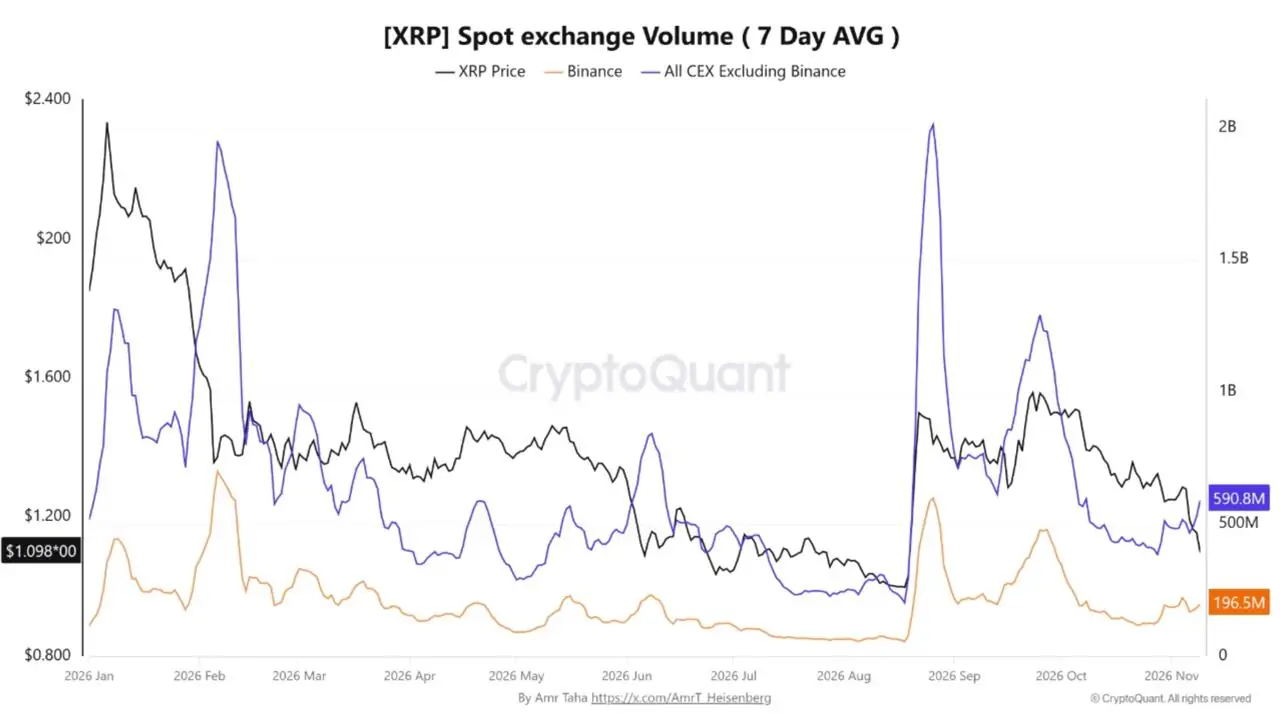
XRP spot trading activity expanded sharply over the past two weeks even as the token's price continued to slide, according to CryptoQuant data. Analyst Amr Taha puts the seven-day average of XRP spot volume at $786 million on November 9, up 53.2% from $513 million on October 28 — a stretch during which the token drifted toward $1.10.
Volume Jumped While the Price Kept Falling
A 53% rise in turnover during a decline indicates a busier market, not a winning side. Volume measures what changes hands, and it says nothing about how much of it buyers intend to keep: the same coins can trade several times in a day and inflate the figure without adding a single long-term holder. Every fill also requires both a buyer and a seller, so the number alone cannot reveal which side was more eager to complete its trade.
Coindoo examined the price breakdown separately in its report on XRP's failed breakout. The question here is what exchange-level data shows about the trading around that decline — and the first answer is that the volume increase was evenly distributed. Binance's spot volume grew 51.9%, while all other tracked exchanges combined grew 53.6%, leaving Binance's share at roughly a quarter on both dates.
Deposits Went to Three Exchanges — and Almost None to Binance
The split surfaces in wallet data rather than volume data. On November 9, three exchanges each logged their widest gap between depositing and withdrawing XRP addresses since August 20, for a combined net reading of +4,744. Binance, the largest venue by turnover, registered just +2. The benchmark date matters: August 20 falls more than two months before the October 29 breach, so gaps of this size were last seen before the hack.
| Exchange | Net addresses |
|---|---|
| Coinbase | +2,485 |
| Bybit | +1,370 |
| Crypto.com | +889 |
| Binance | +2 |
Net depositing minus withdrawing XRP addresses, November 9, 2026. Source: Amr Taha, CryptoQuant.
CryptoQuant's address-count metric tallies addresses involved in exchange transfers. Deposit flows are watched for a mechanical reason: coins generally have to sit on an exchange before they can be sold there, so a rise in depositing addresses is conventionally read as a possible precursor to selling — a reading the count alone cannot confirm. It does not weight them by the amount moved — a hundred small deposits outscore one large one — and it does not indicate whether the coins were sold, parked, or posted as collateral on arrival. What the count does establish is location: the new wallet activity sits on Coinbase, Bybit, and Crypto.com, and not on Binance, even though Binance's trading share never moved.
Timing points to a cause. Binance's hot wallets were compromised on October 29, in an incident that the exchange's own statement put at roughly $6.3 billion in token assets, alongside a pledge to cover losses from company funds. Coindoo's coverage of the incident describes it as the biggest-ever hack, with North Korea blamed. Taha's report adds a Binance-specific measure for the days that followed: cumulative whale net outflows, which had spiked to $1.045 billion after the breach, fell $356 million, or 34.1%, to $689 million by November 4. A falling cumulative-outflow figure means large-holder deposits outpaced withdrawals over that stretch — so the whales who pulled XRP off Binance in the first days after the hack had, on this measure, largely moved it back within a week.
That leaves a two-tier picture on the deposit side: whale balances returning to Binance after the cover pledge, while the broad surge in depositing addresses went elsewhere.
Binance's Futures Crowd Is Thinning, but Dollars Overstate It
A second CryptoQuant post, by CryptoOnchain, puts the 30-day average of XRP open interest on Binance at $453.6 million on November 8 — the lowest reading for that average since September — with XRP at $1.11 in the same snapshot. Open interest tallies futures positions left standing rather than trades executed: it falls only when positions are closed and rises only when new ones are opened. The accompanying chart shows the average topping out slightly above $510 million in mid-October and sliding since, a decline of roughly 11% from the peak.
The figure is a smoothed average rather than the latest print, and it is expressed in dollars: CryptoQuant's XRP market-data documentation confirms that open interest is normalized into dollar terms. That distinction matters here, because XRP fell from about $1.25 on November 2 to $1.11 on November 8 — an 11% drop in six days. A futures position of unchanged size loses 11% of its dollar value over that window with nothing closing at all. Allowing for the lag in a 30-day average, the fall in the series sits within the range the price move alone could produce, so the dollar figure cannot establish how many contracts were actually closed.
CryptoOnchain offers two candidate explanations and labels both unverified: forced closing of long positions after the price drop, or a loss of confidence in Binance derivatives following the hack. Open interest cannot separate the two, because every long is matched by a short and the total shows only that exposure left — not which side left, or why.
Even so, the direction aligns with the wallet data. The venue where depositing addresses barely rose is the same venue where leveraged exposure has been draining since mid-October.
What the Two Reports Cannot Show
Neither post includes the one series that would settle whether buyers are absorbing supply: spot trade direction. Buyer-initiated trades lift available offers; seller-initiated trades hit available bids. Heavy seller-initiated flow with a stable price points to patient buyers soaking up supply; heavy buyer-initiated flow with no price progress points to supply being sold into every bid.
Two further gaps remain. XRP-denominated deposit volume would turn 4,744 addresses into a quantity, and open-interest data from other venues would show whether the Binance contraction is a Binance-specific story or a market-wide one. Until then, the depositor and futures readings describe the shape of the activity, not its result.
Reading the Split
Set the readings side by side, and the volume headline looks like the least informative of them. Turnover rose evenly everywhere. New depositing addresses clustered on three exchanges and skipped Binance. Whale balances, after an initial exit, came back to Binance. Binance's futures exposure thinned to a two-month low, at least partly because XRP itself got cheaper. The busier market is one in which retail-scale deposit activity has routed around the hacked exchange while large holders have not — and the price has yet to respond to either.
Whether the coins arriving on Coinbase, Bybit, and Crypto.com are being bought or merely passed along is the open question, and the data needed to answer it is absent from both reports. The reading that would change the picture is a simple one to watch for: XRP holding its level through continued deposits and elevated turnover. New lows under the same conditions would point the other way.
Data windows: spot-volume comparison, October 28 to November 9, 2026; address counts, November 9; whale net-outflow reading, November 4; futures moving average, November 8. Price figures are snapshots from the cited reports, not live quotes.
Source: Coindoo

