XRP Slides 69% From Peak While Existing Wallet Activity Climbs
Key Takeaways
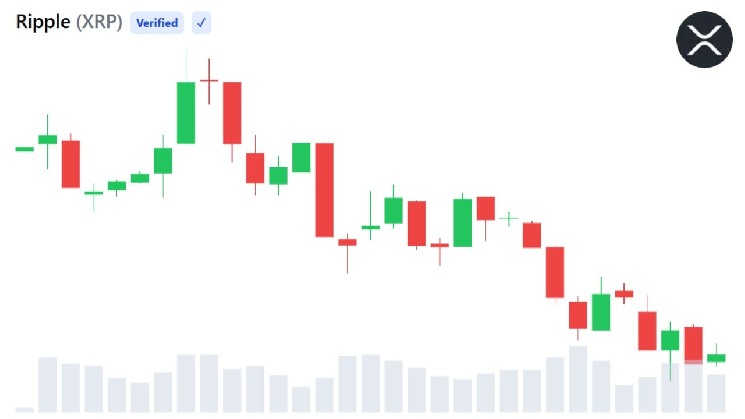
- •XRP traded near $1 on Aug. 13, roughly 69% below its January 2025 peak and at its lowest daily close since November 2024.
- •Santiment reported that average daily active addresses on the XRP Ledger rose to about 35,700 in early August from roughly 26,400 in July.
- •New-address creation remained almost unchanged, averaging about 2,260 per day in August versus 2,270 in July.
- •XRP reached about $3.65 in July 2025 and briefly lifted its market capitalization above $200 billion.
- •An Aug. 12 analysis found wallets holding at least 1 million XRP increased by 32 over three months, even as market capitalization fell 29%.
XRP Slides 69% From Peak While Existing Wallet Activity Climbs
Price Weakness Collides With Higher Ledger Activity
$XRP traded near $1 on Aug. 13, its lowest level since November 2024 and roughly 69% below its January 2025 peak near $3.30, even as ledger activity increased during the steep retreat. Santiment's analysis showed active addresses rising sharply in August while new-address creation remained virtually unchanged from July. The XRP Ledger — the blockchain on which $XRP serves as a bridge asset for cross-border payments and settlement — publishes transaction data publicly, allowing analysts to track network engagement independently of token price.
Amid favorable regulatory momentum, $XRP had climbed even higher in July 2025, reaching a new peak of approximately $3.65. That summer rally briefly pushed its market capitalization above $200 billion, making it one of the top-performing assets of that period.
"Price closed at ~$1.00 on Aug 12, the lowest daily close since Nov 2024 and roughly 69% below the January 2025 peak near $3.30," Santiment wrote, highlighting the extent of the asset's prolonged decline.
The firm added: "Activity picked up anyway. Active addresses averaged ~35,700 a day in August against ~26,400 through July, up roughly a third, with Aug 11 the busiest day since Jun 5."
That data point describes market performance rather than network health, and the simultaneous increase in address activity offers no direct evidence that heavier ledger use will reverse the price trend. The split indicates that activity rose on the $XRP Ledger without a comparable increase in newly created addresses — a pattern that supports a narrower conclusion than broad adoption claims: ledger engagement strengthened during August, while new-address formation showed virtually no expansion. For a payment-focused network where existing users transacting more frequently can signal product-level stickiness, the distinction between returning and first-time participants is central to assessing adoption.
Address Data Shows Use Without Account Growth
Daily active addresses averaged about 35,700 from Aug. 1 through Aug. 12, compared with approximately 26,400 throughout July — an increase of nearly 35%. Santiment defines daily active addresses as unique addresses participating in transactions during a day, making the measure an indicator of network use rather than a direct count of individual users.
New addresses averaged approximately 2,260 per day in August, nearly matching July's 2,270, even as Aug. 11 produced the busiest active-address reading since June 5. The gap underscores a limitation of public blockchain data: address activity does not translate directly into unique users.
Large-holder data presents another dimension of activity during the downturn, although it measures balances rather than new participation or transaction frequency. An Aug. 12 analysis found that $XRP wallets holding at least 1 million tokens increased by 32 over three months, even as the token's market capitalization declined 29% during the same period.
Institutional Access Grows While Adoption Evidence Stays Mixed
Corporate use cases also remain distinct from Santiment's August address figures and cannot explain the short-term increase without transaction-level attribution. Anodos Finance co-founder and CEO Panos Mekras described $XRP as a treasury and payment asset, stating that his company has bought, held, and used $XRP for employee payments since 2023.
Ripple CEO Brad Garlinghouse has separately outlined an institutional opportunity across businesses that handle approximately $16 trillion in annual payments and clearing activity — a figure encompassing correspondent banking, remittances, and business-to-business settlement flows that today rely largely on legacy infrastructure such as SWIFT messaging and pre-funded nostro accounts. Garlinghouse noted that digital assets represented close to zero percent of those flows, framing the figure as potential market reach rather than completed $XRP transaction volume.
Regulated derivatives have broadened professional access to $XRP even as the token's spot price has remained under pressure. CME Group's continuous crypto trading schedule launched with Ripple Prime as a clearing and financing partner, while $XRP futures previously crossed $1 billion in open interest within three months of listing.
The institutional, treasury, and large-wallet developments point to several channels of $XRP engagement, yet none converts August's active-address increase into a verified count of new users. Santiment's new-address average establishes the clearest boundary: roughly 2,260 addresses appeared daily through Aug. 12, about 10 fewer than July's corresponding average. As of writing, $XRP is trading at $1.008.

