XRP Nears $1 as Shark Wallet Count Climbs to 343,500 Despite Selloff
Key Takeaways
- •Santiment counted roughly 343,500 XRP wallets holding at least 10,000 tokens on November 11, an increase of 16,815 addresses, or 5.15%, over nine months.
- •XRP lost approximately 30% of its value over a seven-week stretch, and Santiment views the split between rising wallet counts and falling prices as possible accumulation by larger holders.
- •Santiment identifies $1 as the main support level to defend, with a potential recovery toward $1.10–$1.15 conditional on continued wallet growth, price holding support, and Bitcoin stabilizing.
- •Coinglass reported an XRP funding rate of 0.0095% per eight hours, about 10.4% annualized, alongside a 6.73% 24-hour drop in open interest to $328.5 million as of the November 10 reading.
- •Wallet tallies track addresses rather than individual owners and cannot separate fresh purchases from internal transfers, so rising counts alone do not confirm net buying or capital inflows.
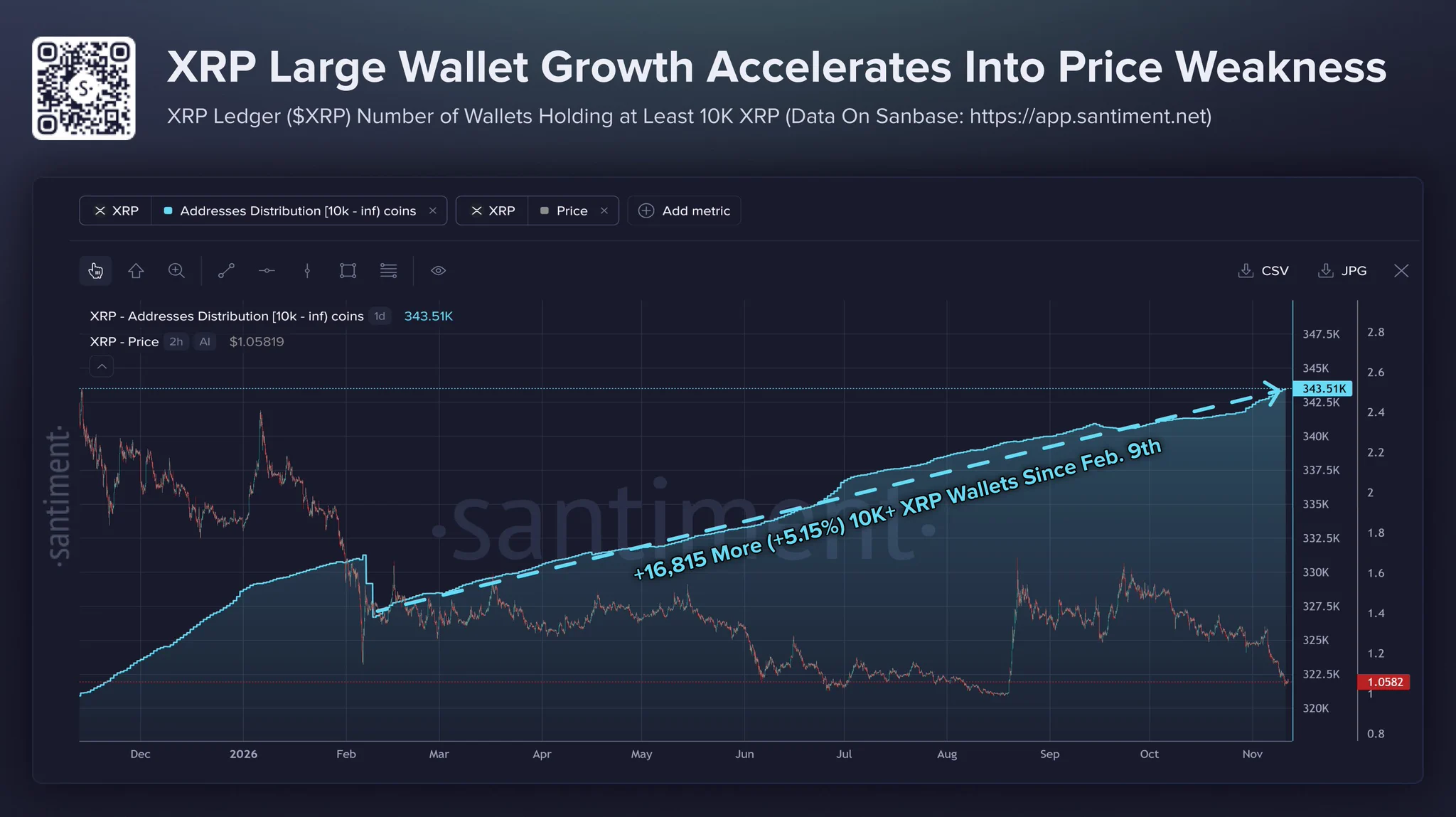
XRP traded near $1.05 on November 11 as the number of wallets holding at least 10,000 tokens continued to climb, according to on-chain analytics firm Santiment. The firm counted roughly 343,500 qualifying addresses despite a prolonged decline in the token's price, a cohort often referred to as “shark” wallets. Balance-based tiers like this one are a standard fixture of on-chain analytics, grouping addresses by size so that the behavior of differently sized holder groups can be compared across market cycles.
The overall tally increased by 16,815 wallets over nine months, representing growth of 5.15%. Over a separate seven-week period, XRP lost approximately 30% of its value. Santiment views the divergence between rising addresses and falling prices as possible accumulation by larger holders.
Futures figures, meanwhile, showed positive funding alongside declining open interest. The contrasting signals leave the $1 support level in focus, and any sustained recovery would depend on stronger buying demand and steadier conditions across the broader cryptocurrency market.
Wallet Growth During a Downturn
Santiment interprets the increase as evidence that some larger holders continue building exposure during market weakness. Its accumulation argument rests on wallet numbers rising while the XRP price moves lower.
Measurement windows matter, however. Nine months of wallet growth cannot identify purchases made during the specific weeks of the recent decline, which means a falling price can coexist with an expanding address group. The totals also cannot establish transfer dates or distinguish fresh purchases from internal movements between wallets.
The count tracks addresses above a balance threshold, so it reflects addresses rather than individual owners. It does not establish how many separate investors bought tokens or how much money entered the market. One holder can control several addresses, while exchanges can hold customer balances in shared accounts. As an illustration, moving 20,000 XRP from a single wallet into two wallets of 10,000 tokens each raises the qualifying count by one while leaving the combined balance unchanged — a demonstration of why wallet growth alone cannot measure net purchases.
At $1.05, the minimum qualifying balance represents approximately $10,500, so the category spans a broad range of holders rather than being limited to institutions.
Key Levels Identified by Santiment
Santiment identifies $1 as the main level to defend — a round-number price that traders routinely treat as a reference point. The firm outlines a conditional recovery toward $1.10–$1.15 if wallet growth continues, XRP holds support, and Bitcoin stabilizes. Measured from $1.05, those targets imply gains of roughly 4.8% and 9.5%, respectively. Whether the price reaches either level depends on subsequent trading.
According to Santiment, losing $1 while wallet growth reverses would weaken the accumulation case. The firm also anticipates a possible bounce after an initial selloff, although its post gives no precise timing. Subsequent wallet tallies from Santiment and derivatives readings from Coinglass can show whether the on-chain and futures trends converge or continue to pull apart.
Funding Stays Positive as Open Interest Falls
According to derivatives data platform Coinglass, the XRP funding rate stood at 0.0095% per eight hours as of the November 10 reading, equivalent to about 10.4% annualized. Open interest, the combined notional value of outstanding futures positions, declined 6.73% over 24 hours to $328.5 million, while the mark price was $1.06. The account breakdown showed 74.4% long positions against 25.6% short positions.
Those percentages measure the number of accounts on each side rather than the value of the positions, so they cannot establish that 74.4% of invested capital supports rising prices. Positive funding requires long traders to pay short traders, and annualizing the rate assumes it persists — actual payments change as funding rates adjust. Funding exists because perpetual contracts carry no expiry date; exchanges use the recurring payments to keep futures prices tethered to the spot market.
XRP therefore faces a market in which bullish positioning coexists with reduced reported futures exposure, a combination suggesting remaining long traders face carrying costs while price momentum stays weak. Dollar-denominated open interest can also fall when the underlying asset loses value, even without an equivalent reduction in contract numbers. In other words, part of the reported dollar decline may reflect price depreciation rather than position closures, and distinguishing between the two requires additional contract- or token-denominated figures.
The same report covered Bitcoin, Ether, Solana, Dogecoin, and XRP. Bitcoin alone recorded higher open interest, rising 0.42% to $7.36 billion, with its funding rate at 0.0073% per eight hours, or roughly 8% annualized.
A positive XRP funding rate does not establish that new demand can sustain the price. The November 10 derivatives readings also precede Santiment's November 11 wallet update, limiting direct comparisons between the two observations.
This article is based on reporting originally published by Blockonomi on November 11.

