XRP Rich List Exposes Stark Wealth Gap Between Whales and Retail Holders
Key Takeaways
- •More than 4 million XRP accounts hold between zero and 20 XRP, while another 2.55 million hold between 20 and 500 XRP.
- •Only 322,083 accounts, or about 4% of all on-chain XRP accounts, hold at least 10,000 XRP.
- •The top 50 wallets control roughly 43% to 45% of the circulating XRP supply.
- •Santiment said the XRP Ledger’s 1M+ wallet cohort added 32 wallets over three months even as market cap fell 29%.
- •Ripple’s RLUSD stablecoin has grown into a meaningful presence on the XRP Ledger alongside XRP.
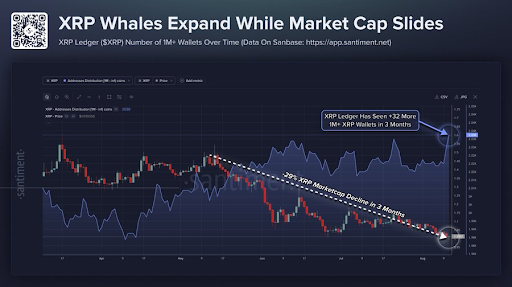
Recent blockchain data reveals a significant concentration of wealth within the XRP Ledger ecosystem, with top wallet addresses controlling a disproportionate share of the total circulating supply while the vast majority of retail accounts hold negligible amounts.
Whale and Retail Tiers on the XRP Rich List
Data from the XRP native rich list provides a clear picture of how unevenly $XRP is distributed across the network. More than 4 million accounts contain between zero and 20 XRP, while an additional 2.55 million accounts fall in the 20 to 500 XRP range. Together, these smaller wallets constitute the overwhelming majority of addresses on the ledger.
By contrast, only 322,083 accounts — roughly 4% of the more than 8 million total XRP accounts on-chain — hold at least 10,000 XRP. The top 0.1% is even more exclusive: just 8,053 accounts hold at least 275,026 XRP each. As of early 2026, the XRP Ledger reached 7.85 million activated addresses, a substantial increase from the 4.5 million range recorded in 2023.
The top 50 wallets hold between 43% and 45% of the circulating supply, indicating notably high ownership concentration. Institutions rather than individuals own a significant portion of these top wallets. The largest single XRP entity remains Ripple Labs, which oversees tens of billions of tokens in locked escrow accounts and corporate treasuries.
On-chain analytics firm Santiment reported on August 11, 2026, that the XRP Ledger's 1M+ wallet cohort added 32 wallets over three months, representing large-holder growth during a 29% market cap decline. Despite underwhelming price performance for $XRP throughout the summer, $RLUSD — Ripple's USD-pegged stablecoin — has grown into a meaningful presence on the ledger, expanding the range of assets transacted on-chain beyond XRP itself.
Centralized exchanges control the majority of the top visible wallets, but those funds consist primarily of aggregate deposits from retail users rather than the platforms' own holdings.
The top 1% threshold currently stands at approximately 46,323 XRP, while reaching the top 0.5% requires about 83,082 XRP — far more than most retail holders possess.
How Institutional Holdings Affect Rich List Metrics
Centralized cryptocurrency exchanges significantly distort on-chain wealth distribution rankings. Major platforms such as Binance, UPbit, and Bithumb aggregate user funds within large wallets, causing combined customer deposits to appear as individual whale holdings in single-address metrics. This pattern is common across major blockchain networks, where exchange-controlled addresses routinely dominate top-holder lists for assets including Bitcoin and Ethereum as well.
Ripple Labs also maintains a substantial proportion of the total circulating token supply. The company places tens of billions of tokens in escrow accounts subject to programmatic time-based release schedules. Consequently, accurately assessing the XRP rich list requires distinguishing corporate escrow holdings from organic market participants.
Company founders, including Chris Larsen, hold significant on-chain token allocations in personal wallets. Insider wallets represent considerable portions of the ledger's total assets, meaning corporate insiders permanently influence top-tier account threshold calculations.
Ripple implemented an escrow system using smart contracts in 2017 to ensure predictable supply releases. The ledger releases one billion tokens per month, with any unused amount returned to escrow. This mechanism provides market transparency and materially shapes XRP rich list statistics.
Market Implications for Traders and Liquidity Dynamics
High supply concentration creates distinctive liquidity conditions during volatile cryptocurrency trading cycles. Large holders operating in public order books can reduce overall liquidity, contributing to sudden price movements in derivatives markets.
When large institutional token holders trade against retail investors, asymmetric market dynamics emerge. Debate continues over whether high token concentration undermines network decentralization objectives. This concern extends across the cryptocurrency sector, where concentration metrics on Bitcoin and Ethereum are also closely tracked by analysts evaluating decentralization claims. Nonetheless, thousands of retail traders continue acquiring tokens despite whale dominance.
Whale address tracking tools enable close monitoring of large-wallet movements on-chain. The transparency of the public ledger allows analysts to review the XRP rich list in real time. Traders monitor large transfers for potential signals of market moves and exchange outflows.
As financial products become more regulated, institutional custody providers are gradually accumulating circulating tokens. This trend could further concentrate token holdings within a few major custody wallets, influencing future wallet tier statistics as institutional market involvement grows.
The XRP Ledger does not use traditional Proof of Work but instead operates on a Federated Consensus mechanism. Independent validators confirm transactions on the ledger without holding financial stake. As a result, wealth concentration does not affect the consensus security of the network — a structural distinction from Proof-of-Stake networks where token holdings directly influence validation power.
The substantial capital gaps revealed by the XRP rich list reflect the structural characteristics of contemporary crypto asset distribution. As institutional adoption expands globally, the XRP rich list continues to attract attention from traders and analysts seeking to understand market dynamics.
