Sellers Drag Ripple's XRP Back Below $100 Billion Market Cap After Brief Milestone
Key Takeaways
- •XRP's market capitalization briefly exceeded $100 billion on September 22 before profit-taking pushed the token back below the threshold, leaving it around $92 billion and still the fifth-largest cryptocurrency.
- •The token gained nearly 14% over seven days from a low near $1.29, a decline triggered when the US Senate failed to advance the CLARITY Act, though XRP remains roughly 57% below its $3.65 all-time high.
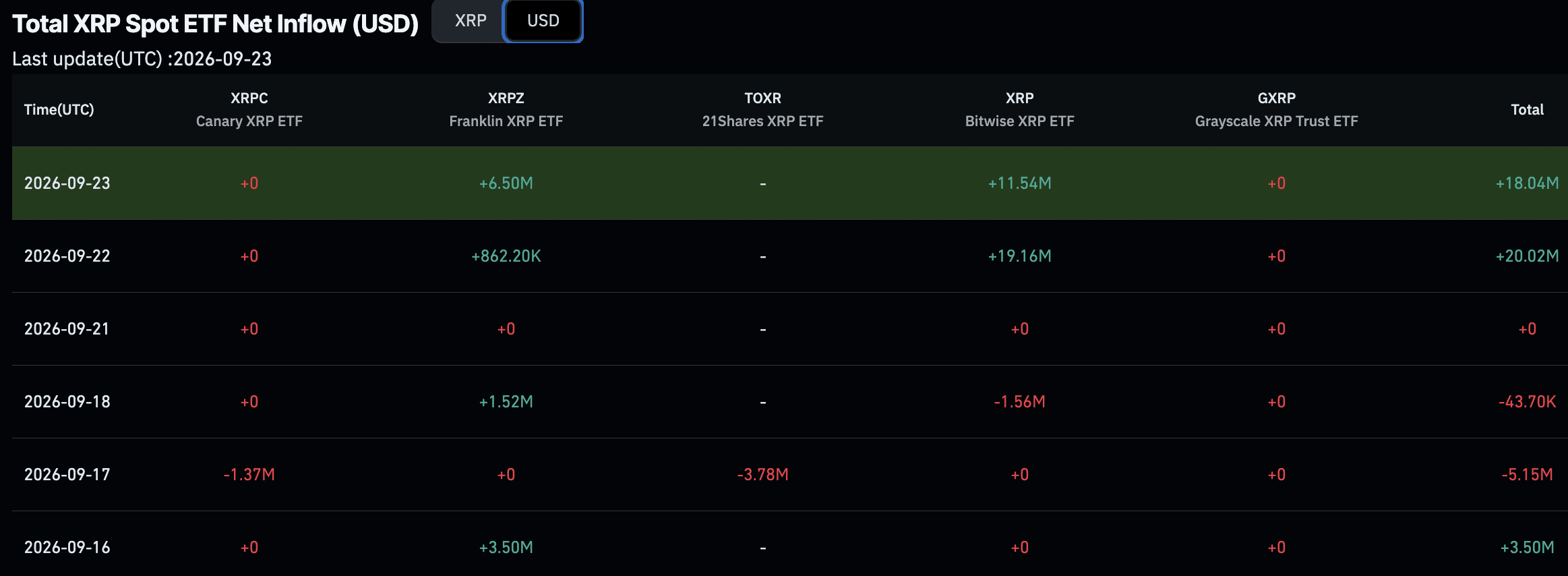
- •US spot XRP ETFs attracted over $20 million in a single day, driven mainly by Bitwise's $19.17 million addition, which brought its fund to about $615 million in net assets and made it the largest XRP ETF.
- •Spot XRP ETFs have recorded 10 straight weeks of positive flows totaling between $1.71 billion and $1.72 billion, including roughly $9.56 million in net inflows over the past week.
- •Tuesday's on-chain activity included 1,917 transactions above $100,000, the highest in a month, along with the creation of 3,647 new wallets.
XRP briefly pushed its market capitalization back above $100 billion on Tuesday, September 22, before profit-taking dragged the token below that threshold later in the session.
Market capitalization — a token's circulating supply multiplied by its price — is the standard yardstick for a crypto asset's overall size, which is why the $100 billion line is treated as one of the sector's most-watched size thresholds.
The milestone drew attention because it landed alongside a reported wave of ETF buying and a sharp rebound from a slide toward $1.29 just a week earlier. The tension worth unpacking: strong institutional demand met a market that was not yet ready to hold new highs.
During the session, XRP traded between $1.54 and roughly $1.66. At the time of writing, the token sits at $1.49, down 7.8% over the past 24 hours, according to CoinGecko data. Its market capitalization has settled back to about $92 billion, keeping it the fifth-largest cryptocurrency by that measure.
For readers newer to the space, XRP is the native token of the XRP Ledger, a blockchain network associated with Ripple, the company best known for building cross-border payment infrastructure used by banks and remittance providers.
XRP's Wild Week: From $1.29 to a Brief Tap of $100 Billion
The rebound follows a rough stretch. XRP slid to around $1.29 a week earlier after the US Senate failed to advance the CLARITY Act, a crypto market-structure bill that would set out how digital assets are classified and overseen in the US, and its defeat rattled sentiment across the sector.
From that low, the token has now gained nearly 14% over seven days, slightly outpacing the broader crypto market's roughly 13% weekly rise, according to figures reported by TheStreet.
The outperformance is notable given how far XRP still has to travel. Even with the rally, the token remains about 57% below its all-time high of $3.65 — a reminder that a brief run past $100 billion in market cap is a milestone, not a reclamation of prior glory.
Ahead of the pullback, CW (@CW8900) flagged the surrounding order-book levels in a September 24 post on X:
$XRP whales are forming a strong support lines around $1.45. On the other hand, a sell wall exists at $1.55. If it break through this, there are another sell walls exist at $1.68–$1.70 range. pic.twitter.com/AGJFyjt6mZ
— CW (@CW8900) September 24, 2026
(via X)
For readers parsing that map: a sell wall is a large cluster of sell orders stacked at a single price that can cap a rally, while a support line marks a concentration of buy orders that can cushion dips.
Bitwise Leads the ETF Charge While On-Chain Activity Spikes
Institutional flows appeared to influence Tuesday's XRP price spike, although they were not the sole cause. US spot XRP ETFs attracted over $20 million, driven mainly by Bitwise, which added $19.17 million in a single day. That brought the firm's fund to around $615 million in net assets, making it the largest XRP ETF, according to CoinGlass data.
Spot ETFs hold the underlying token directly and trade on conventional brokerage platforms, giving traditional investors exposure to XRP without directly handling the asset — one reason daily flow totals are watched as a gauge of institutional participation.
Over the past week, spot XRP ETFs recorded about $9.56 million in net inflows, extending a streak of 10 straight weeks of positive flows totaling between $1.71 billion and $1.72 billion. Coverage of XRP ETF inflows holding up during price weakness suggests institutional interest has been building for weeks, not days — part of why the $100 billion milestone drew attention even though it did not stick.
On-chain activity reflected the price movement. Tuesday saw 1,917 XRP transactions above $100,000, the highest in a month, along with 3,647 new wallets created. The surge signals more large-value transactions, though it does not confirm that large holders were accumulating rather than moving assets.
What Traders Are Watching Next for XRP: $1.60 and $2
With the $100 billion market-cap milestone now in the rearview mirror, attention shifts to two specific price levels. With XRP now trading around $1.47, traders are watching whether it can quickly reclaim $1.50 and hold it before moving back toward $1.60.
If $1.60 is reclaimed and held, that could build momentum toward the psychologically significant $2 level. Neither level is a guarantee, and both should be read as watchpoints rather than forecasts.
The path there likely depends on whether the reported ETF demand from firms like Bitwise persists beyond a single strong session, whether Santiment's large-transaction and new-wallet counts stay elevated, and whether XRP can avoid another sharp pullback like the one that followed the CLARITY Act vote last week.
For now, the fifth-largest cryptocurrency by market capitalization has proven it can touch $100 billion again. Whether it can stay there is a different question entirely — one that this week's profit-taking has already answered in the near term.

