XRP Rebounds to Reclaim $1.27 as $1.32 Resistance Comes Into Focus
Key Takeaways
- •XRP recovered above $1.26 after falling toward $1.20 in the wake of a $6.3 billion security breach at Binance that drove a market-wide sell-off.
- •Daily trading volume climbed nearly 30% to about $1.8 billion, but the absence of significant short liquidations indicates a sustained bullish reversal is not yet confirmed.
- •WTI crude oil fell below $100 per barrel for the first time since October 15, a move that could ease inflation concerns and shape expectations for the Federal Reserve's December interest rate decision.
- •XRP Ledger amendments XLS-65, introducing Single Asset Vaults, and XLS-66, covering the Lending Protocol, hold approximately 60% and 54% validator approval respectively, below the 80% threshold required for activation.
- •The next major test for buyers is the $1.32 resistance level, and a rejection there could pull XRP back toward $1.26, with further support near $1.20.
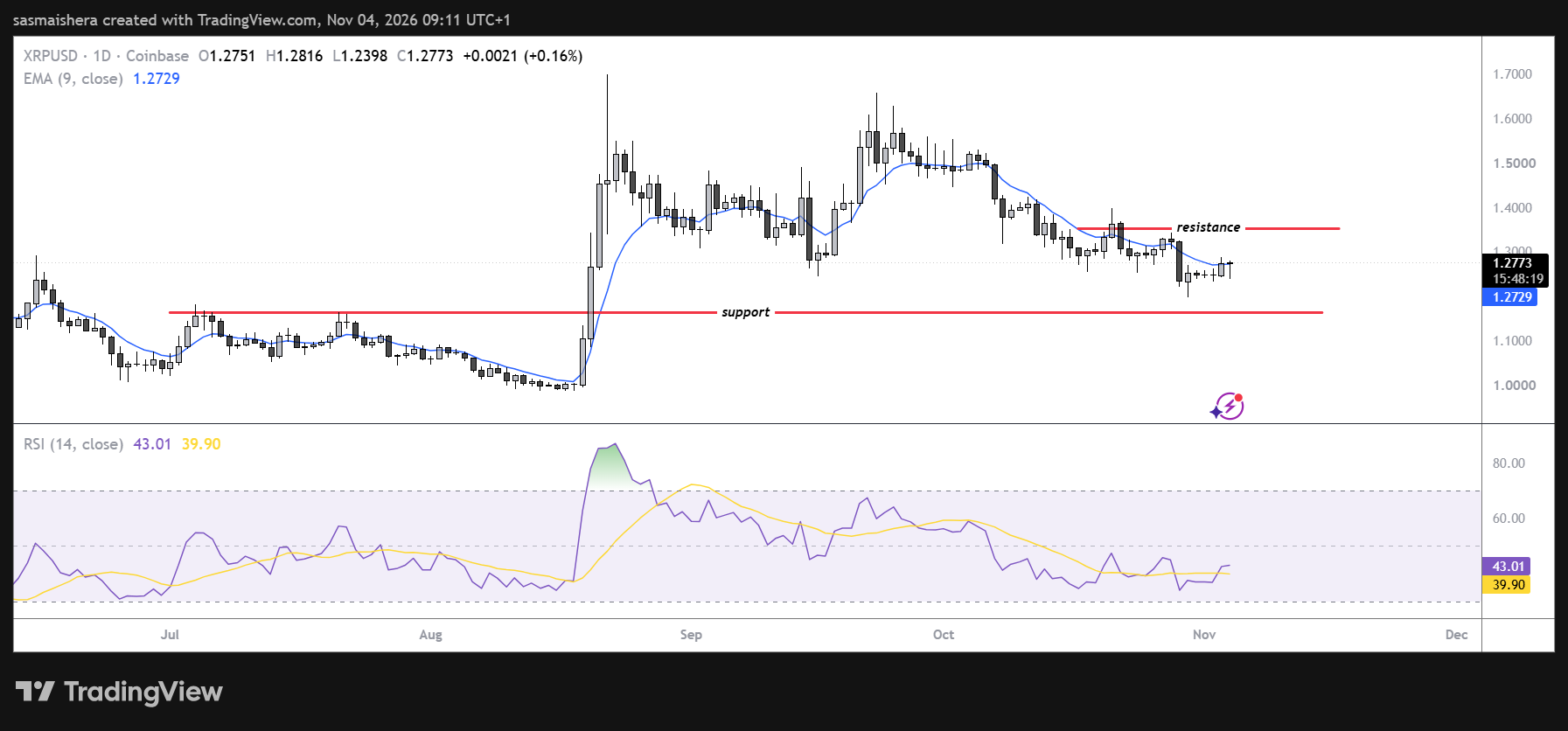
XRP gained 2% over the past 24 hours as buyers returned to the market following last week's cryptocurrency-wide sell-off. The recovery has pushed the token back above the $1.26 level, which briefly gave way after a $6.3 billion security breach at Binance triggered widespread selling pressure.
Trading activity has improved alongside the price recovery, with daily volume rising nearly 30% to approximately $1.8 billion. However, the rebound has yet to trigger a significant wave of short liquidations, indicating that XRP has not cleared the resistance levels needed to confirm a sustained bullish reversal.
Rebound from $1.20 after the Binance breach
XRP's latest recovery follows a difficult stretch for the broader cryptocurrency market. The token dropped toward $1.20 after the Binance hack, reaching a price area last visited on August 20. The incident sparked concerns about cryptocurrency exchange security and prompted substantial withdrawals from Binance as investors reassessed their exposure.
As confidence gradually improved, XRP recovered above $1.26, reclaiming a level that had previously served as support during the recent decline.
The rebound has been accompanied by increased trading activity. Daily volume has climbed to approximately $1.8 billion, accounting for more than 2% of XRP's circulating market capitalization.
Macro conditions also in focus
Broader macroeconomic conditions may also be contributing to XRP's recovery. West Texas Intermediate (WTI) crude oil fell below $100 per barrel for the first time since October 15, despite continuing geopolitical tensions involving the United States and Iran. Lower oil prices can help ease inflation concerns by reducing energy-related costs across the economy.
If the decline persists, it could also influence expectations for the Federal Reserve's December interest rate decision. A more favorable inflation outlook may reduce pressure on policymakers to raise borrowing costs, potentially improving sentiment toward risk-sensitive assets such as cryptocurrencies.
XRPL lending proposals gain validator support
Beyond the broader market recovery, developments within the XRP Ledger could provide additional support for XRP's medium-term outlook. Two proposed amendments designed to introduce native lending capabilities are attracting growing support from network validators.
The first, XLS-65, would introduce Single Asset Vaults, a feature intended to support lending-related functionality on the XRP Ledger. According to XRPScan data, the proposal has reached approximately 60% validator approval. That places it 20 percentage points below the 80% threshold required for amendment activation, and reaching the threshold must also satisfy the network's applicable activation conditions. Under the XRP Ledger's amendment process, proposals that reach the 80% consensus threshold must then maintain that level of support for a continuous two-week period before the feature becomes active network-wide.
The second proposal, XLS-66, covers the Lending Protocol itself. It currently holds approximately 54% validator support, leaving it further from the required approval threshold.
The two proposals are closely related: the proposed lending functionality would depend on infrastructure provided by Single Asset Vaults. If XLS-65 gains sufficient support, validators may be more inclined to approve XLS-66, although neither outcome is guaranteed. Together, the amendments could expand the XRP Ledger's decentralized finance capabilities by introducing new lending-related use cases. Movements in the two approval percentages will be worth monitoring, as they indicate how close the ledger is to activating native lending functionality.
$1.32 resistance emerges as the next test
XRP's four-hour chart shows improving short-term momentum following the rebound from the $1.20 area. The token has reclaimed $1.27, a level that previously acted as support before the Binance-related sell-off pushed prices lower. Recovering this area is an encouraging development, as it suggests buyers are attempting to rebuild the market's short-term bullish structure.
The Relative Strength Index (RSI) on the four-hour chart currently stands near 64. A reading above 50 generally indicates that bullish momentum is strengthening, while a move above 70 can suggest an asset is becoming overbought.
Although trading volume has increased, XRP still needs stronger participation to overcome resistance levels that previously attracted selling. The next major challenge for buyers is the $1.32 resistance level. A decisive breakout above this area would strengthen the short-term bullish outlook and suggest the recent rebound is developing into a more sustained recovery. If buying momentum continues, XRP could extend its advance toward $1.40.
The $1.32 level, however, may attract renewed selling from traders looking to exit positions after the recent decline. A rejection at this resistance could trigger another pullback toward $1.26. If that level fails to hold, the next important support lies near $1.20, where buyers previously stepped in following the Binance-related sell-off.
Below $1.20, traders are watching potential demand zones around $1.14 and $1.08. These areas correspond to fair value gaps (FVGs) identified on the four-hour chart.
Source: CoinJournal

