XRP Price Prediction: Can XRP Reach $3 in 2026 as Google Gemini AI Forecasts?
Key Takeaways
- •Spot XRP ETFs have continued to attract capital, although inflows have eased from the initial launch pace.
- •Progress on the proposed CLARITY Act is viewed as a major potential catalyst for XRP, but it would not automatically lift prices immediately.
- •Ripple has expanded RLUSD and continued tokenization and cross-border payment efforts to increase activity on the XRP Ledger.
- •XRP is holding near $1.00 support while facing repeated resistance between $1.20 and $1.60.
- •The article says a move toward $3 by the end of 2026 would likely require several bullish catalysts to occur together.
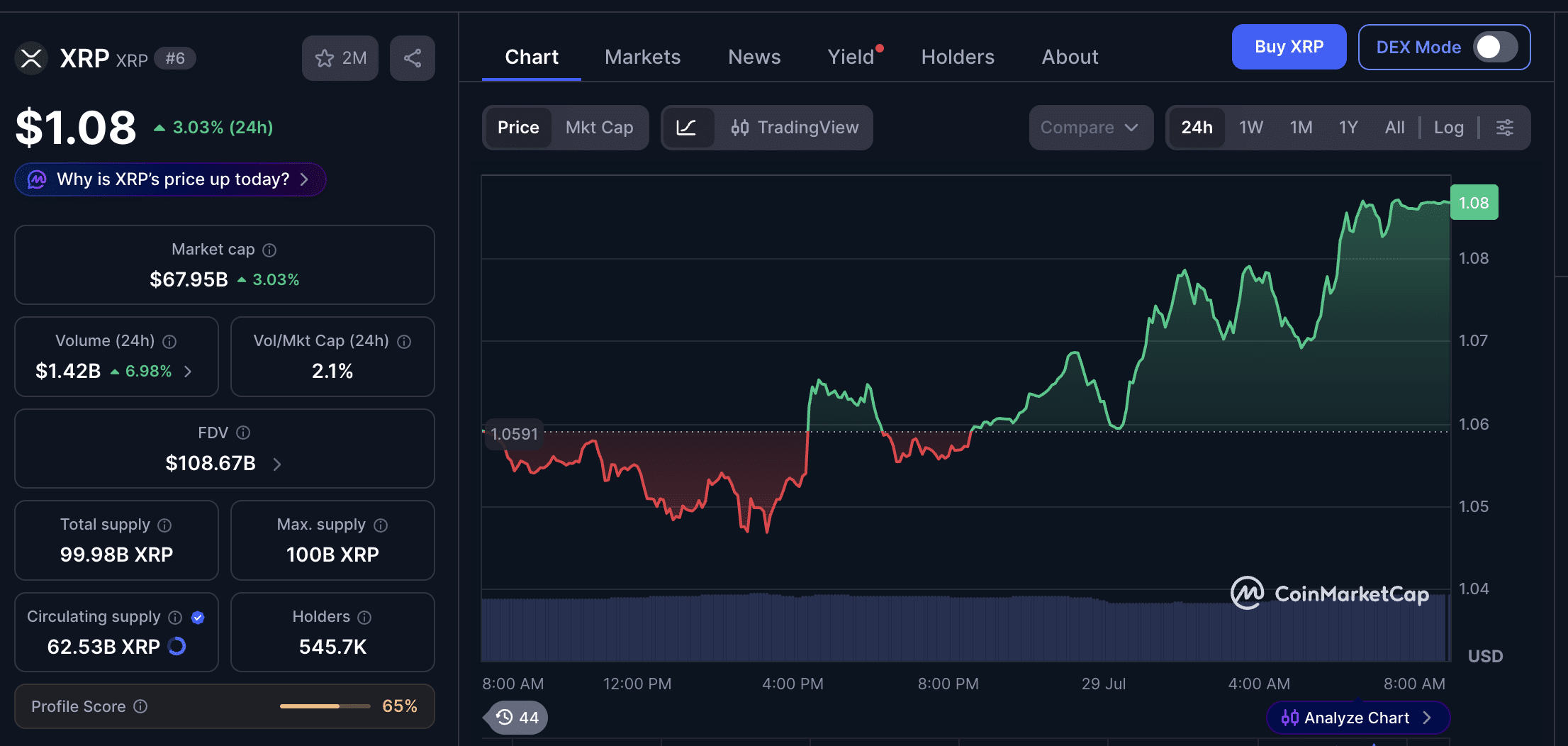
Despite a series of positive developments, including spot ETF approvals, improving regulatory clarity in the United States, Ripple’s continued expansion of its RLUSD stablecoin ecosystem, and broader institutional interest, XRP has struggled to break decisively above the $1.20 resistance zone.
That gap between improving fundamentals and weak price action has prompted bold XRP price predictions, including Google’s Gemini AI, which suggests XRP could rise toward $2.80-$3.75 by the end of 2026 if several catalysts align.
That outcome is possible, but it would depend on far more than a single regulatory event or an ETF launch. The key question is whether on-chain activity, institutional adoption, and market momentum can finally translate into sustained buying pressure.
Why XRP’s Fundamentals Look Stronger Than Its Price
Unlike earlier cycles driven primarily by retail speculation, XRP’s current investment case is more closely tied to institutional infrastructure.
Several developments have strengthened the long-term outlook. Spot XRP ETFs have continued to attract fresh capital, although inflows have moderated from the strong pace seen shortly after launch.
At the same time, regulatory progress around the CLARITY Act remains one of the market’s biggest potential catalysts, as investors look for clearer rules governing digital assets in the United States.
Ripple has also expanded the commercial use of RLUSD, its enterprise-focused stablecoin, while continuing to pursue tokenization and cross-border payment initiatives. These efforts are designed to increase activity across the XRP Ledger rather than rely solely on speculative trading volumes.
Another positive development is Ripple’s expansion under Europe’s Markets in Crypto-Assets, or MiCA, framework. Regulatory approval in Luxembourg gives the company a clearer path to offer regulated services across the European Economic Area, reducing its dependence on the U.S. market alone.
Even so, stronger fundamentals have not yet translated into a breakout in XRP’s market price, which is why traders continue to focus on whether adoption trends can turn into visible network activity.
XRP Technical Analysis Shows Bulls Still Have Work to Do
From a technical perspective, XRP remains locked in a well-defined consolidation range.
Since peaking near $3.66 in mid-2025, the token has formed a pattern of lower highs before stabilizing around the psychologically important $1.00 level. That support has repeatedly attracted buyers, preventing a deeper sell-off even during broader crypto market weakness.
Resistance continues to build between $1.20 and $1.60. Multiple recovery attempts have stalled inside that zone, making it one of the most important technical barriers for the rest of 2026.
The current market structure suggests XRP is in a period of accumulation rather than expansion. A decisive move higher or lower will likely require a meaningful catalyst, not technical momentum alone, especially with longer-term participants still waiting for confirmation that demand is broadening.
Can Regulation and ETF Demand Trigger a Breakout?
Expectations remain high, but investors should remember that progress on the proposed CLARITY Act does not automatically translate into immediate price appreciation. Markets often price in anticipated developments well before they become law.
Institutional demand also deserves attention. Spot XRP ETFs have shown that traditional investors are willing to gain exposure through regulated products, but recent data suggests inflows have cooled compared with the initial launch period.
Slower inflows do not necessarily indicate weakening confidence. They may simply reflect a more mature phase after early demand.
The focus now is whether institutional use of the XRP Ledger increases alongside ETF ownership. If payment providers, financial institutions, and tokenization platforms generate higher transaction volumes on-chain, that would strengthen the fundamental case for higher valuations over time and give the market more than headlines to react to.
Expert Forecasts Vary Widely
Forecasts for XRP remain divided, reflecting uncertainty over regulation, macroeconomic conditions, and adoption.
Rather than focusing on a single price target, investors should examine the assumptions behind each forecast.
The more optimistic projections require multiple catalysts to occur simultaneously, while conservative outlooks assume XRP continues trading within its established range.
Could XRP Reach $3 by the End of 2026?
A move to $3 is no longer as unrealistic as it appeared earlier this year, but it is not the base-case scenario.
From current levels around $1.08-$1.10, XRP would need to rally roughly 170%. While crypto markets have delivered moves of that magnitude before, history suggests they usually require several bullish catalysts to occur at the same time.
The most optimistic outlooks, including Google’s Gemini AI and some independent analysts, assume that institutional demand continues to build, XRP ETF inflows remain positive, Ripple expands RLUSD adoption, and the U.S. establishes clearer digital asset regulations.
However, the technical picture calls for caution.
XRP continues to trade below its longer-term moving averages, indicating that the downtrend has not yet been fully reversed. Buyers have repeatedly defended the $1.00 support level, but every rally since early 2026 has stalled before confirming a new uptrend.
XRP Price Prediction for the Rest of 2026
Among these outcomes, the base case currently appears the most likely.
While institutional adoption continues to improve, price has not yet confirmed that demand is strong enough to overcome months of selling pressure.
Conclusion
Based on the available evidence, XRP price prediction for 2026 remains cautiously optimistic rather than outright bullish. The fundamentals are considerably stronger than they were a year ago, but XRP still needs to reclaim critical resistance levels before the market can justify forecasts near $3.
Investors should watch three factors closely over the coming months: sustained ETF inflows, progress on U.S. crypto legislation, and evidence that growing institutional partnerships are increasing activity on the XRP Ledger.
If those catalysts begin reinforcing one another, the bullish forecasts become more credible. If not, XRP may continue trading within its established range despite an improving long-term outlook.
Glossary
XRP Ledger (XRPL): The blockchain network that supports XRP and enables fast, low-cost payments and tokenization.
RLUSD: Ripple’s U.S. dollar-backed stablecoin designed for enterprise payments and settlement.
Spot ETF: An exchange-traded fund that holds the underlying asset directly, allowing investors to gain exposure through traditional financial markets.
CLARITY Act: Proposed U.S. legislation intended to establish a clearer regulatory framework for digital assets.
Support Level: A price zone where buying demand has historically been strong enough to prevent further declines.
Resistance Level: A price area where selling pressure has historically limited upward price movement.
Institutional Adoption: The use or investment in digital assets by banks, asset managers, payment companies, and other large organizations.