XRP Price Muted After Ripple's OCC Banking Approval as Whales Hold 68.5% of Supply
Key Takeaways
- •The OCC approved Ripple's entry into federally supervised banking infrastructure, formally recognizing the company as a corporate entity operating within national banking frameworks.
- •XRP's price moved only marginally after the announcement, with no breakout or sustained volume spike, continuing a pattern of disconnect between Ripple's regulatory milestones and token performance.
- •The approval applies to Ripple as a company rather than to XRP as a tradeable token, a distinction markets appeared to price in quickly.
- •Whale wallets hold approximately 68.5% of total XRP supply, a concentration that can limit liquidity and suppress price reactions to positive news.
- •Potential follow-through signals include movements in large-holder balances and the SEC's ongoing review of leveraged XRP ETF products.
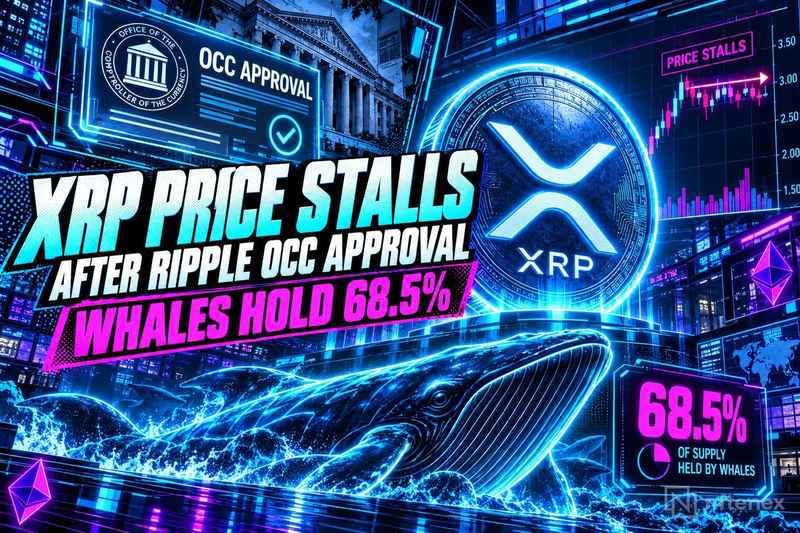
XRP Shows Limited Reaction to OCC Approval
XRP's price barely moved following the Office of the Comptroller of the Currency's (OCC) approval of Ripple's entry into federally supervised banking infrastructure, underscoring a persistent disconnect between the company's regulatory milestones and the token's market performance.
The OCC, the federal regulator that oversees national banks and federal savings associations, published its 2026 approval covering Ripple's regulatory entry into federally supervised banking infrastructure. The decision represents formal recognition of Ripple as a corporate entity operating within national banking frameworks — a goal the company pursued through years of litigation and regulatory engagement, most prominently a multi-year legal dispute with the U.S. Securities and Exchange Commission over the securities-law status of XRP sales. Supervision at the federal level consolidates oversight into a single nationwide framework rather than a patchwork of state-by-state regimes, which is part of why federal banking recognition has been a long-pursued milestone for crypto-adjacent financial firms.
Despite the headline-level significance of federal banking approval, XRP's price action was notably muted in the immediate aftermath, according to Bitcoin.com News reporting on the event. There was no dramatic breakout and no sustained volume spike; the catalytic move that regulatory clarity has sometimes triggered for other assets simply did not materialize.
A key distinction explains part of the market's measured response: the OCC approval addresses Ripple as a company, not XRP as a tradeable token, and markets appeared to price that difference quickly. The pattern is familiar to anyone tracking XRP's price behavior around major catalysts, where corporate regulatory wins and token price moves have repeatedly failed to correlate in a straightforward way — partly because the token's market structure exerts its own gravitational pull.
Whales Control 68.5% of XRP Supply
Supply concentration is the central piece of structural context. Whale wallets — addresses holding unusually large token balances — hold approximately 68.5% of total XRP supply, according to the same reporting. When the majority of a token's float rests in a small number of wallets, retail-driven price discovery becomes harder: positive sentiment from smaller participants can be absorbed or offset by large holders choosing not to move.
Concentrated ownership also shapes liquidity. If whale wallets remain static, the effective circulating supply available for trading is far smaller than headline figures suggest, compressing volatility in both directions. A positive news event may fail to produce a price spike simply because the wallets capable of moving markets are not responding.
This dynamic sits alongside broader macro signals. The Federal Reserve's rate posture heading into the October meeting of the Federal Open Market Committee (FOMC) — the Fed's monetary policy body — and risk appetite across crypto assets remain co-variables in any XRP price analysis.
The 68.5% figure should be read strictly as a market-structure observation, not an inference about intent. It describes where supply sits — not why those holders are inactive or what they plan to do. Large holders include early investors, protocol reserves, institutional custodians, and ecosystem funds, each operating with different mandates and time horizons.
What Traders May Watch Next
The immediate question is whether XRP's price and on-chain transfer activity show sustained follow-through in the days after the OCC announcement. A muted first reaction does not rule out a delayed one, particularly if institutional participants treat the approval as a compliance green light for deeper engagement with XRP Ledger-based products.
Changes in large-holder balances are the most direct signal to monitor. If whale wallets begin moving tokens to exchanges, that behavioral shift would suggest a re-rating of the news; if balances stay flat, the 68.5% concentration figure likely continues to act as a ceiling on near-term volatility. The SEC's ongoing review of leveraged XRP ETF products — exchange-traded funds designed to amplify an underlying asset's daily performance — adds a separate regulatory variable that could amplify or dampen any follow-through from the OCC decision.
For builders and creators working on the XRP Ledger — the blockchain network on which XRP runs as the native asset — the more durable significance may lie in what federally recognized banking infrastructure enables over a longer horizon: clearer custody frameworks, institutional settlement channels, and a more defined legal perimeter around XRP-based financial products. A 24-hour price window is a narrow lens for that kind of structural shift.
Disclaimer: This article is for informational purposes only and does not constitute financial or investment advice. Cryptocurrency and digital asset markets carry significant risk. Always do your own research before making decisions.

