XRP Price Holds Near $1.04 as XRP Ledger Payment Volume Retreats 90% from August 7 Surge
Key Takeaways
- •XRPL payment volume fell nearly 90% from its August 7 peak of roughly 614.9 million XRP, though similar spike-and-reversal patterns have occurred repeatedly over the past month.
- •XRP is trading near $1.04 and faces immediate resistance between $1.075 and $1.087, with the $1 level serving as a critical support and $0.95 marking the next downside reference.
- •Analysts project a price range of $1.10 to $2.50 over coming quarters, but XRP must first clear $1.10, reclaim key moving averages, and end its sequence of lower highs.
- •Ripple raised $500 million at a $40 billion valuation in November 2025, with investment led by affiliates of Fortress Investment Group and Citadel Securities.
- •Ripple has expanded beyond cross-border payments into custody, stablecoins, prime brokerage, and corporate treasury services, while RLUSD and an EVM-compatible sidechain broaden the XRP ecosystem's utility.
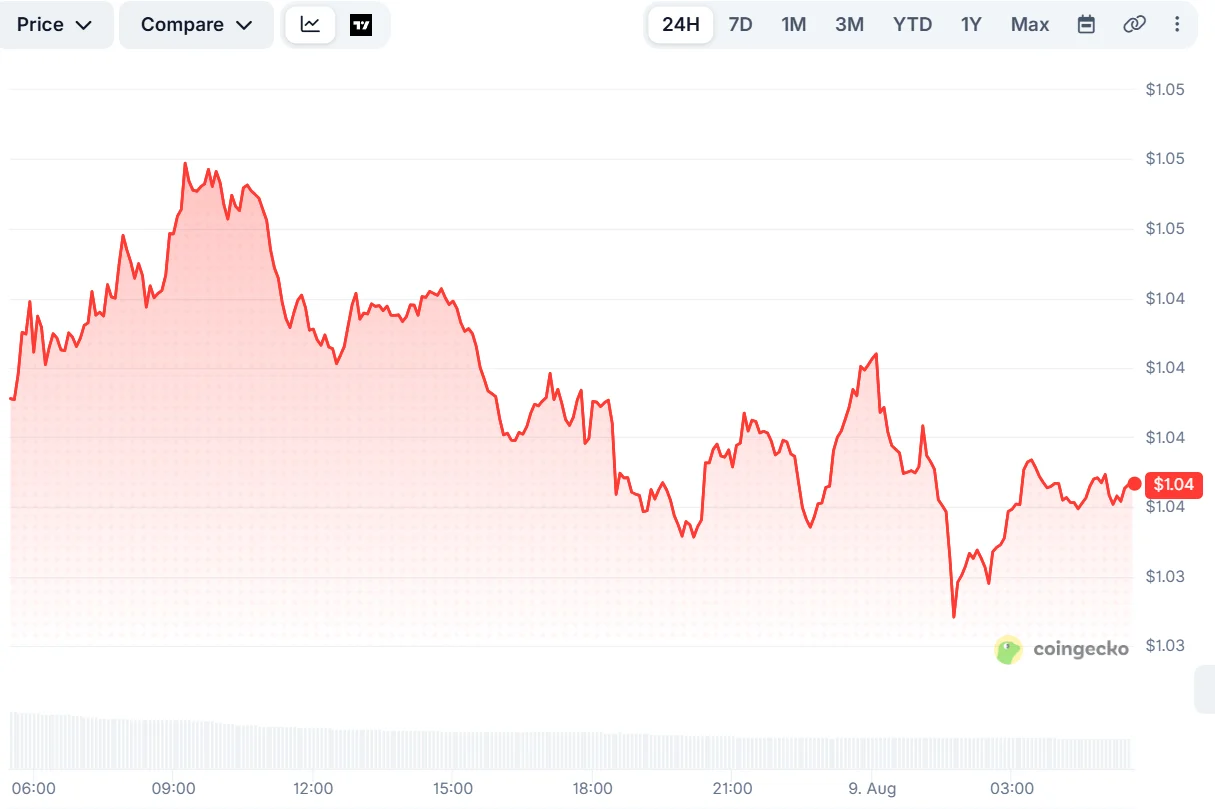
XRP is trading near $1.04 after XRP Ledger (XRPL) payment volume fell almost 90% from its August 7 surge, when the network processed approximately 614.9 million XRP at its local peak before activity quickly returned toward its recent baseline.
The contraction appears severe at first glance, but the underlying pattern provides essential market context. XRPL payment flows have repeatedly produced brief jumps followed by rapid reversals over the past month, a behavior that differs meaningfully from a sustained collapse in established payment demand.
Price forecasts place $2.50 as an upper recovery boundary over the coming quarters. However, XRP must first defend parity at the $1 level and reclaim nearby resistance.
XRP Price Faces Resistance as Ledger Volume Normalizes
XRP Ledger payment volume measures transfers between accounts rather than exchange trading activity. A single institutional transfer, treasury movement, or exchange reshuffle can create an unusually large reading, and the metric cannot identify the purpose behind each transfer.
The August 7 surge fits that pattern. Payment activity climbed near 614.9 million XRP without forming an upward trend. Volume then retreated sharply by August 9, producing the headline 90% decline from the temporary high.
XRPL history contains similar reversals. Payment volume exceeded one billion XRP on August 1 before falling near 100 million XRP. Those bursts make peak-to-trough comparisons appear more damaging than the broader activity trend suggests.
A structural warning would require low payment activity across a longer observation period. Analysts would need confirmation from transaction counts, active accounts, exchange flows, and stablecoin transfers — alongside RLUSD supply growth and sidechain deployment metrics — before concluding that network usage has materially weakened. One volatile metric alone cannot establish a persistent network slowdown.
The gap between XRPL payment readings and XRP's spot price reflects a well-known dynamic in crypto markets: network utility metrics and speculative exchange demand frequently move on separate cycles, so a sharp drop in on-chain transfers does not mechanically translate into equivalent selling pressure.
The XRP price chart carries a more immediate risk. XRP trades below key moving averages, while sellers maintain a sequence of lower highs. Short-term resistance sits between $1.075 and $1.087. Larger moving averages stand near $1.185 and $1.377.
Momentum lacks a reversal signal. The Relative Strength Index sits near 40, indicating weak demand without reaching oversold conditions. XRP could face further selling before technical exhaustion appears.
XRP Price Forecast Sets $2.50 as Conditional Boundary
The $1 level now controls the short-term XRP price structure. Holding that threshold could support consolidation and another test of the $1.08 to $1.10 range. A daily breakdown would expose recent price lows between $0.95 and $0.97.
The wider XRP price forecast spans approximately $1.10 to $2.50 over the coming quarters. That range represents a scenario rather than a guaranteed path, as XRP must first recover nearby moving averages and end its lower-high sequence.
Ripple's business expansion supplies a fundamental backdrop. The company raised $500 million at a $40 billion valuation in November 2025, with funds managed by affiliates of Fortress Investment Group and Citadel Securities leading the investment.
That fundraising followed a July 2023 federal court ruling that programmatic sales of XRP on public exchanges did not constitute securities offerings — a degree of regulatory clarity that most other digital assets still lack and that has underpinned Ripple's institutional push.
Ripple has broadened its operations beyond cross-border payments. Its product range now includes custody, stablecoins, prime brokerage, and corporate treasury services — a strategy that ties XRP demand to an institutional infrastructure network.
RLUSD adds compliant, dollar-based liquidity across the XRP Ledger and Ethereum. The stablecoin can handle transfers requiring low price volatility, while XRP can support bridge liquidity and cross-border routing where rapid conversion matters.
Additionally, XRPL development targets tokenized assets and decentralized finance. Its EVM-compatible sidechain supports Ethereum applications while connecting them with the XRP ecosystem. Native ledger features cover token issuance, trading, escrow, and automated market making.
These developments do not directly guarantee a higher XRP price. Market demand, liquidity conditions, and broader risk appetite still determine price performance, and adoption must translate into sustained network activity rather than isolated payment spikes.
The $2.50 boundary would require a recovery from the present zone. XRP would need to clear $1.10, reclaim larger moving averages, and build higher lows. Until then, $1 remains the chart's immediate decision level, while $0.95 marks the next downside reference.

