XRP Holds $1.30 as Falling Futures Open Interest Signals Softer Demand
Key Takeaways
- •XRP slipped from its Monday high of $1.50 to trade just above $1.30 on Friday as buyers defended a cluster of short-term moving-average supports.
- •The U.S. Senate failed to advance the CLARITY Act, a proposed market-structure bill intended to establish clearer federal oversight of digital assets.
- •The Federal Reserve raised its benchmark interest rate by 25 basis points to a range of 3.75%-4.00%, but the widely anticipated move limited the immediate reaction in digital-asset markets.
- •Ripple argues that its litigation with the SEC established XRP is not inherently a security, giving the token firmer legal footing even without comprehensive U.S. crypto legislation.
- •XRP futures open interest fell to 2.12 billion XRP on Friday from 2.25 billion the previous day, reflecting a pullback in leveraged positioning that could hamper a sustained move back toward $1.50.
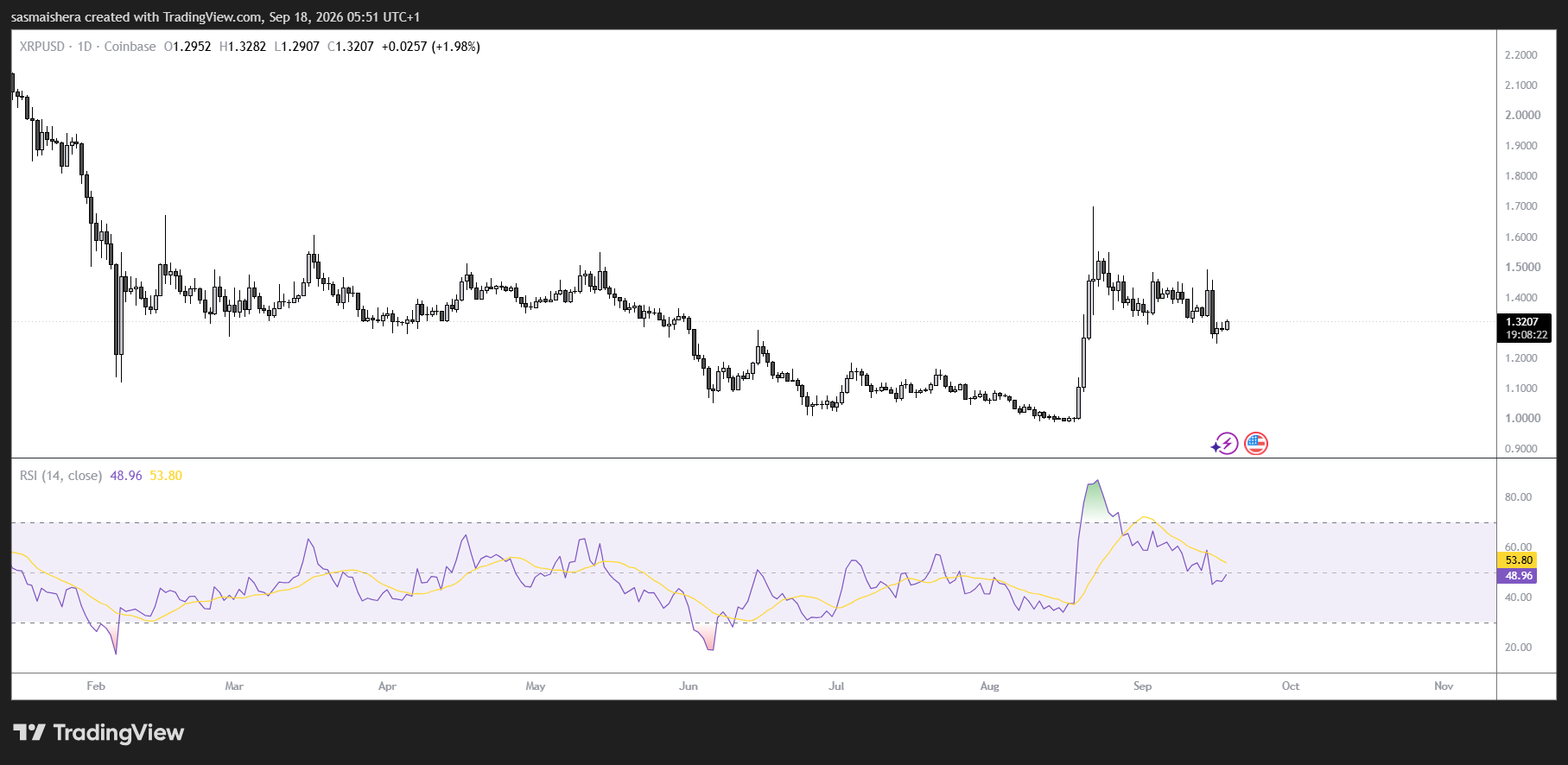
Ripple's XRP remained under bearish pressure on Friday, trading just above the $1.30 mark as buyers attempted to defend a cluster of short-term moving-average supports. The token has struggled to hold its footing since climbing to $1.50 on Monday, and sentiment weakened further after the U.S. Senate failed to advance the CLARITY Act, a proposed market-structure bill designed to establish clearer federal oversight of digital assets, and the Federal Reserve raised its benchmark interest rate by 25 basis points to a range of 3.75% to 4.00%.
Higher borrowing costs can reduce liquidity across markets and weaken demand for risk assets, cryptocurrencies included. Still, the Fed's decision was widely anticipated by market participants, which limited the immediate reaction across digital-asset markets.
Ripple Points to Existing Legal Clarity
Despite the legislative setback, Ripple maintains that XRP already carries a meaningful legal advantage following the company's lengthy court battle with the U.S. Securities and Exchange Commission. According to Ripple, that litigation established that XRP is not inherently a security, giving both the company and the token firmer legal footing even in the absence of a comprehensive U.S. digital-asset framework.
The company acknowledged that the CLARITY Act could have delivered greater certainty across the broader crypto industry. Even so, it argued that XRP remains on "settled ground" compared with many other digital assets.
Futures Open Interest Retreats
Derivatives activity has weakened alongside XRP's fading price recovery. Data from Coinglass shows futures open interest — the total size of open futures contracts — fell to 2.12 billion XRP on Friday, down from 2.25 billion a day earlier. The figure also sits considerably below the 2.78 billion XRP recorded on August 15, reflecting the gradual pullback in leveraged positioning.
Falling open interest typically indicates that traders are closing leveraged positions or becoming less willing to establish new ones. If the decline continues, XRP may struggle to attract the speculative demand needed to fuel a sustained move back toward $1.50.
The token nevertheless displayed some resilience following the Fed's widely expected rate increase. XYO co-founder Markus Levin noted that the central bank's improved growth outlook suggests policymakers do not believe the U.S. economy is approaching a severe downturn. However, the effects of higher borrowing costs could emerge gradually as financial conditions tighten.
Bulls Defend the $1.26-$1.28 Support Zone
On the technical side, XRP remains above the 50-day and 100-day exponential moving averages, which provide around $1.28 and $1.26, respectively. The 200-day EMA, at approximately $1.36, represents the first major overhead resistance. A decisive break above that level could improve momentum and reopen the path toward $1.50.
Technical indicators currently point to consolidation with a bearish tilt. The Moving Average Convergence Divergence (MACD) indicator has fallen further below zero, and its expanding negative histogram suggests bullish momentum is continuing to weaken. Meanwhile, the Relative Strength Index (RSI) stands at 49, slightly below its neutral midpoint.
A daily close below the $1.26-$1.28 support cluster would strengthen the bearish outlook and could potentially trigger a deeper correction. Conversely, holding this zone and reclaiming the $1.36 level would provide an early sign that buyers are regaining control of the market.

