Peter Brandt Maps $2.16 XRP Target as Ripple Deepens Brevan Howard Partnership
Key Takeaways
- •Peter Brandt set a $2.16 measured-move objective for XRP based on an inverse head-and-shoulders pattern, implying a gain of roughly 43% from about $1.51.
- •Brandt said the pattern's right shoulder is poorly formed, so XRP may spend more time building the structure, though further development is not required for the setup to remain valid.
- •Substantial overhead supply, starting near the mid-$1.60 range and extending toward prior highs above $3, could generate selling pressure and add friction to XRP's recovery attempt.
- •Brandt favored Monero's chart over those of XRP, Solana, Ethereum and Stellar because Monero had already absorbed much of its prior overhead supply.
- •Ripple Prime will provide Brevan Howard with multi-asset prime brokerage, clearing and financing services, including access to crypto assets such as XRP and RLUSD.
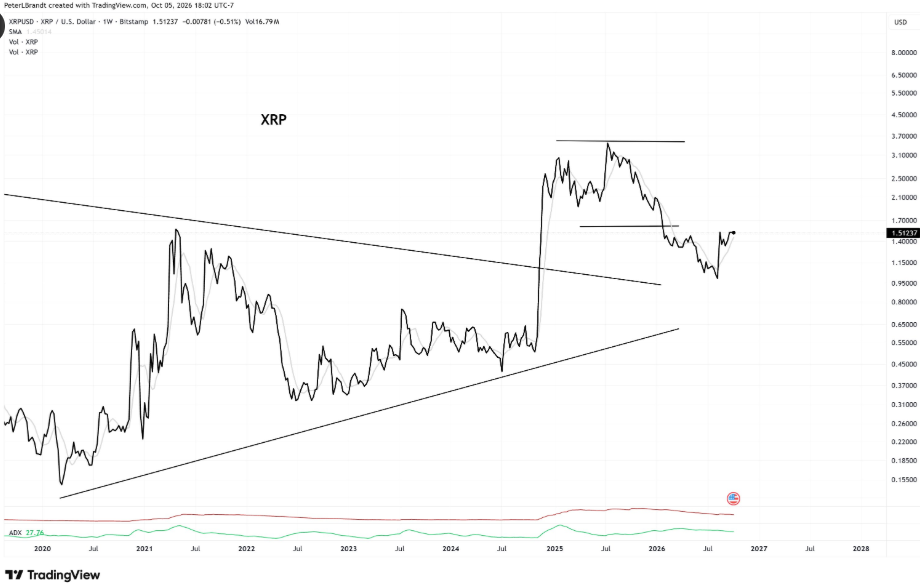
XRP traded near $1.50 on Oct. 6 as veteran trader Peter Brandt mapped a potential measured-move target of $2.16, while Ripple separately announced an expansion of its institutional relationship with hedge fund Brevan Howard through Ripple Prime.
Inverse Head-and-Shoulders Structure Points to $2.16
Brandt shared his latest technical assessment in a post on X as XRP changed hands around $1.50. Brandt, known for a classical charting approach developed over decades across commodities and crypto markets, derives the $2.16 objective from the height of the developing inverse head-and-shoulders pattern, projected upward from the neckline — a standard measured-move convention in charting rather than a guaranteed outcome. A move from $1.51 to $2.16 would equate to an increase of roughly 43%.
Inverse head-and-shoulders formations are traditionally read as potential reversal structures, with the neckline serving as the reference line against which the pattern's objective is measured. According to Brandt, the structure remains incomplete because the right shoulder is poorly formed and abbreviated. XRP could therefore spend more time building out the right side of the pattern before attempting a larger move. He added, however, that further development of the shoulder is not required for the setup to remain valid.
Brandt had previously identified a cup-and-handle formation on XRP's daily chart. Resistance near $1.6572, which marked the Sept. 23 high, remains an important level within that structure. A move above that area would take XRP beyond its recent trading range and closer to the projected neckline zone.
The trader also noted that technical patterns can change as price action develops. Under one scenario, the cup-and-handle formation could become part of the right shoulder of the larger inverse head-and-shoulders setup.
Heavy Overhead Supply Caps the Recovery Path
XRP still faces a considerable amount of overhead supply above its current price, a factor Brandt flagged as negative as the token works toward higher resistance levels. Previous trading activity above the current range has created several zones where selling pressure could emerge.
The first resistance area sits around the mid-$1.60 range. Beyond it, XRP faces a broader supply zone extending toward previous highs above $3. Holders who bought at higher prices may sell as the token returns to those levels, adding friction to any recovery attempt. Within Brandt's framework, how the right shoulder fills out over time — and how price behaves at the supply zones above — are the near-term developments that would either clarify or redraw the setup as currently sketched.
Brandt also compared XRP's structure with those of Monero, Solana, Ethereum and Stellar. Monero was trading around $560.88 and testing a long-term resistance area, with much of its prior overhead supply already absorbed — Brandt named XMR as his preferred chart among the group. Solana likewise displays a broad cup-and-handle formation: SOL traded around $121, with its multi-year structure placing a major resistance area near $250. Ethereum remained inside a large congestion zone, while Stellar also carried overhead supply, though Brandt said it was smaller than the overhang facing XRP. The contrast is the point of the exercise: how much prior overhead supply each chart has already absorbed is what separates Brandt's preferred structure from the heavier load he flagged on XRP.
Ripple Expands Brevan Howard Partnership via Ripple Prime
Separately, Ripple has broadened its relationship with Brevan Howard, a major global macro hedge fund, through Ripple Prime, as detailed in the company's announcement. Under the agreement, Ripple Prime will provide multi-asset prime brokerage, clearing and financing services to Brevan Howard funds. The platform spans both traditional and digital markets, including access to crypto assets such as XRP and Ripple USD, or RLUSD — placing the token and the stablecoin inside the kind of consolidated prime brokerage offering that lets an institutional fund reach trading, clearing and financing across asset classes through one counterparty.
The expanded partnership builds on earlier investment activity involving Brevan Howard affiliates, which participated in Ripple's $500 million funding round last year — a round that valued the company at $40 billion. Ripple subsequently reached a $50 billion valuation following a $750 million share buyback program earlier this year.
Ripple Prime has also been widening its range of institutional trading services. In August, the business added U.S. stock trading through its Delta One operation, allowing clients to execute total return swaps on U.S. equities. Taken together with the crypto access in the announcement, the buildout gives a single institutional relationship reach across equities, financing and digital assets.
This article is for informational purposes only and does not constitute financial or investment advice. Technical patterns, analyst targets and market conditions may change as price action develops.
This article originally appeared on The Market Periodical.

