XRP Open Interest on Binance Falls 42% as Futures Positions Shrink
Key Takeaways
- •Binance XRP open interest declined 42% in less than a month, from $502 million on November 2 to about $291 million, according to CryptoQuant analyst Darkfost.
- •The contraction was attributed to position closures, liquidations, and falling prices, and because open interest is dollar-denominated, the 42% figure does not mean the number of open positions fell by exactly that amount.
- •The rolling seven-day open interest change improved to minus 2.4% by November 28 after readings as steep as minus 30.1% in mid-November, indicating the contraction is slowing but not confirming renewed demand or buyer dominance.
- •The holder group Make XRP Great Again sent an open letter to Ripple CEO Brad Garlinghouse on November 16 demanding the permanent removal of 31.1 billion escrowed XRP, setting a March 31, 2027 deadline.
- •Ripple CTO David Schwartz stated that even a validator supermajority cannot force the company to surrender its escrow, since XRP Ledger amendments require more than 80% validator support sustained for two weeks and only alter software rules rather than transfer control of Ripple's account.
XRP open interest on Binance has fallen 42% in less than a month, according to data from CryptoQuant analyst Darkfost. The value of open futures positions on the exchange dropped from $502 million on November 2 to roughly $291 million, marking a sharp retreat in Binance's futures market for the token.
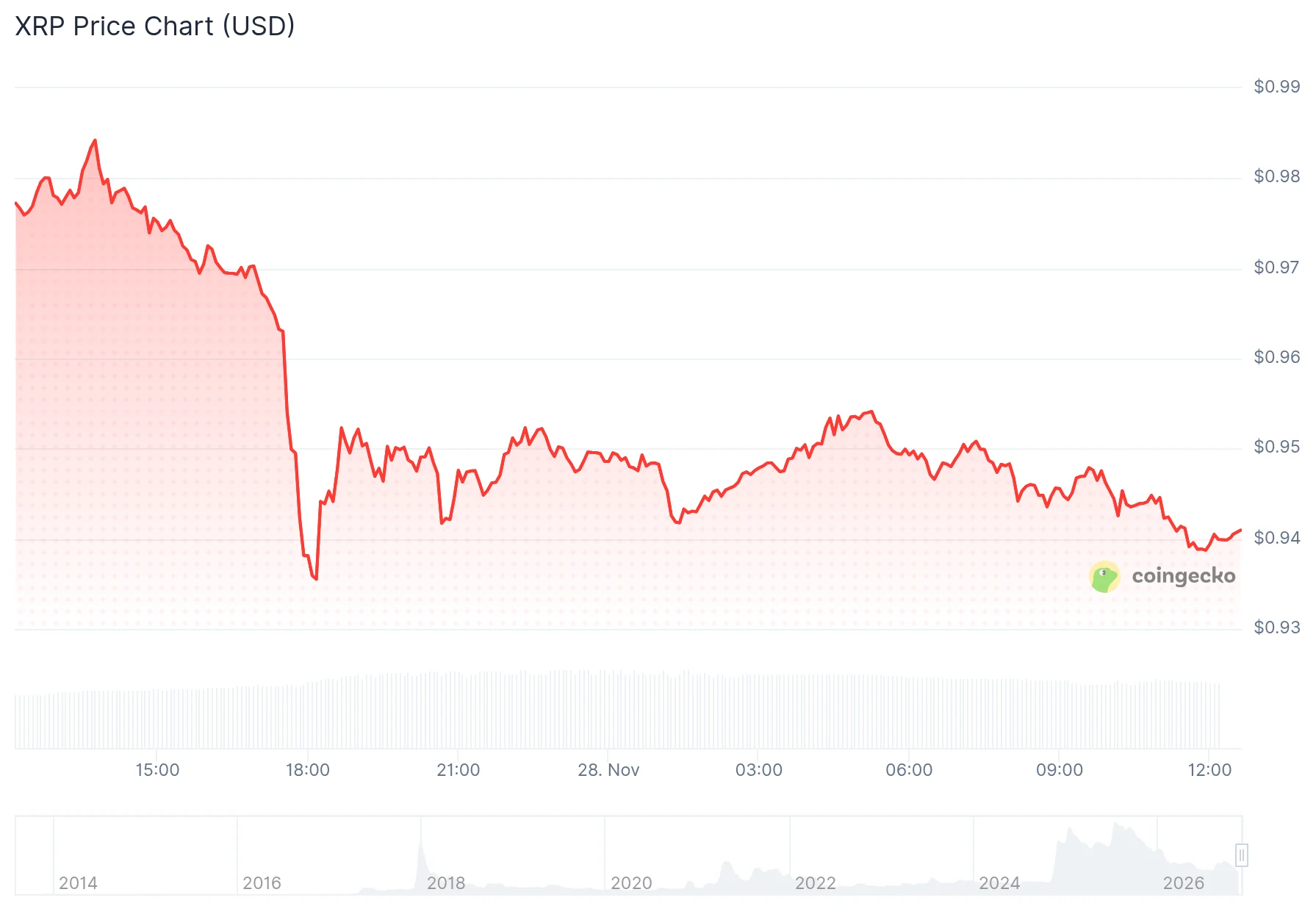
Darkfost attributed the contraction to three factors: position closures, liquidations, and falling prices, which reduce the dollar value of remaining contracts. XRP traded near $0.95 on November 28, leaving the market well below its early-month levels.
Darkfost's rolling seven-day measure of open interest change has since eased from the deep negative readings recorded in mid-November to minus 2.4% as of November 28. That shift suggests the contraction is slowing and points to calmer derivatives activity, but it does not yet confirm renewed demand.
Why Open Interest Fell on Binance
Open interest measures the total value of open futures contracts, but it does not show whether those positions are long or short. Analysts across crypto markets use the metric as a gauge of leveraged participation, since it counts positions that remain open rather than completed trades. A decline can reflect position closures, liquidations, or lower contract values as the underlying token price falls. Darkfost attributed the recent drop to all three factors.
Because open interest is dollar-denominated, falling XRP prices also reduce the displayed value. The 42% decline therefore combines actual changes in positions with the token's price slide, and it does not mean that the number of open positions fell by exactly 42%. A lasting recovery in open interest would require firmer prices and stronger spot demand.
Steepest Declines Clustered in Mid-November
The steepest readings appeared in Darkfost's rolling seven-day sum of daily percentage changes. The measure fell to minus 30.1% on November 11, minus 29.5% on November 14, and minus 27.5% on November 16. These overlapping windows indicate one sustained contraction rather than three separate events.
The indicator then moved closer to zero, reaching minus 2.4% on November 28. Net reductions persist across the latest window, which suggests that position reductions have slowed. However, the easing does not confirm renewed market activity or buyer dominance, and Binance futures exposure could keep falling if prices weaken further or participants remain cautious.
Without firmer prices and stronger spot demand, the latest easing may show only that the liquidation wave has passed its most intense phase.
Escrow Campaign Tests the Limits of Ledger Governance
The derivatives retreat coincides with a campaign by XRP holders calling on Ripple to permanently remove 31.1 billion escrowed tokens. The group Make XRP Great Again sent an open letter to Ripple CEO Brad Garlinghouse on November 16, setting March 31, 2027, as its deadline. Supporters say a lower locked supply would address concerns over Ripple's holdings.
Ripple plans to unlock 1 billion XRP on December 1 and return any unused amount to escrow. Such releases follow a monthly schedule under Ripple's long-standing escrow arrangement. Escrowed XRP does not automatically become available for sale — its release depends on programmed ledger conditions. The December 1 release and the campaign's March 31, 2027 deadline give observers fixed dates to track both the escrow schedule and the effort to change it.
Ripple Chief Technology Officer David Schwartz addressed the governance question in a November 27 post on X, saying validators cannot compel the company to surrender the escrow.
"If the majority of nodes want something, nothing can stop them from having it. They just can't force those who don't agree to go along with them. But the same is true for a minority of nodes too. There's no coercive mechanism at all."
— David 'JoelKatz' Schwartz (@JoelKatz) November 27, 2026, via X
Even a supermajority of validators cannot force dissenting network participants to adopt rules they reject. Validators can approve amendments to transaction processing, but each server operator chooses which rules to support.
According to the XRP Ledger documentation, amendments require more than 80% support from trusted validators maintained for two weeks. That process changes software rules; it does not transfer control of Ripple's account. Schwartz has said validators attempting to impose a change without broad agreement could isolate themselves from other network participants, since each operator decides independently which rules to run.
The distinction matters for the escrow campaign. An amendment could change transaction processing for participating servers, but it cannot make Ripple voluntarily surrender its existing escrow. Schwartz has previously said Ripple could send future escrow releases to an inaccessible account to achieve a similar result.
This article is based on reporting by Blockonomi.

