XRP Price Holds Near $1.39 After Critical XRP Ledger Flaw Disclosure
Key Takeaways
- •A critical arithmetic overflow vulnerability in the XRP Ledger's payment engine, present since 2015, could have enabled a single transaction to create approximately 18.45 trillion XRP, roughly 184 times the original supply.
- •RippleX shipped the patched xrpld 3.4.1 software on September 25, and more than 80% of relevant validators upgraded that same day, protecting the network through rapid adoption rather than the standard amendment activation process.
- •Veria Labs' AI system discovered the flaw, which entered its bug bounty program on September 22 and earned the firm the maximum critical reward of $250,000 before the official disclosure on October 9.
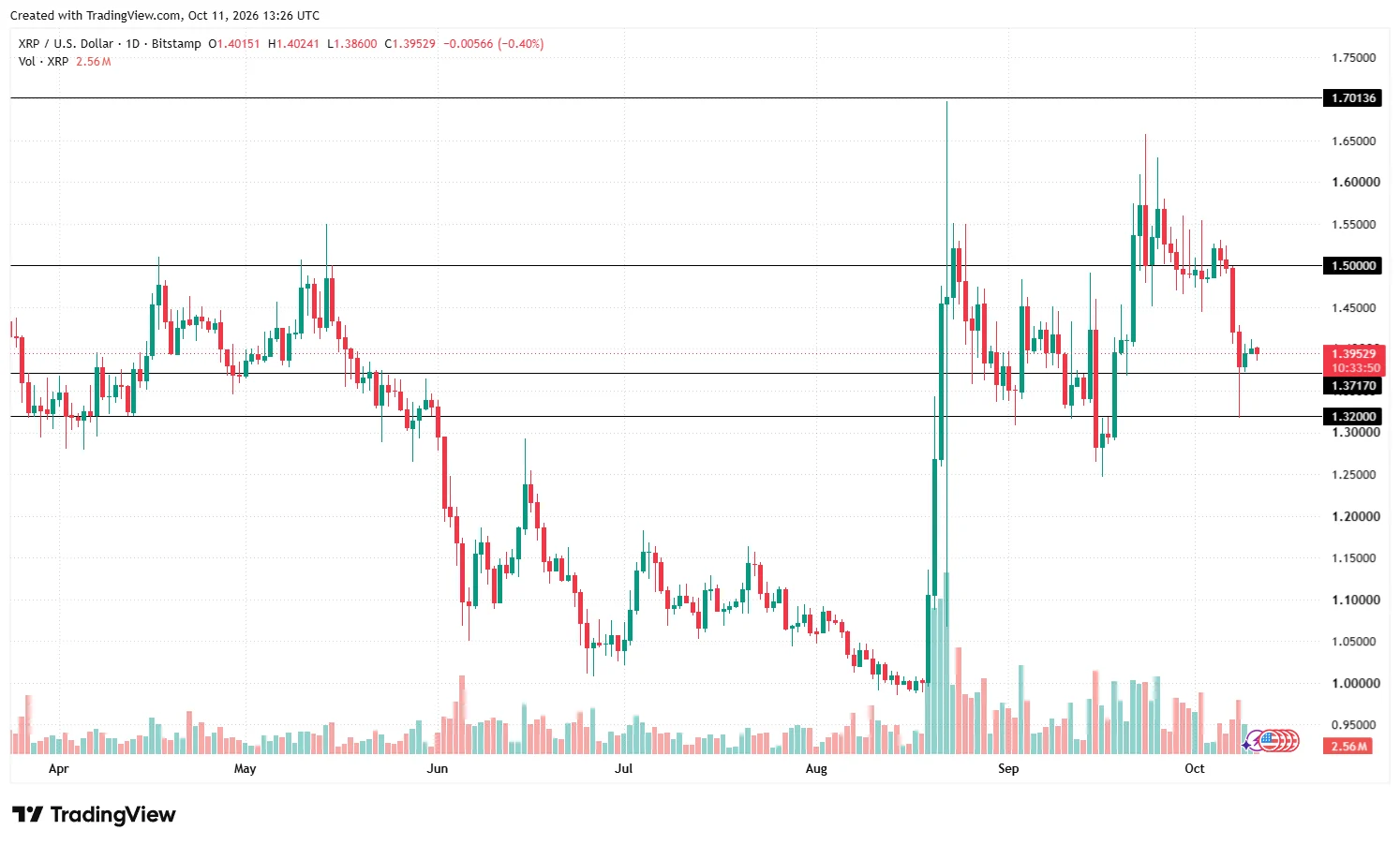
- •Investigators found no evidence the vulnerability was exploited on any public network, and XRP reacted mildly, trading near $1.39 with buyers holding the $1.32–$1.37 support zone against resistance between $1.50 and $1.70.
- •Separate lending amendments that would add native borrowing functions and pooled-asset vaults remain open for validator voting, with activation dependent on sustained validator support rather than a set launch schedule.
XRP traded near $1.39 on Sunday after researchers disclosed a critical vulnerability in the XRP Ledger that could have allowed the creation of unauthorized tokens. The flaw, which affected the ledger's payment engine, had remained hidden since 2015. Developers released a fix before publishing details of the bug, and investigators found no evidence it was exploited on public networks.
According to TradingView market data, XRP — the native token of the XRP Ledger — changed hands around $1.39, with its daily change remaining below 1%. Buyers continued to defend recent lows despite the security disclosure. The muted reaction followed a difficult week, leaving traders focused on nearby support and on whether the recovery could extend beyond the narrow weekend trading range.
Buyers Defend Support Zone
XRP continued to trade above the $1.32–$1.37 support zone after buyers absorbed the latest decline. The weekly chart showed a lower wick near $1.32, indicating buying interest below current levels. That rebound kept an ascending support line connecting earlier lows in focus.
Holding support, however, does not establish a lasting. A stronger recovery would require sustained demand above the current range. A broader resistance area remains between $1.50 and $1.70, where earlier weekly highs could attract selling. Until buyers reclaim those levels, the recent stabilization leaves the larger trading range intact.
XRP also remained sensitive to broader cryptocurrency conditions. Bitcoin had retreated toward the $80,000–$83,000 area, adding pressure across digital assets. The limited weekend movement therefore offered evidence of stability without proving that sellers had exhausted their positions.
The security report described a vulnerability that had already been addressed, which may help explain the restrained market reaction. That interpretation remains an inference, since price action alone cannot establish why individual traders bought or sold. For XRP, the immediate distinction lies between defending support and clearing resistance. A brief recovery from the weekly low confirms that buying occurred there, but it does not guarantee the same zone will hold during another selloff.
Fix Shipped Before Public Disclosure
Veria Labs said its AI system identified the flaw on September 21. Researcher Cayden Liao validated the finding, which entered the bug bounty program on September 22.
The firm estimated that a single transaction could have created approximately 18.45 trillion XRP, roughly 184 times the original supply. Its $94 billion exposure estimate referred to the value of existing tokens rather than money stolen. Veria also cautioned that an attacker could not have sold such an enormous quantity at prevailing prices; the central threat was unauthorized supply undermining confidence in the asset.
The official October 9 disclosure explained that an arithmetic overflow — a condition in which a calculation exceeds the largest value its number format can store and wraps around to a much smaller figure — affected payment calculations and a separate supply safety check. Both calculations could wrap around, allowing newly created XRP to escape detection.
RippleX engineers confirmed the issue via a post on X and released xrpld 3.4.1 on September 25. More than 80% of relevant validators upgraded that same day. The emergency protection took effect through software upgrades rather than the usual amendment activation process, which is why the pace of that same-day adoption — not an on-chain vote — determined when the network was actually protected. The patch-before-publication timeline also mirrored standard coordinated disclosure practice, in which fixes ship ahead of technical details so operators can upgrade first.
Veria reported receiving the maximum critical bounty of $250,000 on October 8. The official investigation found no evidence that attackers exploited the flaw on any public network.
Lending Amendments Still Await Validator Support
XRP traded quietly as separate network amendments remained under review. Official documentation lists the lending feature as open for voting, with its activation dependent on validator support rather than a predetermined commercial launch schedule.
The proposed lending framework would add native borrowing functions, while associated vault amendments would support pooled assets. These changes are separate from the emergency overflow repair. Their voting status measures progress toward deployment, but it does not measure future demand for XRP or establish how much lending activity the network will eventually attract commercially.
Ordinary amendments require sustained validator approval before activation, and losing the required support interrupts the process. The ledger records amendment status and majority timing, allowing observers to distinguish proposed functionality from features already available on the network.

