XRP Ledger Ranks Sixth in Tokenized Asset Value — What the Headline Number Misses
Key Takeaways
- •RWA.xyz ranks the XRP Ledger sixth among tracked networks, with $5.046 billion in tokenized real-world asset value excluding stablecoins and $4.550 billion in represented value.
- •Only 9.8% of XRPL's tracked tokenized value is labeled as distributed, and the article identifies this gap as more telling than the network's ranking itself.
- •XRPL's tokenized products focus on institutional instruments, including Ondo Finance's OUSG Treasury fund, Archax's access to abrdn's tokenized U.S. dollar liquidity fund, and OpenEden's partnership with Doppler Finance.
- •Stablecoins are deliberately excluded from the ranking to separate settlement balances from yield-generating investment claims such as tokenized Treasury and money-market funds.
- •The article states that the tokenized-asset totals do not establish a fixed link to XRP demand, since product flows may use XRP, RLUSD, or other digital assets.
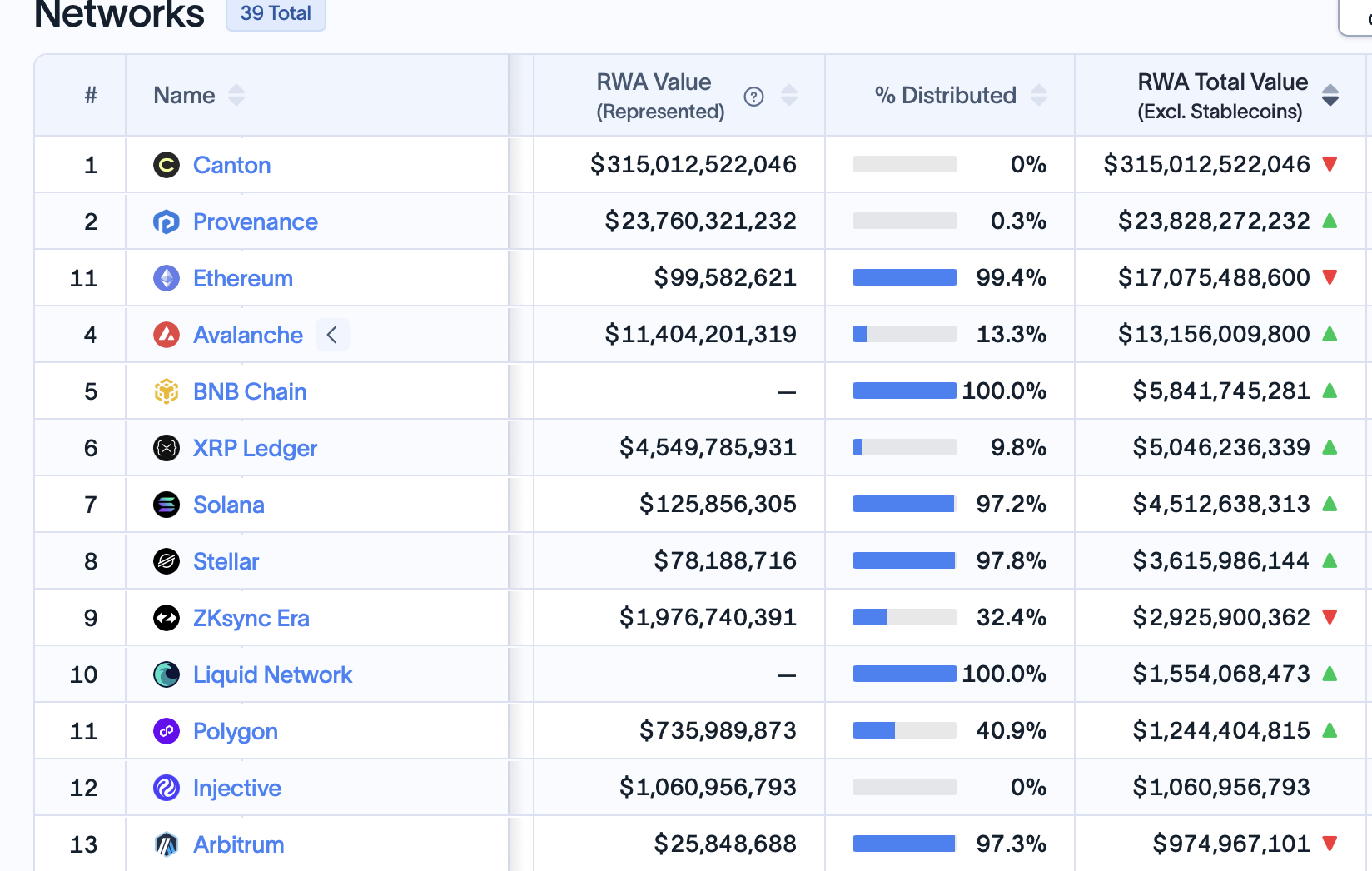
The RWA.xyz network table places the XRP Ledger (XRPL) sixth among tracked networks, with $5.046 billion listed under “RWA Total Value (Excl. Stablecoins),” $4.550 billion in represented value, and 9.8% marked as distributed. RWA.xyz is a public dashboard that tracks tokenized real-world assets — traditional instruments such as Treasury securities and fund shares represented as blockchain tokens — a category that asset managers and crypto-native issuers have used to bring regulated products onto public ledgers.
Read the Whole XRPL Row, Not Just the Ranking
The dashboard presents three separate figures for XRP Ledger: $5.046 billion in “RWA Total Value (Excl. Stablecoins),” $4.550 billion in “RWA Value (Represented),” and 9.8% under “% Distributed.” Each label describes a different part of the tracker’s view of the network, and the 9.8% distributed figure is the detail that matters most.
RWA.xyz separates the network’s total and represented values from the portion it labels as distributed. The table does not identify who holds the assets, which investor restrictions apply, or what terms govern the transfer and redemption of each product. That leaves an important distinction between the size of financial products associated with a blockchain and the portion measured as distributed through it.
A high placement in the ranking can show that major tokenized products have reached the network. By itself, however, it cannot show how widely their units are held, how often they move, or how easily they can be redeemed.
Why Treasury and Money-Market Products Matter Here
XRPL’s tokenization story has grown around familiar institutional products: short-term U.S. Treasuries and money-market funds. These instruments give eligible investors a way to hold a regulated claim on cash-like assets while using blockchain infrastructure for recordkeeping, settlement, or transfer processes. Products of this kind anchor the broader tokenization market, where short-duration, regulated fund structures are among the assets most commonly moved onchain.
Ondo Finance deployed OUSG on XRPL, bringing its tokenized short-term U.S. Treasury fund to the network for institutional investors. The product uses eligibility and compliance controls, so its availability depends on the investor and the applicable terms rather than on the existence of a wallet alone.
Distribution through regulated market infrastructure forms the next part of the model. Archax, a UK-regulated digital securities platform, provided access to abrdn’s U.S. dollar liquidity fund in tokenized form on XRPL. Its product page identifies the fund as available to professional and institutional investors, with investment minimums and specified dealing arrangements.
OpenEden’s partnership with Doppler Finance, an XRPL-native yield protocol, points to a third use: connecting Treasury-backed assets with XRPL-native liquidity. Together, these examples show how a network can carry tokenized products for cash management, fund access, and settlement without turning every asset into an unrestricted retail token.
The Ranking Leaves Out the Terms That Decide Usefulness
A tokenized fund unit can be valuable while still carrying important limits. The issuer may restrict who can subscribe, require investor verification, control transfers, set redemption windows, or use an external legal register as the authoritative ownership record. Those conditions are part of the product, even when its representation appears on a public blockchain.
This is why a tokenized-asset total should be read alongside the offering terms. A large represented value can signal institutional interest and a meaningful distribution partnership. It says less about secondary-market liquidity, holder concentration, or how quickly a participant can enter and exit the product.
The same distinction applies across the wider onchain-finance market. Digital dollars can connect payments, treasury management, and tokenized investments, but each layer has its own issuer, access rules, and redemption process.
Stablecoins Are Deliberately Outside This Comparison
The total shown in RWA.xyz’s XRPL row excludes stablecoins. That choice helps keep two separate financial functions visible: a stablecoin generally serves as a settlement balance, while a tokenized Treasury or money-market fund gives its holder an investment claim that may generate yield from the underlying assets.
Both products can work together. An institution may use a stablecoin to settle a payment or subscribe to a fund, then hold the fund token as part of its cash-management strategy. Treating them as one measure of adoption would hide the difference between payment liquidity and investment exposure.
The Ranking Does Not Establish a Fixed XRP-Demand Effect
More tokenized assets can broaden XRPL’s role in fund distribution, asset administration, and settlement. The ranking offers no fixed equation between that activity and XRP demand.
Each product has its own mechanics. Some flows may use XRP, RLUSD (Ripple’s U.S. dollar stablecoin), or another digital asset. Other arrangements may center on issuer permissions, custodians, and tokenized fund records. The $5.046 billion figure therefore provides evidence of financial products associated with XRPL; it does not provide a price target or a direct demand forecast for XRP.
The Number to Watch Next
Sixth place shows that XRPL has become a meaningful venue in the tokenized-asset landscape. The data point the headline misses is the distance between the network’s large total and the 9.8% share RWA.xyz labels as distributed.
That gap makes the next evidence easy to identify: a larger distributed share, more eligible holders, recurring subscriptions and redemptions, and tokenized assets being used repeatedly in settlement or collateral workflows. Those developments would show whether XRPL’s tokenized value is turning into a deeper and more active financial market.
This article is provided for informational purposes only and does not constitute financial or investment advice. RWA.xyz rankings and asset values may change as products are issued, redeemed, revalued, or reclassified. Source: Coindoo.

