XRP Ledger's Permission Delegation Amendment Enters Final Activation Window for October Launch
Key Takeaways
- •The PermissionDelegationV1_1 amendment received 29 validator votes in favor and entered a 14-day activation window that opened September 21, 2026, with an earliest possible activation of October 5, 2026, at 11:18 AM UTC.
- •Activation fails and the full countdown resets if validator support falls to the 80% threshold or below at any point during the two-week window.
- •Permission Delegation lets account holders assign narrowly defined authorities to other accounts while keeping full control, with instant revocation and certain controls excluded to prevent privilege escalation.
- •The amendment ships in the xrpld 3.3.0 release under the XLS-75 technical standard and replaces an earlier version that reportedly contained a critical bug.
- •Ripple's RLUSD team has begun building and testing the functionality in a development environment, and the potential activation date falls weeks before Ripple's Swell conference on October 27–29.
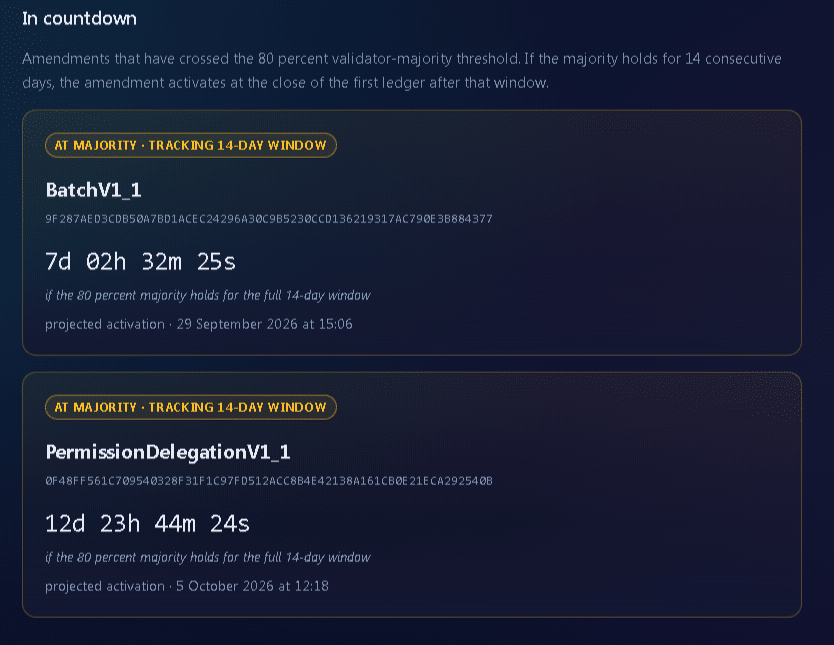
The XRP Ledger's PermissionDelegationV1_1 amendment has entered its final two-week activation window after receiving 29 validator votes in favor, according to reporting from BigGo Finance. The tally starts a 14-day countdown toward the earliest possible activation on October 5, 2026, at 11:18 AM UTC — but only if validator support holds above the required threshold for the entire period.
That condition carries more weight than it may appear. While the amendment has cleared its required threshold, XRPL validators — the server operators whose votes determine which protocol changes go live — only need to allow support to slip to 80% or below at any point in the window for the entire clock to reset to zero. Passing the hurdle once is not the same as clearing it for good, and the next fourteen days effectively function as a probation period.
(Source: XRPL Dashboard – Amendments)
How Permission Delegation Works
Permission Delegation allows an account holder to assign specific, narrowly defined authorities to another account without surrendering full control of the original account. Certain account-level controls are deliberately excluded from delegation to prevent a delegate from escalating its privileges or compromising the issuer account outright. The owner decides exactly what is delegated and can revoke it instantly.
The amendment ships inside the xrpld 3.3.0 release of the ledger's core server software and is implemented under the XLS-75 technical standard, one of the ledger's numbered specifications for proposed features. It replaces an earlier version of Permission Delegation that, per BigGo's reporting, contained a critical bug — making this release a corrected rebuild rather than a brand-new feature.
Lauren Berta, Ripple's stablecoin product lead, tied the upgrade directly to compliance workflows for regulated issuers. “This separation of duties is standard practice for stablecoin issuers operating on other blockchains,” Berta said, adding that the RLUSD team has already begun building and testing the functionality in a development environment — a preparatory step, not evidence of a mainnet deployment.
What the Vote Tally Shows
BigGo's figure of 29 favorable votes aligns with the tally reported by XRPL Dashboard. That is above the required 80% threshold, but the margin depends on support remaining above that level throughout the activation window. Any dip to the threshold or below would trigger a reset of the full 14-day period.
Amendments are the XRP Ledger's built-in mechanism for upgrading its core rules: validators running updated software vote on each proposed change, and a feature only takes effect once support builds — and holds — above the consensus threshold. None of this guarantees the October 5 date holds. The XRP Ledger's own amendments documentation frames every amendment vote as conditional by design — support must hold for the entire two-week stretch, not merely at the moment it first crosses the line. Data from XRPScan is used to calculate the earliest possible activation timestamp, but that timestamp moves the instant the majority slips.
Berta's framing centers on regulated issuers needing to split duties across teams — compliance staff, asset movers, treasury operators — without any of them gaining outright control of the issuer account. That is the pitch for RLUSD specifically, with Ripple's stablecoin team serving as the named early adopter testing the feature pre-launch.
A retail-facing use case exists as well. RippleX engineer Mayukha Vadari described a scenario involving blackhole issuer accounts — accounts that have permanently locked their own keys — where a holder could delegate select responsibilities, such as managing an account domain, to a separate trusted account before blackholing. Hussein Zangana, a community figure known as Vet, called the amendment a foundational building block for corporate adoption, framing it as groundwork for asset managers and real-world asset issuers rather than a finished product.
An Activation Date, but No Guaranteed Outcome
The mechanics from here are simple, even if the outcome is not assured. The window opened September 21, 2026; the earliest activation is October 5 at 11:18 AM UTC; and validator support has to stay above 80% for all 14 days in between. Any dip to the threshold or below sends the process back to the starting line.
The timing places a potential activation just weeks ahead of Ripple's Swell conference, running October 27–29, where the feature is likely to receive attention regardless of whether it has gone live by then. In the meantime, the markers to track are public ones: the running validator tally on XRPL Dashboard, any movement of the activation timestamp, and whether RLUSD testing moves beyond the development environment. Broader questions about how much organic activity the ledger is currently generating are worth keeping in view alongside the vote, in light of recent reporting on stalling new-user growth on the XRP Ledger.

