XRP Holds $1.23 Support as Exchange Reserves Fall by 250 Million
Key Takeaways
- •Binance's XRP reserves fell 8.18% to 2.47 billion tokens between Oct. 28 and Oct. 30, marking the lowest level since December 2022.
- •The combined 250 million-token reserve decline across Binance, Bybit and Bithumb coincided with Binance's Oct. 29 hack and the temporary withdrawal suspension that followed, making a bullish interpretation less certain.
- •Upbit bucked the trend by adding 20 million XRP during the same period, lifting its balance to 6.44 billion tokens.
- •Daily technical readings stayed below neutral, with the RSI at 36.55 and the Money Flow Index at 42.31, indicating buyers had not yet regained control of the chart structure.
- •Analyst EGRAG CRYPTO identified monthly-chart Fibonacci targets of $6.80, $16.17 and $31.64, conditional on XRP reclaiming the 21-month EMA and breakout conditions developing.
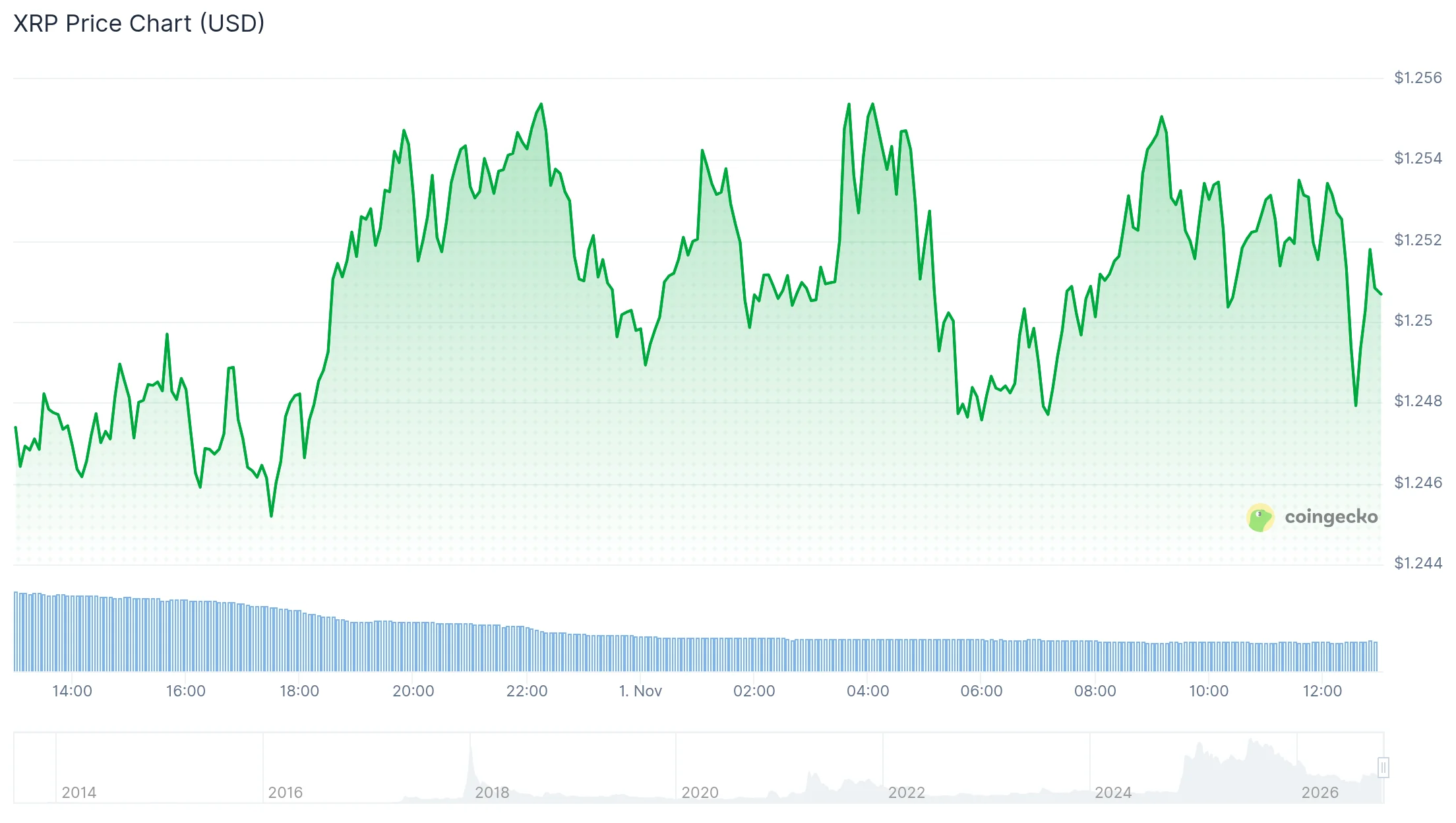
XRP held near $1.24 after buyers defended the $1.23 level, while Binance, Bybit and Bithumb recorded a combined 250 million XRP decline in reserves between Oct. 28 and Oct. 30. Binance's balance fell to its lowest level since December 2022.
Market data published Oct. 31 showed weak momentum alongside the reduction in exchange-held tokens. Binance reserves fell 8.18% to 2.47 billion XRP, while Upbit moved in the opposite direction by adding 20 million tokens. Daily technical indicators also remained below neutral, indicating that buying strength had not yet recovered.
Exchange balances decline unevenly
CryptoQuant analyst Amr Taha reported that Binance held 2.47 billion XRP on Oct. 30, down from 2.69 billion. The 220 million-token decline represented an 8.18% reduction over two days. Reserve counts at Binance, the world's largest cryptocurrency exchange by trading volume, are a widely referenced gauge of how many tokens sit on major trading venues. CryptoQuant's report is available here.
Bybit's XRP balance fell 6.54%, from 306 million to 286 million tokens. Bithumb, a South Korean exchange, lost a further 10 million XRP, leaving 1.837 billion tokens on the platform. Upbit, South Korea's largest crypto exchange, added 20 million XRP during the same period, lifting its balance to 6.44 billion.
As a result, the combined 250 million-token decline applies to the three named platforms—Binance, Bybit and Bithumb—not to every exchange. The measurement period also overlapped Binance's Oct. 29 hack and the temporary suspension of withdrawals that followed, making a bullish interpretation of the reserve decline less certain. Future Binance reserve prints will therefore need to be interpreted with the hack and its withdrawal suspension in mind. Related reporting on the incident is available from CoinCentral and MoneyCheck.
CryptoQuant measures balances held at addresses labeled as belonging to exchanges. Determining whether individual transfers resulted from theft, custody changes or customer withdrawals requires tracing the transactions and their eventual destinations. Lower exchange reserves can reduce the inventory immediately available for trading, but wallet balances alone cannot establish whether investors accumulated XRP or moved existing holdings elsewhere.
A sustained XRP recovery would require buying demand to strengthen alongside the reduction in exchange-held supply. CoinGlass figures showed $5.78 million in spot net outflows, although spot trading flows and exchange wallet balances measure different activity. The negative spot-flow reading should therefore be considered separately from the reserve data.
CryptoQuant's Network Value to Transactions ratio also fell 54.77% over 24 hours to 54.69, according to the report. NVT compares market capitalization with transaction volume. A declining ratio can result from increased transaction activity, lower valuation or both, and does not independently establish that an asset is undervalued.
The daily XRP chart showed a Relative Strength Index of 36.55, below its moving average of 40.19. The Money Flow Index stood at 42.31. Both readings were below 50, indicating that buyers had not yet regained control of the daily structure.
EGRAG CRYPTO identifies three monthly-chart targets
In an Oct. 30 post, EGRAG CRYPTO examined XRP's monthly chart and highlighted three descending trendlines together with the Atlas Line, a rising support line traced back to 2014. The post is available on X.
#XRP – ZOOM OUT! YOU HAVE NO IDEA WHAT'S COMING! : Guys, look at the MONTHLY chart! THREE CYCLES. THREE DESCENDING LINES. ONE MACRO ATLAS LINE! In previous cycles, XRP struggled to reclaim the 21 EMA before exploding higher. NOW? WE'VE TESTED THE 21 EMA AND WE'RE… pic.twitter.com/7ZxkpMToh8 — EGRAG CRYPTO (@egragcrypto) October 30, 2026
The analyst linked previous rallies to XRP reclaiming the 21-period exponential moving average. Because the chart uses monthly candles, the indicator represents a 21-month moving average. Reclaiming that level would be the next step in the cycle structure described in the analysis.
The chart comparison showed consolidation lasting 30 bars in one cycle and 23 bars in the next. The current structure had reached 17 bars. EGRAG CRYPTO's analysis equated those periods to approximately 912, 699 and 518 days, respectively.
The Fibonacci-extension targets presented in the analysis were $6.80, $16.17 and $31.64—levels produced by applying standard Fibonacci ratios to a prior price swing. EGRAG CRYPTO described them as macro targets without assigning a deadline. Their relevance depends on the breakout conditions identified in his chart developing.
The analyst also said he was keeping cash available and waiting for confirmation before opening another leveraged long position. His comments made the projected upside conditional on a stronger technical setup rather than a stated expectation of a price move.
In the nearer term, the daily review identified the $1.23–$1.2352 area as support. XRP would need to hold that range, while a sustained recovery above $1.25 would improve the immediate chart structure as buyers attempt to rebuild momentum. The original report was published by Blockonomi.

