XRP Cup-and-Handle Setup Maps Targets to $27.31 as Spot ETF Inflows Build
Key Takeaways
- •U.S. spot XRP exchange-traded funds posted $22.65 million in net inflows on Sept. 25, led by Bitwise with $18.39 million and Franklin Templeton's XRPZ with $4.26 million, while the other three funds recorded no net flow.
- •Cumulative net inflows across the five listed XRP funds have reached $1.79 billion, with combined net assets of $1.77 billion and daily trading value of $57.75 million.
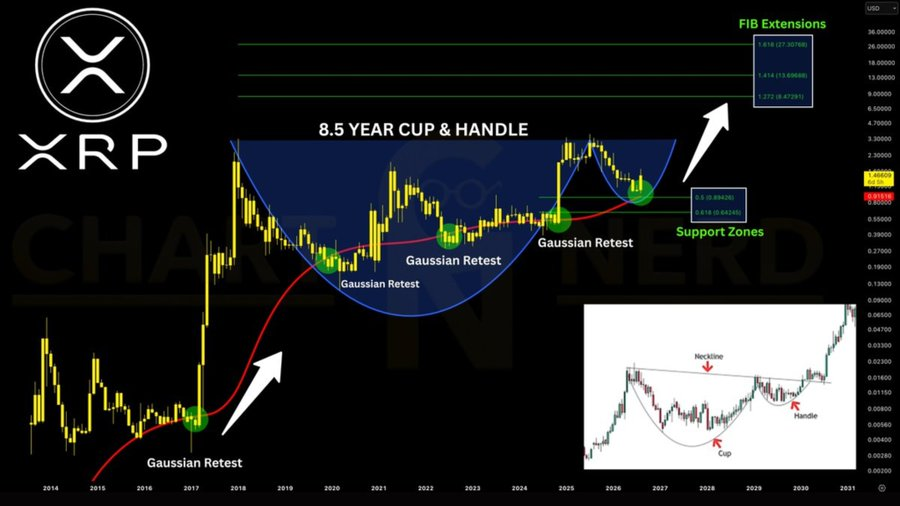
- •Analyst ChartNerd's 8.5-year cup-and-handle chart projects Fibonacci extension targets near $8.47, $13.70, and $27.31, while identifying $0.894 and $0.642 as potential support zones during the handle phase.
- •The U.S. Senate failed to advance the CLARITY Act on Sept. 15 with a 49-50 cloture vote, and SEC staff issued new crypto asset FAQs on Sept. 25 that do not directly classify XRP.
- •XRP faces immediate resistance at $1.60 and nearest support at $1.50, with a break above opening $1.65-$1.70 and a close below support exposing $1.45.
XRP traded near $1.52 after retreating from a recent move above $1.60, a pullback that arrived just as demand for regulated XRP products in the United States continued to build. U.S. spot XRP exchange-traded funds recorded $22.65 million in net inflows on Sept. 25, according to SoSoValue data cited in a report by The Market Periodical.
Long-Term Cup-and-Handle Chart Maps $8.47 to $27.31
Renewed attention has also fallen on a long-term chart shared by analyst ChartNerd on X (@ChartNerdTA), which tracks an 8.5-year cup-and-handle structure that begins near XRP's 2018 cycle peak. The cup-and-handle is a pattern chartists use to describe a rounded, multi-period base followed by a smaller pullback, with the handle conventionally read as the final consolidation before any attempted continuation. The formation treats the rounded multi-year recovery as the cup and the decline after the 2025 peak as the developing handle, placing the focus on whether XRP can complete the handle before attempting a larger breakout.
The projection maps the 1.272 Fibonacci extension near $8.47, the 1.414 extension near $13.70, and the 1.618 extension near $27.31 if the broader formation eventually confirms. Fibonacci extensions are horizontal levels derived from ratios of a prior price swing and are commonly used to set measured-move objectives, while retracement zones mark percentage pullbacks from that same swing. The chart accordingly identifies lower Fibonacci retracement zones at $0.894 and $0.642 as potential support during the handle phase.
The same long-term chart tracks XRP's interaction with a Gaussian Channel across earlier market cycles. A Gaussian Channel is a band indicator that frames price around a statistical mean, and channel retests are often used to gauge trend conditions. ChartNerd uses those historical retests to frame the current handle and the possibility of another support test before any breakout attempt. The analyst additionally rejects the $750 to $1,000 targets that have been attached to the same cup-and-handle analysis, arguing that those figures do not match the Fibonacci structure shown on his chart. His projection instead remains tied to the measured extension framework defined by the displayed Fibonacci levels.
Spot XRP ETFs Log $22.65 Million in a Single Session
Bitwise led the Sept. 25 total in SoSoValue's daily breakdown with $18.39 million in net inflows, while Franklin Templeton's XRPZ added $4.26 million. The other three listed products recorded no net flow for the session, leaving the day demand concentrated in two funds. Net inflow figures tally daily creations against redemptions, which is why they are widely read as a gauge of fresh capital moving into or out of the funds.
The latest additions lifted cumulative net inflows across the five funds to $1.79 billion. Combined net assets reached $1.77 billion, and daily trading value totaled $57.75 million, with Bitwise accounting for $37.07 million of that activity. The figures point to continued capital movement into regulated XRP investment products as the token tests a key technical area. Spot XRP funds in the United States have become a closely watched channel for institutional exposure to the token.
SEC Guidance Follows Failed CLARITY Act Vote
The inflows arrived amid a shifting U.S. regulatory backdrop. The Senate failed to advance the CLARITY Act on Sept. 15 after a cloture vote fell short of the 60 votes required, recording 49 votes in favor and 50 against the motion to proceed. The bill sought to establish a federal framework for digital commodity markets and to divide regulatory responsibilities between the SEC and the Commodity Futures Trading Commission (CFTC), a division that bears on which agency oversees a given digital asset.
On Sept. 25, staff of the SEC's Division of Corporation Finance issued new frequently asked questions on crypto assets. The guidance covers functional networks, staking receipt tokens, buybacks, network maintenance, and related promotional statements. SEC staff said the answers do not create new legal obligations and do not carry the force of Commission rules. The document does not directly classify XRP.
Near-Term Price Levels
XRP traded near $1.55 on Saturday after reaching $1.60 earlier in the week. The four-hour structure places immediate resistance at $1.60, an area the price tested in recent sessions, while the $1.50 zone has acted as the nearest support during the latest pullback. A break above resistance would put $1.65 and $1.70 in view, while a close below support would expose $1.45.
Together, the fund flows and the regulatory developments frame the backdrop against which the long-term technical formation is being watched, with the handle's resolution, the $0.894 and $0.642 retracement zones, and the next daily flow prints from SoSoValue standing out as the checkpoints on the chart.

