XRP Traders Cut Binance Leverage by 26% in Under a Month as Remaining Positions Lean Long
Key Takeaways
- •CryptoQuant data shows Binance's estimated leverage ratio for XRP dropped 26.2% in less than a month, from about 0.229 in September to 0.169 this week, as traders closed borrowed bets after October's liquidation wave.
- •Binance XRP open interest fell from $538.1 million on October 4 to $453 million by October 17, with the steepest decline on October 7-8 when the price slid from $1.52 to as low as $1.32 and long positions were forced shut.
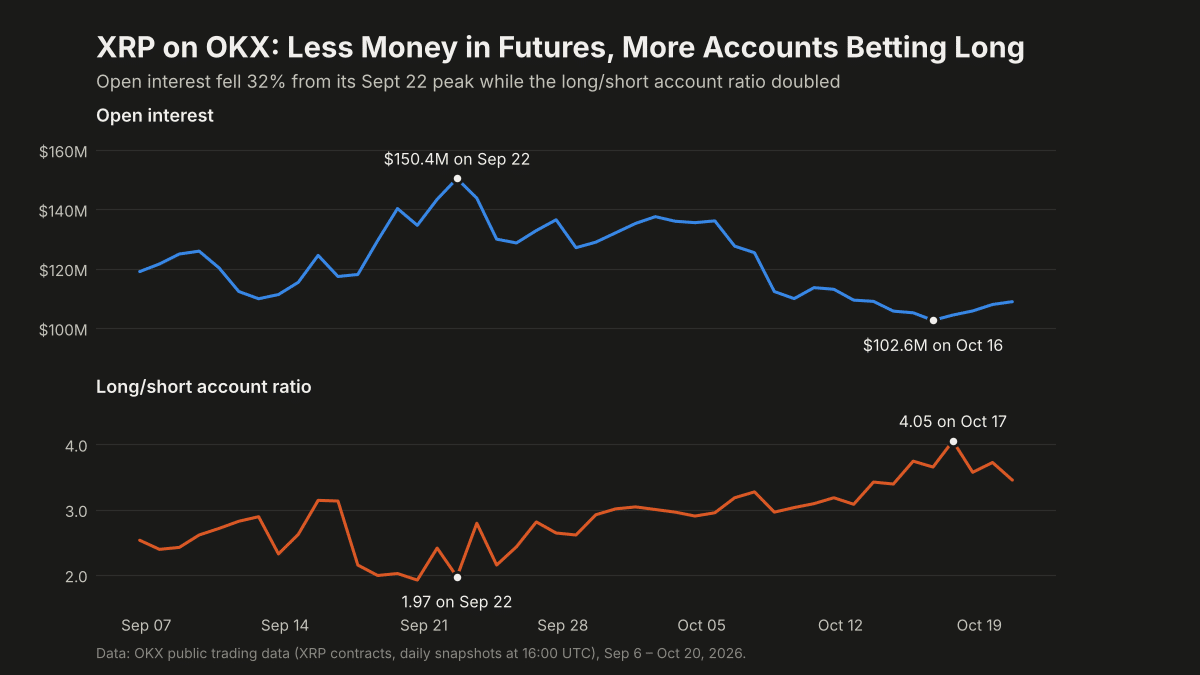
- •OKX futures open interest dropped 32% between September 22 and October 16, yet the long-to-short account ratio doubled from 197 to a high of 4.05 on October 17, indicating smaller accounts built heavily one-sided long positioning.
- •XRP traded at $1.35, up 4.5% over the past 24 hours on $1.68 billion in volume, while funding rates returned to a neutral 0.01% per eight hours after briefly turning negative in mid-October.
- •Ripple filed a comment letter backing the SEC's proposed Regulation Crypto Assets, arguing the investment contract rather than the token is the security, and noting XRP lost roughly $15 billion in value after the SEC's December 2020 lawsuit.
The estimated leverage ratio for XRP on Binance has fallen 26.2% in less than a month, sliding from roughly 0.229 in September to 0.169 this week, according to data from on-chain analytics provider CryptoQuant. The decline reflects traders closing borrowed bets in the wake of October's liquidation wave — and what is left behind is a smaller crowd with a distinctly one-sided tilt.
The token tied to Ripple traded at $1.35, up 4.5% over the past 24 hours, on $1.68 billion in volume. Ripple, meanwhile, used the same day to tell the U.S. Securities and Exchange Commission (SEC) to finish the rules it says would have spared the company a years-long court fight.
The combined picture raises the question at the heart of both datasets: is the XRP market genuinely healthier now, or just quieter?
Binance XRP Estimated Leverage Ratio Drops 26.2% in Less Than a Month
Binance XRP Estimated Leverage Ratio Drops 26.2% in Less Than a Month
"The decline may reflect a reduction in leveraged positioning, potentially mitigating the risks associated with liquidations." – By @ArabxChain pic.twitter.com/eXfPyxe3Ts
The XRP leverage ratio CryptoQuant tracks divides open interest — the value of all open futures positions — by the amount of XRP Binance holds in reserve. A falling ratio therefore means traders are using less borrowed money against the coins sitting on the exchange, while a rising one signals that leveraged activity is building.
"The decline may reflect a reduction in leveraged positioning, potentially mitigating the risks associated with liquidations," CryptoQuant analyst Arab Chain wrote in the quicktake.
The money left with the leverage. CryptoQuant's data puts Binance's XRP open interest at $453 million on October 17, down from $538.1 million on October 4. The sharpest leg of the decline came on October 7 and 8, when XRP slid from $1.52 to as low as $1.32 on Binance and long positions were forced shut.
For context, Arab Chain flagged the ratio at 0.213 on August 26, its highest level in more than seven months, just days after XRP topped out at $1.70. Leverage kept building into late September, when the ratio reached about 0.23, and XRP has drifted lower ever since. The build-up peaked near the local price top; the unwinding followed the liquidation wave that forced overextended longs out of their positions.
Are XRP Traders Done Betting on a Bounce?
No — and that is the catch. The OKX data tells the same story on size and the opposite one on mood. OKX's public trading data shows XRP futures open interest fell 32% over the period, from $150.4 million on September 22 to $102.6 million on October 16. Over the same weeks, however, the number of accounts holding longs for every account holding shorts doubled, from 1.97 to a high of 4.05 on October 17.
Here is how the OKX readings stack up:
- Open interest: $150.4 million on September 22, $102.6 million on October 16, and $108.9 million on October 20.
- Long-to-short account ratio: 1.97 on September 22, 4.05 on October 17, and 3.45 on October 20.
- Funding rate: briefly negative on October 9, 15 and 18, and back to a neutral 0.01% per eight hours at the time of writing.
In other words, the big leveraged money appears to have left the market, while a growing crowd of smaller accounts bought the dip with leverage of their own. A ratio near 3.5 to 1 means the crowd is still pointing one way, and crowded longs are exactly what a sharp drop goes after.
Funding tells you who pays. When the funding rate dipped below zero in mid-October, shorts were paying longs to stay open — a sign that sellers were briefly in charge. Today's 0.01% is the default rate, meaning nobody is overpaying for a side yet.
That leaves the next market readings to watch in the same set of measures: whether open interest begins rebuilding, whether the long-to-short account ratio remains elevated, and whether funding stays near neutral or moves decisively to one side. Together, those figures would show whether positioning is returning after the liquidation wave, without by themselves establishing which direction XRP will take.
Ripple's Message to the SEC: The Token Isn't the Security
What is Ripple's message to the SEC? Essentially, to finish the job. Comment letters are a standard part of the agency's rulemaking process, and in its newest filing, Ripple sent one on Tuesday backing the SEC's proposed Regulation Crypto Assets. Chief legal officer Stuart Alderoty summed up the position on X.
1/ Today Ripple filed its comment letter on the SEC's proposed Regulation Crypto Assets. We support the proposal, and the SEC has clear authority to adopt it. 2/ Years of "case by case, coin by coin" enforcement has pushed innovation offshore. We need holistic rules for digital…
"The investment contract is the security, not the token," he wrote. Under the proposed rule, a token would be treated as tied to a security only while the issuer's promises to buyers last, and Ripple wants that question judged on what the issuer actually said — with no loose "decentralization" test.
XRP holders know what the alternative costs. Ripple's comment letter states that XRP lost about 70% of its value within days of the SEC's December 2020 lawsuit — roughly $15 billion — as U.S. exchanges delisted the token. When a judge ruled in July 2023 that XRP itself was not a security, its market cap jumped by about $21 billion, and Coinbase and Kraken relisted it the same day. Getting there cost Ripple more than $150 million in legal fees.
The SEC placed the proposal in the Federal Register on August 21. Final rules would give exchanges a written test to list against, instead of waiting for a lawsuit to settle the question.

