XLM Trades Near $0.19 as U.S. Bank Confirms First Live USBDC Stablecoin Pilot on Stellar
Key Takeaways
- •U.S. Bank’s USBDC transaction tested the full operational lifecycle of a bank-controlled stablecoin on Stellar.
- •The USBDC initiative remains an internal pilot, with broader customer availability not announced.
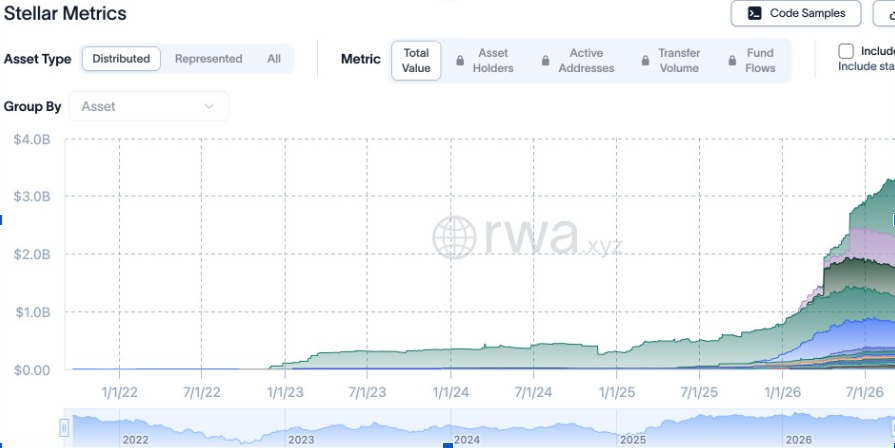
- •Stellar reported approximately $3.32 billion in distributed assets, $387.92 million in stablecoin capitalization and about 706,000 stablecoin holders.
- •USDT0 expanded Stellar’s access to pooled USDT-backed liquidity across chains.
- •XLM needs sustained gains above $0.19 and $0.20 to strengthen its recovery, while support is located around $0.178-$0.180.
Stellar's XLM token traded near $0.180 on September 10 after retreating from the $0.19 area, a pullback that came despite a fresh institutional milestone for the network. U.S. Bank confirmed the first live cross-border pilot of its proprietary USBDC stablecoin on Stellar on September 9, and Stellar added USDT0 earlier this month, expanding access to USDT-linked liquidity. Read together, the two developments capture a network where bank-led stablecoin testing and established tokenized-asset issuance are advancing in parallel.
U.S. Bank Tests USBDC on Stellar
U.S. Bank confirmed the live USBDC transaction on September 9 through an official company announcement. USBDC is the bank's proprietary dollar-backed stablecoin and remains part of a pilot program rather than a generally available product.
During the transaction, the bank tested minting, redemption, freezing, and clawback functions — the full operational lifecycle of an issuer-controlled token, spanning creation, withdrawal, and issuer oversight. U.S. Bank also exercised its internally developed Digital Asset Platform alongside Stellar.
Gunjan Kedia, U.S. Bank chairman and CEO, said the pilot demonstrated faster global cash management capabilities. The bank is also examining liquidity management, collateral mobility, and cross-border treasury operations — the same cross-border function the live transaction was designed to test.
For now, USBDC differs from retail stablecoins because the bank has not announced general customer availability. The pilot involved U.S. Bank entities rather than external customers, leaving the jump from internal testing to broader rollout as the milestone that would define the program's next phase.
Stellar On-Chain Data Shows Growing Institutional Asset Activity
Stellar already hosts a substantial tokenized asset market ahead of any expansion of USBDC beyond testing. According to RWA.xyz, distributed asset value on the network stood at around $3.32 billion as of September 8.
Stellar also counts approximately $387.92 million in stablecoin market capitalization and about 706,000 stablecoin holders. Spiko leads the network's distributed asset rankings with roughly $1.6 billion, while Ondo accounts for about $535.5 million and Franklin Templeton's Benji assets stand near $527.5 million. The figures show that tokenized financial assets already represent a material share of activity on Stellar — and that tokenized funds currently outweigh the network's stablecoin capitalization by a wide margin, the segment a bank-issued token like USBDC would add to if it moves beyond pilot testing.
USDT0 has added another source of dollar liquidity to the network. Stellar said USDT0 maintains unified liquidity backed by USDT rather than separate wrapped token pools, as noted in an announcement on X — a structure that keeps USDT-linked liquidity pooled across chains instead of fragmenting it into chain-specific wrapped versions.
XLM Technical Outlook: Can Stellar Break Above $0.20?
According to the 1-day chart, XLM is changing hands around $0.1884 after recovering from its August lows and holding near the $0.19 resistance level. The price has bounced back from the $0.155 support and is moving toward $0.20, though buyers have struggled to keep XLM above the $0.19–$0.20 resistance zone.
The 14-day Relative Strength Index stands at 52.43, slightly above the neutral 50 level. Readings above 50 indicate that buying pressure has the upper hand, although the narrow margin suggests momentum remains limited. The MACD is also generating a mild bullish signal, with the blue line near $0.00304 and above the signal line at $0.00268, suggesting buyers may hold somewhat more momentum. The histogram remains positive, indicating bullish momentum has not disappeared as buying pressure builds. Even so, the tight gap between the two lines points to modest momentum overall.
XLM therefore needs a sustained move above $0.19 and $0.20 before the current recovery can strengthen. A daily close above $0.20 could open a move toward $0.21 and $0.22. On the downside, immediate support sits between $0.178 and $0.180. Losing that range could expose $0.170, while stronger selling could bring the $0.155–$0.160 area back into focus.
Away from the charts, the items worth tracking are whether U.S. Bank widens USBDC's pilot scope and whether Stellar's stablecoin base — about $387.92 million today — grows alongside USDT0 and the network's existing institutional issuers.
This article is for informational purposes only and should not be considered financial or investment advice. Cryptocurrency markets remain highly volatile, and readers should conduct independent research before making investment decisions.
This article was originally published on The Market Periodical.
