XLM Price Gains as Stellar's Protocol 28 Upgrade Draws Market Focus
Key Takeaways
- •XLM traded at $0.1985 on September 19, gaining 3.79% in 24 hours as it approached the $0.20 level two days after the Stellar network activated Protocol 28.
- •The Protocol 28 upgrade, switched on September 17, delivers consensus changes and contract-migration tools for the Soroban smart-contract platform, with the network sustaining 211 transactions per second across a 100-block test period.
- •Stellar hosts approximately $3.3 billion in tokenized real-world assets, nearly $884 million in stablecoins, and about $294 million in DeFi value, with Franklin Templeton and Ondo among institutions that have used the network.
- •XLM trades above its middle Bollinger Band near $0.19277, with the upper band at roughly $0.21832, and the $0.197 level flagged as a key area where a firm hold could keep buyers focused on $0.20.
- •Derivatives data shows long-to-short ratios near 1.15 alongside positive funding rates, signaling growing long exposure that may amplify sharp price moves following network or broader market developments.
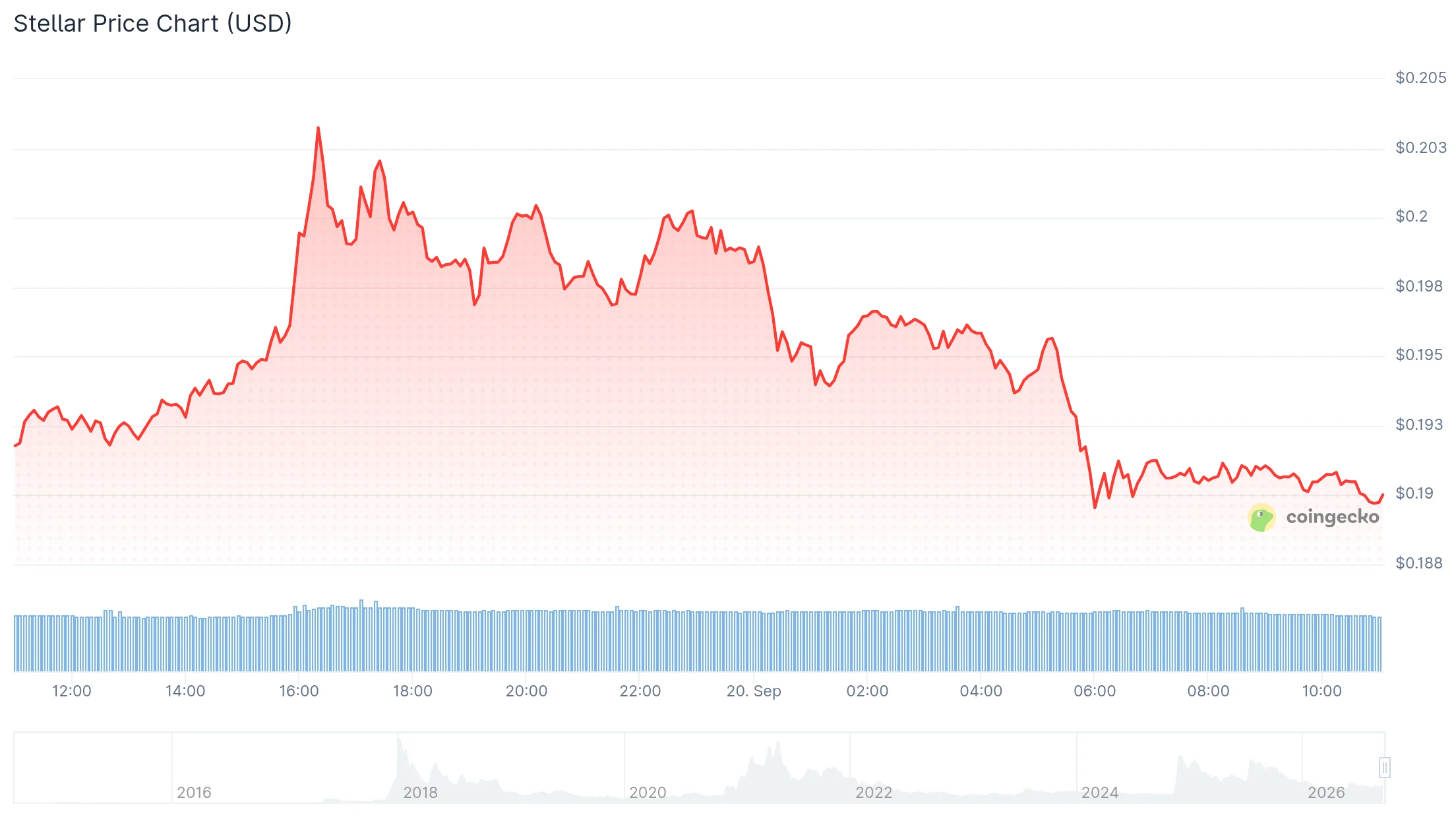
XLM, the native token of the Stellar network, moved back toward the $0.20 mark on September 19, changing hands at $0.1985 with a 3.79% gain over 24 hours, after the Stellar network activated its Protocol 28 upgrade two days earlier. Trading volume reached about $568.96 million over the period, while market capitalization stood near $6.99 billion. The advance followed a rebound from lower September levels and kept the $0.20 threshold in focus, with traders also tracking a possible pullback toward $0.197, where a firm hold could clarify whether short-term buyers retain control.
The move outpaced the broader market. Total crypto capitalization rose 1.6% over the period, while altcoin capitalization increased 1.2%, leaving XLM ahead of both measures.
Protocol 28 Adds Consensus Tooling and Contract-Migration Capabilities
Stellar switched on Protocol 28 on September 17, introducing consensus changes and contract-migration tools. The network recorded 211 transactions per second across a 100-block test period, and XLM gained roughly 4% around the activation, trading near $0.186. The timing aligns with the upgrade, though several factors can influence price action.
The upgrade supports Soroban, Stellar's smart-contract platform, as projects prepare their contracts for newer network functions, giving developers a clearer route for migrating existing contracts. Stellar processes payment and asset-issuance activity alongside token trading, and later phases of the roadmap could target throughput above 3,000 transactions per second.
$XLM just activated Protocol 28. The upgrade adds new consensus tooling and improvements for Soroban smart contracts. Stellar also recorded sustained throughput around 211 TPS over 100 blocks. #XLM #Stellar #Web3
— Akshay (@iiam_Akshay) September 19, 2026
Tokenized-Asset Footprint Frames the Upgrade
Stellar reports about $3.3 billion in tokenized real-world assets on the network, along with nearly $884 million in stablecoins and roughly $294 million in decentralized-finance value. Those measures place the upgrade within a broader stretch of infrastructure activity. Franklin Templeton and Ondo have both used Stellar for tokenized-asset initiatives, feeding the network's real-world-asset narrative.
Policy Backdrop
XLM and XRP previously moved more than 8% during earlier positioning around US crypto market-structure legislation, an advance that showed the token's sensitivity to policy developments. Even so, legislation does not set the token's immediate technical direction.
The International Monetary Fund has published 2026 research on tokenized finance, stablecoins, and tokenized money. The work identifies faster settlement and lower reconciliation costs as possible benefits, while flagging liquidity, interoperability, and financial-stability risks. It does not endorse individual networks or tokens.
Bollinger Bands Define Key Support and Resistance Levels
Bollinger Bands plot a central moving-average line between upper and lower bands that expand and with volatility, mapping where price sits relative to its recent range. Before the recent rebound, XLM traded in the mid-$0.15 range. Its return toward the 200-day moving average put the $0.188 to $0.190 zone under scrutiny, and a hold above that range keeps attention on the $0.20 mark.
The token currently trades above the middle Bollinger Band near $0.19277, placing the recent range midpoint in focus as potential support. The upper band stands near $0.21832, while the lower band sits around $0.16922. A move toward the upper band would extend the recovery from earlier September weakness, and a sustained push through $0.20 would bring the $0.21 to $0.22 zone into view.
Momentum indicators point to a firmer short-term structure. The MACD line stood at 0.00313, above its 0.00185 signal line, and the positive 0.00128 histogram shows buying pressure improved from weaker prior sessions. Momentum can change quickly, however, if price returns below the middle band.
The $0.197 level features prominently in the immediate setup. Market commentator Udy Highs identified it as a possible long-entry area after a retracement, and a retest that firmly holds could keep buyers focused on $0.20 and the upper band. Losing the midpoint near $0.19277 would present a separate test, potentially shifting attention toward support between $0.176 and $0.182.
Derivatives Positioning Adds Another Layer
Long-to-short ratios near 1.15 and positive funding rates — the periodic payments traders holding long positions make to those holding shorts — point to growing long exposure, positioning that can amplify sharp moves after network news or broad market shifts.
Source: Blockonomi

