Xi Invokes 'Thucydides Trap' at White House as Trump Faces Criticism Over Deference to China
Key Takeaways
- •Xi Jinping invoked the 'Thucydides trap' during a White House meeting with President Donald Trump while discussing the conditions needed for the United States and China to avoid war.
- •The term, drawn from the Greek historian Thucydides, describes tensions that emerge when an emerging power challenges the dominance of an established power, and Xi first raised it during a summit with Trump in Beijing in May.
- •Analysts Phillips P O'Brien and former Ambassador Michael McFaul said Xi's reference signaled a view of China as the rising power and the United States as the declining one, and faulted Trump for letting the remark pass.
- •Trump broke with tradition by traveling to Joint Base Andrews on Wednesday to greet Xi upon his arrival, which The Atlantic characterized as a remarkable act of deference that only a handful of presidents have matched, including Eisenhower's reception of Nikita Khrushchev and Obama's welcome of Pope Francis in 2015.
- •Trump plans to extend the pageantry with a state dinner for Xi, following a welcome ceremony that featured both nations' anthems, a cannon salute, and a flyover by two U.S. Air Force B-1 bombers.
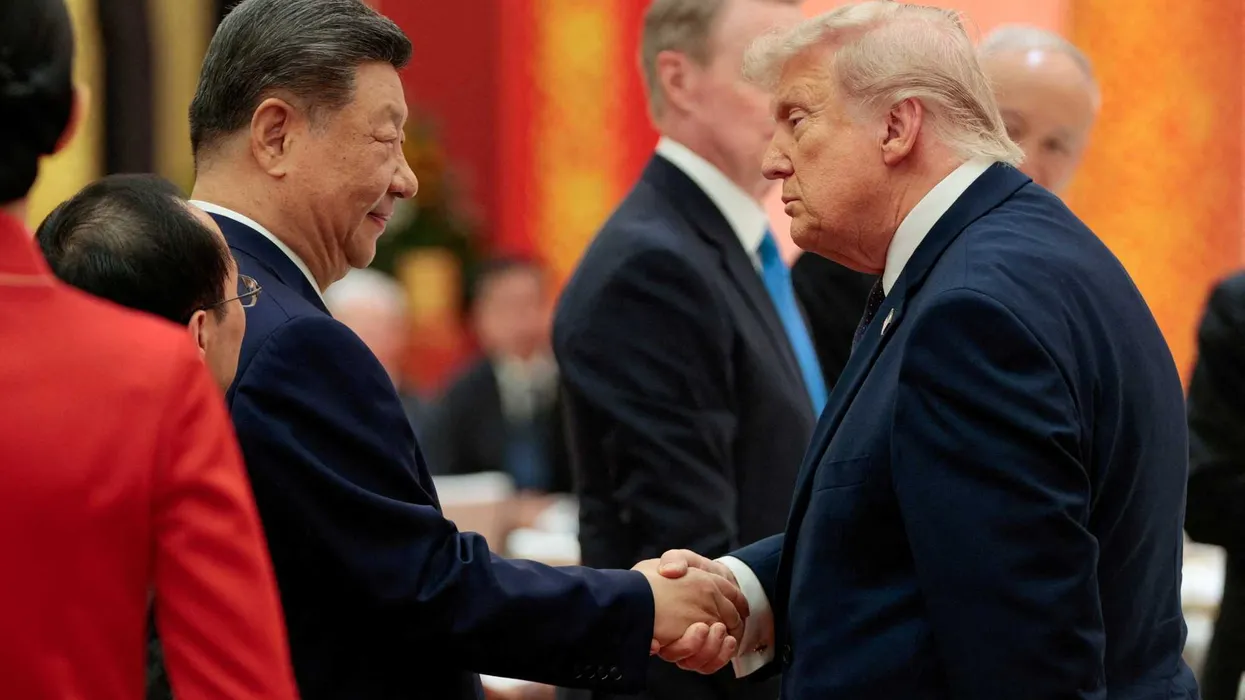
Chinese leader Xi Jinping on Thursday used an ancient literary reference to deliver a pointed message about the United States during a White House meeting with President Donald Trump, at which the American president was accused of diminishing his office through displays of deference toward the U.S. adversary.
The reference came as Xi, in a statement on the conditions necessary for the United States and China to avoid war, invoked "the Thucydides trap." According to the Guardian, the phrase "refers to the phenomenon, defined by the Greek historian, of tensions that arise when an emerging power challenges the dominance of an established power." The concept originates in Thucydides's history of the Peloponnesian War, which he traced to Sparta's fear of a rising Athens. Xi first raised the term during his summit with Trump in Beijing in May, asking the U.S. president how he planned to avoid it.
"President Xi just insulted Trump and the USA, right to Trump's face -- in the White House," posted Phillips P. O'Brien, distinguished professor of strategic studies, in a post on X. "Xi referred, yet again, to the 'Thucydides trap.' This is a reference to the US being in decline and China replacing it. And Trump sits there making moo eyes like a lovestruck teenager."
Former U.S. ambassador to Russia Michael McFaul seconded that assessment, posting on X: "When Xi invokes the Thucydides Trap, as he did again today, he means he sees China as the rising power and the U.S. as the declining power. Kinda weird for an American president to just let that go, especially in remarks delivered in the White House. But these are not normal times."
The criticism of Trump's conduct at the summit extended beyond the meeting itself. On Wednesday, he took the unusual step of traveling to Joint Base Andrews outside Washington, D.C., to meet Xi upon his arrival.
"It was a remarkable act of deference," The Atlantic asserted. "By tradition, American presidents don't make the 12-mile trip to the base to greet a foreign leader. They instead wait at the White House, backed by the grandeur and power of the executive mansion. But not this time." The magazine added that "Xi did not display the same level of hospitality when Trump visited Beijing."
According to The Atlantic, Trump will continue to "extend the pageantry" by throwing "a glitzy state dinner for the Chinese president." The publication observed that the trip to Andrews "underscored the lengths to which he is willing to go to flatter Xi." Only a handful of American presidents have greeted a visiting leader at the base — among them a pair of pontiffs, the most recent being President Obama's welcome for Pope Francis in 2015, and Soviet leader Nikita Khrushchev, who was received by President Dwight Eisenhower at the height of the Cold War.
At Wednesday's ceremony, the national anthems of both the United States and China were played and a cannon sounded. Xi glanced overhead as a pair of B-1 bombers — the U.S. Air Force's long-range strategic bombers — flew past; Trump winced at the noise.

