Wyoming Moves FRNT Stablecoin to Chainlink Infrastructure After Security Review
Key Takeaways
- •Wyoming's FRNT stablecoin will run on Chainlink infrastructure after a security review prompted the state to select the oracle network as its service layer.
- •The Wyoming Stable Token Act, passed in 2023, created the first U.S. state legal framework for a government-issued stablecoin.
- •Chainlink, an oracle network founded in 2017, provides price feeds, Proof of Reserve attestation, and cross-chain messaging, and has conducted pilots with institutions including SWIFT and DTCC.
- •The GENIUS Act, enacted in July 2025, established a U.S. federal payment stablecoin framework with reserve, disclosure, and oversight requirements for issuers.
- •Wyoming has not disclosed which Chainlink services FRNT will actually use, what the security review covered, or how the arrangement will be governed over time.
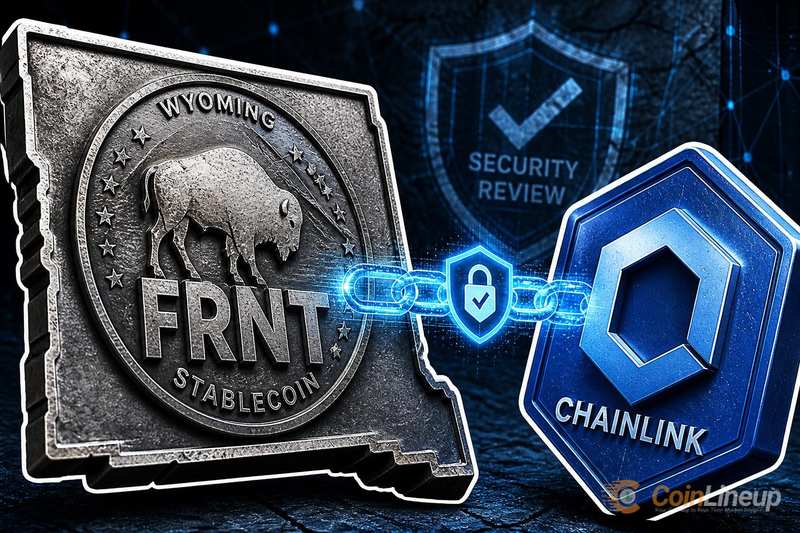
Wyoming has moved its state-issued FRNT stablecoin onto Chainlink infrastructure following a security review, a decision that positions the Chainlink network as the service layer for the state's stablecoin initiative.
What changed
The change centers on FRNT, the stablecoin project operated through Wyoming's state stablecoin program, which describes its mandate and governance on its official state token page.
Rather than a proposal or a pilot, the shift is framed as a completed operational decision. Chainlink has been adopted as the infrastructure — the service layer — supporting FRNT going forward.
The arrangement pairs a government-backed stablecoin with a third-party blockchain infrastructure provider, a combination that is still uncommon among public-sector digital asset efforts. It also fits into a broader pattern of activity: Wyoming has been active on digital asset policy across other areas, including its approach to data center and mining power rules. That groundwork predates the stablecoin itself — the state created a charter for special purpose depository institutions serving digital asset businesses, recognized DAOs as limited liability companies, and in 2023 enacted the Wyoming Stable Token Act, the first U.S. state legal framework for a government-issued stablecoin.
Why the security review led to Chainlink
The move is tied directly to a security review, which is presented as the trigger for selecting Chainlink rather than a routine upgrade. A security-driven infrastructure change of this kind implies a priority on risk reduction and stronger operational assurances for the state token.
For any stablecoin, resilience and trust in the underlying rails are central concerns, as past stablecoin depeg episodes and their warning signs have illustrated. The collapse of TerraUSD in May 2022 remains the most prominent example, an event that erased tens of billions of dollars in value and sharpened industry focus on reserve transparency and the reliability of oracle-fed systems.
Chainlink itself is not a newcomer in that environment. The oracle network, founded in 2017, supplies price feeds, reserve attestation tooling such as Proof of Reserve, and cross-chain messaging widely used across decentralized finance, and it has taken part in pilots with established financial institutions including SWIFT and the Depository Trust & Clearing Corporation (DTCC). Selecting a provider with that operational history is consistent with a security-driven procurement choice.
Beyond the stated link to the review, the specific technical findings behind the decision are not detailed in the available material. As a result, the rationale is best read as a trust-and-safeguards choice rather than a documented set of fixes.
Signaling for stablecoins and public blockchain projects
A state-linked stablecoin selecting an established provider such as Chainlink carries signaling value, suggesting that institutional and government-adjacent issuers are weighing security-focused tooling when they build.
The episode also points to security reviews becoming a more visible step in infrastructure selection, a consideration that matters for organizations evaluating which stablecoin to use for payments. The regulatory backdrop has shifted as well: the United States enacted a federal payment stablecoin framework in July 2025 under the GENIUS Act, establishing reserve, disclosure, and oversight requirements for issuers within a federal-state system. For state token programs, pairing with audited and widely used infrastructure is a natural fit in that environment.
Details available on the FRNT move remain limited. Until Wyoming publishes fuller documentation of the change, readers should treat the specifics as partially verified. Among the open questions are which Chainlink services FRNT will actually use — price feeds, proof-of-reserve attestation, or cross-chain messaging — what the security review covered, and how the arrangement is governed over time.
Disclaimer: This article is for informational purposes only and does not constitute financial or investment advice. Cryptocurrency and digital asset markets carry significant risk. Always do your own research before making decisions.
Source: CoinLineup

