Wove speeds tariff-change updates for forwarders and TMS users for free
Key Takeaways
- •Wove repurposed its logistics automation technology to build a free U.S. tariff calculator after access to a competing free tool was reduced.
- •The company says the calculator attracted thousands of weekly users soon after launch and now also helps compare past duty rates for refund calculations.
- •Wove’s AI agents automatically update client systems when tariff changes appear in the Federal Register, including recent Section 338 Canada and Section 301 changes.
- •Edlin said the company turned around nearly 400 pages of Section 301 changes in about an hour.
- •Wove supports imports into Mexico, Canada, Australia, the United Kingdom and the European Union, and its users include forwarders, importers, researchers and ERP teams.
It’s January 2025. The raucous New Year’s celebration has barely subsided when a forwarder’s crystal ball predicts more than 2.5 million rule changes across more than 40 Harmonized Tariff Schedules in the next 18 months. What is the next move?
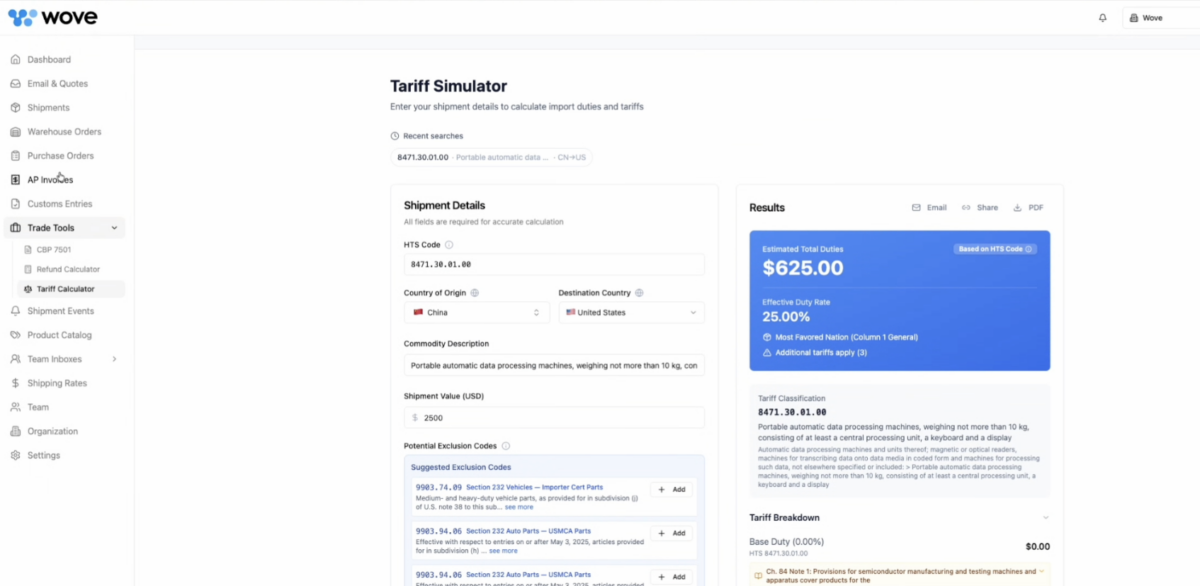
Take a breath. A mostly stealth startup has been helping logistics providers make sense of the rapidly expanding tariff universe — and it is doing so for free.
Wove provides workflow automation, document ingestion and structured data services for freight forwarders and customs brokers, automating manual but critical tasks such as creating shipments in CargoWise, creating customs entries, automating emails, generating quotes and more.
“But we realized about seven months ago, around the end of last year, that we could repurpose a lot of what we had built to understand the unstructured documents in shipping and logistics and apply that to the U.S. Harmonized Tariff Schedule (HTS),” said Jay Edlin, co-founder and chief executive of Wove, based in Atlanta. He described a use case that addressed a major problem while taking advantage of a significant market change.
“HTS is published mostly in PDFs,” he said, “so it’s unstructured and hard to really understand. And, this also coincided with [forwarder] FlexPort removing access to their free tariff calculator for a lot of people. This was around the holiday time, and we didn’t have that much going on. So we just decided to kinda build this.”
Within a couple of days of launch, Wove, founded in 2022, was hosting what Edlin said is now the industry’s leading free tariff calculator, attracting thousands of users each week.
“Ultimately, that became more of a tariff time machine because as these changes kept coming out, you could really use the tariff calculator and tariff simulator to go back in time and compare what the duties were on entry dates from last year, and that’s really actually helped us go into the IEEPA (International Emergency Economic Powers Act tariffs) refund calculations,” Edlin said. “So, we’ve been working with companies to help them calculate their tariff refunds.”
The U.S. IEEPA law allows the president to regulate or block certain economic transactions during a declared national emergency involving an unusual and extraordinary foreign threat. President Donald Trump used it to deploy tariffs as leverage in negotiations over new trade agreements. The Supreme Court struck down the IEEPA tariffs, ruling that the act does not authorize the president to impose levies. That left Customs and Border Protection on the hook for tens of billions of dollars in refunds, while traders faced highly complex paperwork.
At the same time, the administration shifted to new tariff regimens, some implemented overnight, seemingly based on little more than Trump’s whims. “Obviously,” Edlin said, “the pace of change is not slowing down.” For importers, forwarders and brokers, that means tariff data is not a static reference table but a moving compliance input that must be kept current across operational systems.
Recent changes included Section 338 Canada tariffs and Section 301 levies on dozens of trading partners based on alleged forced labor manufacturing issues. Wove has automated that process, Edlin said.
“Every time there’s an update in the Federal Register, we get a notification in [messaging app] Slack, and we have [AI] agents that then just go in and basically make all these changes [to a client’s system] automatically,” he said.
An agent is a software system that can reason about a goal and take actions to complete it, and it differs from a copilot or workflow automation tool.
Edlin said Wove’s agents, for example, turned around the Section 301 changes, which amounted to nearly 400 pages, in an hour. That kind of speed matters in a trade environment where tariff notices can affect classification work, customer quotes and entry data before operations teams have time to process them manually.
Wove has also used the tariff tool for lead generation. More recently, the company has fielded requests from importers that want to integrate it into their own systems through an API, or use it as a product catalog where they can load their own SKUs with HTS codes, SKU numbers, part numbers and related data, Edlin said.
Academic researchers have been using Wove’s tariff data, while some importers and manufacturers are plugging the data into their ERP systems.
Wove also supports imports into Mexico, Canada, Australia, the United Kingdom and the European Union. Its customers include forwarders Hellmann Worldwide, Navia Freight, Future Forwarding and CBX Global, as well as importers Babcock Power, Greatneck Tools, Roto and Wabtec (NYSE: WAB).
“Because we’re not a customs broker ourselves, we have no reason to gate anyone from accessing our data,” Edlin said. “Which is a little different from others that may offer similar tools. But, they have different incentives than we do.”
This article was updated July 28 to correct that Wove does not provide import support for Africa.

