World Liberty Financial to Face Justin Sun's Claims in Public Court After California Ruling
Key Takeaways
- •U.S. District Judge James Donato ruled that Justin Sun’s personal claims against World Liberty Financial cannot be resolved through private arbitration.
- •The ruling does not address whether Sun’s allegations are true or whether World Liberty is liable.
- •Sun says he invested about $45 million in WLFI and is questioning token features that he says can freeze, restrict, or burn tokens.
- •World Liberty has denied Sun’s accusations and has filed a counterclaim against him in Florida.
- •The dispute will now proceed in open court, while World Liberty continues expanding USD1 and exploring other business activities.
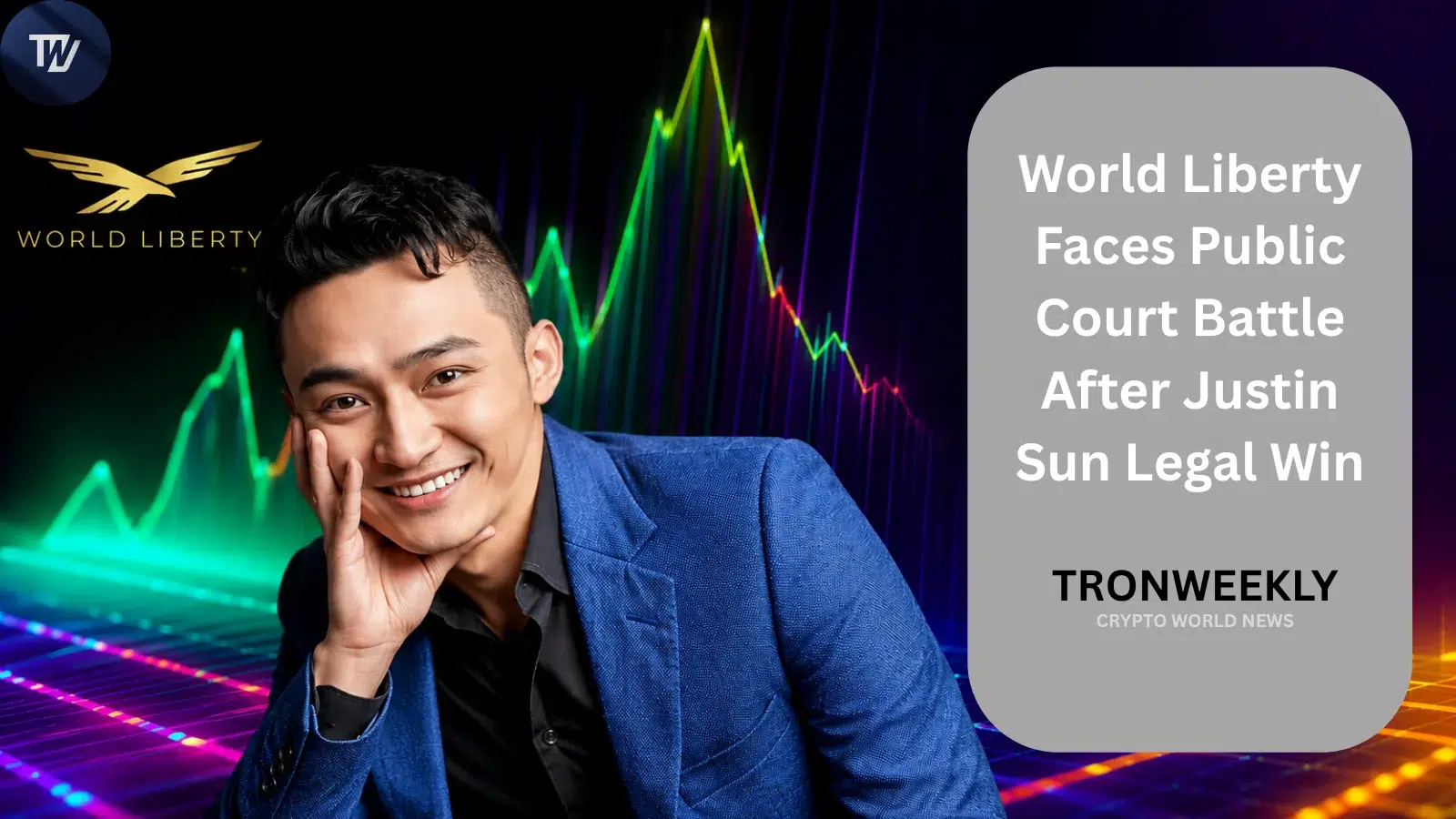
World Liberty Financial, the Trump family-linked cryptocurrency venture launched in 2024 as a decentralized finance platform, has suffered a procedural blow in its litigation battle against cryptocurrency entrepreneur Justin Sun, founder of the Tron blockchain, after a federal judge in California ruled that the company cannot have Sun's personal claims arbitrated privately.
United States District Judge James Donato of the U.S. District Court for the Northern District of California stated that Sun's personal claims are going to be heard publicly. The ruling is procedural in nature: it does not address the validity of the claims made by Sun, nor does it consider the responsibility of World Liberty regarding the matter at hand. The decision means that, rather than being resolved through confidential arbitration and sealed documents, the dispute will now unfold in open court, where filings become part of the public record. Forum fights of this kind are familiar in crypto litigation, where token-sale terms of service routinely embed arbitration clauses and disputes over their enforceability recur.
Claims Over Token Controls
Sun claims that he has spent an estimated $45 million on WLFI, and subsequently began questioning the control features embedded in the smart contract system of World Liberty. According to Sun, these features enable the freezing, restriction, and burning of the tokens.
Today, my counsel appeared in California federal court to oppose World Liberty Financial's @worldlibertyfi efforts to force our dispute into secret arbitration proceedings and seal documents from public view. We argued forcefully that this case belongs in open court—and the…
— H.E. Justin Sun 👨🚀 🌞 (@justinsuntron), August 20, 2026
Sun is also doubtful about similar functions linked to the stablecoin USD1, which belongs to World Liberty and was launched in 2025 as a dollar-pegged token. Sun describes such features as “backdoor functions,” which might provide World Liberty with technical control over the tokens. Freeze-style controls are not unusual in themselves: major regulated stablecoins such as Tether's USDT and Circle's USDC carry issuer blacklisting capabilities, typically cited on compliance and law-enforcement grounds. The existence of these technical features does not in any way prove their improper use by WLFI, a question that remains part of the ongoing discussion within the legal context.
Beyond the smart contract questions, Sun has also raised the issue of whether the company has sufficient capital to settle any legal claims brought against it. In this regard, he has argued that the assets backing the multibillion-dollar market capitalization of USD1 do not necessarily belong to the company. Sun stated that he has yet to see any proof that the company holds enough extra money to offset possible liabilities, and he called upon all users to be cautious.
World Liberty Denies the Accusations
World Liberty has rejected Sun's accusations. Zach Witkoff, co-founder of the company, has termed them completely baseless, pushing back against the allegations. The controversy has extended even further with the filing of a counterclaim by the company against Sun in Florida.
In spite of the ongoing dispute, World Liberty is still growing its business activities. The project's USD1 stablecoin has gained new managers, while the company is seeking to get involved in an AI cooperation with WorldClaw.
The California ruling therefore stands as a procedural victory for Sun, since it does not settle the underlying controversy. Sun's claims will be heard in open court until all the sides have made their points, and the merits of the allegations remain untested, with the company's counterclaim in Florida proceeding on a separate track.
Separate Claims Over Sun's Investment
In a separate development, Hunter Biden, who is an investigator into the crypto sector and the son of former President Joe Biden, alleged in a post on X that WLFI raised $75 million related to Sun's investments. In addition to this, he alleged that World Liberty raised $75 million by leveraging its own tokens.
The Trump family's business, World Liberty Financial, is corruption at a scale we've never seen. World Liberty is currently being sued by Justin Sun, a major crypto founder, for: 1.Seizing his $75 million $WLFI investment. 2.Secretly adding controls allowing it to unilaterally…
— Hunter Biden (@HunterBiden), August 20, 2026
In comparing this situation with other past failures of the crypto sector, such as the collapse of FTX, Hunter Biden used the concept of circular leverage. He has also raised the issue of WLFI being conditionally approved by the Office of the Comptroller of the Currency, the U.S. Treasury Department's regulator of national banks, as a national trust bank. Biden further alluded to reports suggesting that the Abu Dhabi-backed firm holds a 49% share in the company, and that a different fund from the United Arab Emirates has invested $100 million in it.
As of now, the case will remain in the public domain, as claimed by Sun. Both Sun and Biden published their posts on X on August 20, 2026, as the dispute continues to play out in public view.

