Bitcoin Trades Below $65,000 as World Bank Explores USDC Payment Rails With Circle and Citi
Key Takeaways
- •The World Bank Group announced on November 17 that it is exploring Circle's USDC stablecoin together with Citi to route development funds through blockchain-based payment rails.
- •The initiative builds on the World Bank's FundsChain platform, which already spans more than 350 projects across 96 countries, with initial deployments limited to borrower countries where digital assets are permitted.
- •Citi's network reaches clients in more than 180 jurisdictions, and the arrangement is designed to deliver 24/7 real-time payments instead of conventional business-hour correspondent processing.
- •Circle reported average USDC circulation of $73.3 billion in the third quarter of 2026, with on-chain transaction volume of $13.9 trillion, representing 49% annual growth.
- •Bitcoin traded below $65,000 as US spot Bitcoin ETFs saw $239.9 million in net outflows on November 17, with BlackRock's IBIT accounting for $209.5 million of those withdrawals.
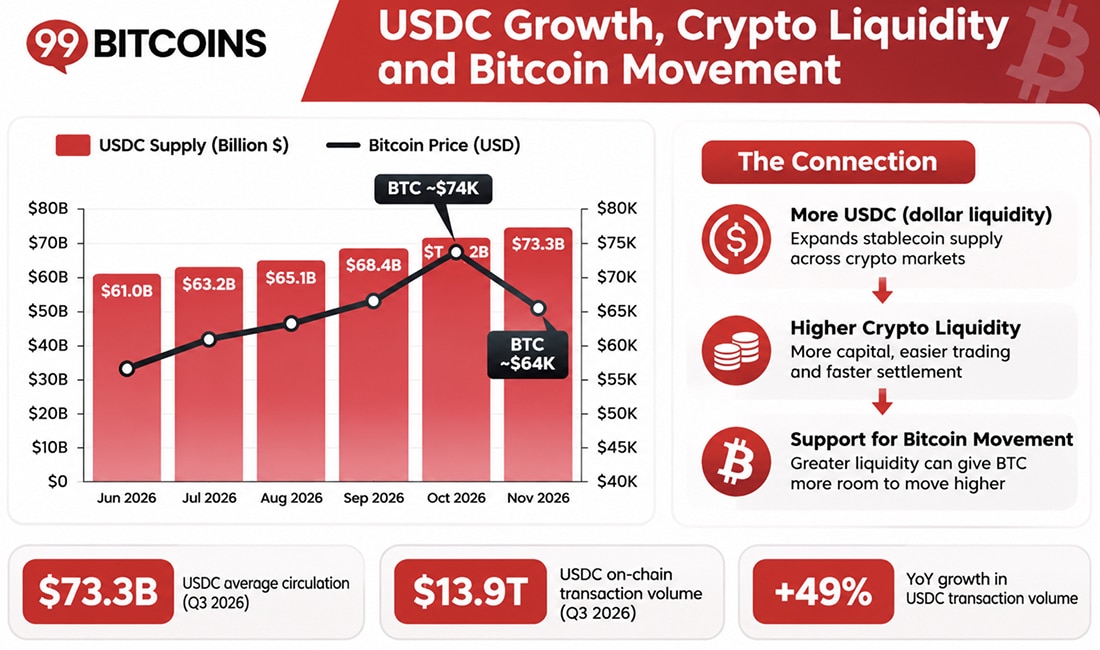
Bitcoin remained under pressure, trading below $65,000, but the most notable institutional development of the session came from the stablecoin sector. The World Bank Group announced on November 17 that it is exploring Circle's USDC stablecoin together with Citi to move development funds through blockchain-based payment infrastructure. For a global development institution of this scale, the exploration amounts to a high-profile test of whether regulated stablecoins can handle official disbursements at institutional scale.
The 82-year-old institution wants to determine whether regulated stablecoins can make international disbursements faster, cheaper, and more transparent. The proposed arrangement combines Circle's USDC settlement infrastructure with Citi's established banking connections, and it builds on FundsChain, the World Bank's existing blockchain platform that already covers more than 350 projects across 96 countries.
The announcement arrives as Bitcoin struggles to recover from a sharp market correction. US spot Bitcoin ETFs recorded another $239.9 million in net outflows on November 17. Institutional adoption of blockchain-based dollar payments, however, continues to expand, raising the question of whether the growing movement of dollars onto blockchain rails could eventually provide an additional source of liquidity for Bitcoin, the largest cryptocurrency by market value.
World Bank Turns to Circle's USDC for Global Payments
The World Bank Group disclosed the exploration in a press release, bringing together two major financial infrastructure providers. Circle will supply the stablecoin infrastructure to mint and settle funds in USDC, while Citi will connect those transactions with established correspondent banking networks.
The objective is to improve how development financing reaches governments, businesses, and local projects. Traditional international payments often involve multiple banking intermediaries, processing windows, and settlement delays — precisely where the bank's speed, cost, and transparency targets are aimed, since each additional intermediary adds a step where funds can sit and costs can accrue. Blockchain-based settlement could reduce some of these obstacles through faster transaction processing.
Citi says its network connects clients across more than 180 jurisdictions, and the bank aims to deliver 24/7 payment capabilities that allow critical funds to move in real time, in contrast to the business-hour processing windows that shape conventional correspondent flows. Circle CEO Jeremy Allaire described development finance as one of the most important applications for internet-native money:
"Circle is building the infrastructure for an internet-native financial system, and development finance is one of its most important applications." — Jeremy Allaire, CEO of Circle
The initiative builds on FundsChain, which already provides transparency across the World Bank's development projects. Its digital ledgers allow participating parties to track how project funds are used, and the platform currently spans more than 350 projects across 96 countries.
The potential scale is considerable. The World Bank Group delivered $123.5 billion in loans, grants, equity investments, and guarantees during fiscal 2026, and the latest exploration could eventually introduce stablecoin settlement into a substantial institutional financial network. The initial phase, however, will involve borrower countries where digital assets are permitted, making those early deployments the first measurable indication of how stablecoin settlement performs with official development funds. The World Bank also plans an intermediated and interoperable payment model that connects blockchain infrastructure with conventional banking systems.
USDC's Growing Footprint in Crypto Dollar Liquidity
USDC, the fully reserved, dollar-backed stablecoin issued by Circle, has become one of the most important dollar-denominated assets circulating across blockchain networks. Circle reported average USDC circulation of $73.3 billion during the third quarter of 2026, with on-chain transaction volume reaching $13.9 trillion, representing 49% annual growth.
Circle's latest earnings presentation also showed USDC accounting for 79% of stablecoin transaction volume, compared with a 27% share of stablecoin supply. The difference highlights how frequently USDC moves across blockchain-based financial applications.
The figures are significant because stablecoins provide much of the dollar liquidity used throughout crypto markets. Traders use USDC to enter positions, move capital between exchanges, and settle transactions, and greater institutional adoption could expand the infrastructure supporting those activities.
Bitcoin remains the largest cryptocurrency and a major destination for digital asset capital. More accessible stablecoin infrastructure could make it easier for institutions and market participants to move dollars into crypto markets, creating a potential second-order effect on Bitcoin liquidity.
The timing is notable given current market conditions. Bitcoin has been hovering below $65,000 as it attempts to stabilize after the correction, and US spot Bitcoin ETFs recorded $239.9 million in withdrawals on November 17, with BlackRock's IBIT accounting for $209.5 million of those outflows.
The contrast between weakening Bitcoin ETF demand and expanding institutional stablecoin infrastructure leaves an open question: could the next phase of cryptocurrency liquidity come from traditional financial institutions moving dollars onto blockchain rails?
Source: 99Bitcoins

