WLFI Token Draws China AI Scrutiny After U.S. Trust Bank Approval
Key Takeaways
- •Reuters reported that AI platform WorldClaw offered 90 artificial-intelligence models, 43 of which came from Chinese companies including Alibaba, Baidu and Z.ai, some of which face U.S. restrictions or military-related designations.
- •WorldClaw accepted World Liberty's USD1 stablecoin for AI services, World Liberty earns revenue when users employ its crypto products, and the Trump family owns 38% of World Liberty.
- •On Aug. 14 the OCC granted World Liberty Trust Company preliminary conditional approval as a national trust bank to issue USD1, subject to preopening requirements, with BitGo Bank & Trust currently serving as USD1's exclusive issuer and custodian.
- •Reuters found the relationship did not violate U.S. law, and individuals and businesses can generally use the Chinese models offered on WorldClaw legally, though seven specialists questioned its consistency with Washington's China policy.
- •The WLFI token traded near $0.0583 with a market capitalization of roughly $1.76 billion across about 31.8 billion circulating tokens, showing no sharp event-driven repricing.
World Liberty Financial faced renewed scrutiny on Aug. 17 after Reuters published details of its relationship with the artificial-intelligence platform WorldClaw. The WLFI token traded near $0.0583 as the report linked the Trump-backed venture to Chinese AI models, and Reuters said several of the developers behind those models face U.S. national-security restrictions or designations.
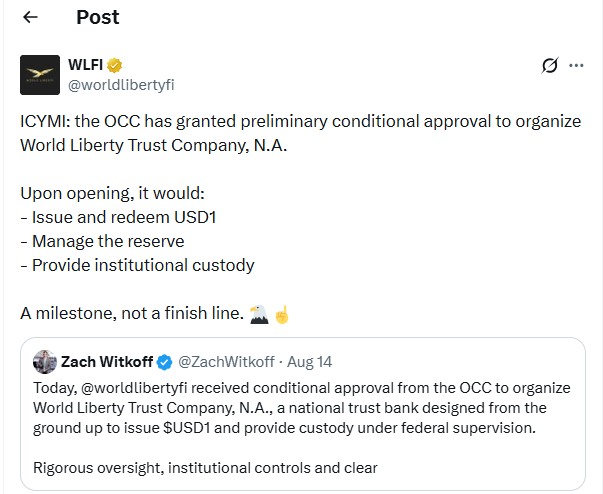
The timing drew attention because U.S. regulators had just advanced World Liberty's banking plans. On Aug. 14, the Office of the Comptroller of the Currency (OCC) granted preliminary approval covering USD1 issuance, reserve management, digital-asset custody and related conversion services.
World Liberty's documentation describes WLFI as its governance token and USD1 as its dollar-backed stablecoin. The distinction matters because WorldClaw accepted USD1, while the market-traded WLFI reflects investor exposure to the broader Trump crypto venture. USD1 has already moved through large transactions, including a $2 billion investment in Binance by Abu Dhabi-based MGX that the parties said was settled in the stablecoin — the kind of institutional use that gives a federally chartered issuing bank practical significance for the venture.
WLFI Token Scrutiny Follows WorldClaw AI Report
Reuters reported that WorldClaw offered 90 artificial-intelligence models through its platform, 43 of which came from Alibaba, Baidu, Z.ai and other Chinese technology companies. Some of those companies face U.S. restrictions or military-related designations.
WorldClaw also accepted World Liberty's USD1 stablecoin for artificial-intelligence services. Reuters said World Liberty earns revenue when users employ its crypto products, and that the Trump family owns 38% of World Liberty.
The relationship did not violate U.S. law, according to Reuters. However, seven technology, trade and ethics specialists questioned its consistency with Washington's China policy. White House spokesperson Anna Kelly rejected conflict-of-interest concerns in a statement provided to Reuters.
World Liberty spokesperson David Wachsman described WorldClaw as an independent company and said U.S. technology firms commonly offer models developed by Chinese and American companies. WorldClaw separately said model availability did not represent endorsement of its developers.
OCC Banking Approval Adds Regulatory Context
The OCC issued Corporate Decision 1385 on Aug. 14, granting World Liberty Trust Company preliminary conditional approval as a national trust bank. The approval remains subject to preopening requirements before business can begin.
The application follows the GENIUS Act, signed in July 2025, which created the first federal regulatory framework for payment stablecoins and set reserve, disclosure and supervision expectations for issuers. Crypto firms have pursued OCC trust charters before — Anchorage Digital received one in 2021 — and World Liberty's filing extends that pattern to a stablecoin market still dominated by Tether's USDT and Circle's USDC, where newer issuers have sought regulated banking structures to serve institutional clients.
The OCC decision stated that the proposed bank would issue and redeem dollar-backed stablecoins, maintain reserves and provide digital-asset custody services. The bank plans to issue USD1 nationwide to institutional clients after satisfying final conditions.
The regulator said BitGo Bank & Trust currently serves as USD1's exclusive issuer and custodian. World Liberty Trust Company would assume that issuing role after opening, and its custody business would primarily serve USD1 customers and other institutional clients.
The charter decision did not address WorldClaw or Chinese artificial-intelligence models. That separation limits any direct regulatory connection between the two developments, though the timing placed World Liberty's business relationships beside its expanding federally supervised activities.
Chinese Technology Restrictions Raise Separate Questions
The U.S. Department of Defense listed Baidu among Chinese military companies in June 2026, linking the company to China's military-civil fusion industrial base through government affiliations. Reuters said WorldClaw offered models developed by Baidu.
The Commerce Department's Bureau of Industry and Security also lists Beijing Zhipu Huazhang Technology, or Zhipu AI, which now operates as Z.ai, Reuters reported. Entity List restrictions generally require export licenses for covered U.S. technology transactions.
Reuters additionally identified Alibaba, DeepSeek and Moonshot models on WorldClaw. Alibaba disputed its military-company designation and said it planned legal action, while Baidu and Z.ai also challenged U.S. government characterizations, Reuters reported.
These restrictions target specific companies and transactions rather than general U.S. access to all Chinese models. Reuters said individuals and businesses can generally use the models offered on WorldClaw legally, a distinction that remains central to assessing the relationship.
WLFI Token Shows Limited Immediate Reaction
Market data showed the WLFI token near $0.0583 on Aug. 17. CoinMarketCap placed its market capitalization near $1.76 billion, with roughly 31.8 billion tokens circulating. An analysis of those figures alone did not indicate a sharp event-driven repricing.
The WLFI token news now combines two separate pressures: World Liberty gained conditional regulatory progress for USD1 while facing questions about WorldClaw's Chinese-model offering. Neither development established wrongdoing by World Liberty or WorldClaw. That combination has fed a broader debate in Washington, where some members of Congress have proposed restrictions on digital-asset ventures tied to senior officials and their families, though none of those measures has become law.
The next formal milestone rests with the OCC's preopening process. Corporate Decision 1385 stated that final approval follows only after required conditions are met, and until then the regulator can modify, suspend or rescind its preliminary approval.

