WLFI Hits All-Time Low of $0.0158 as Warning Signs Preceded the Crash
Key Takeaways
- •$WLFI dropped to an all-time low of $0.0158 on November 28 after World Liberty Financial's strategic reserve wallet sold $20.06 million in Ethereum-related holdings, including 10,600 ETH and 1,378 mETH, according to Lookonchain.
- •Order book data from November 23 showed $3.8 million in sell orders within 3% of the market price versus only $1.6 million in buy orders, leaving little standing demand to absorb selling pressure.
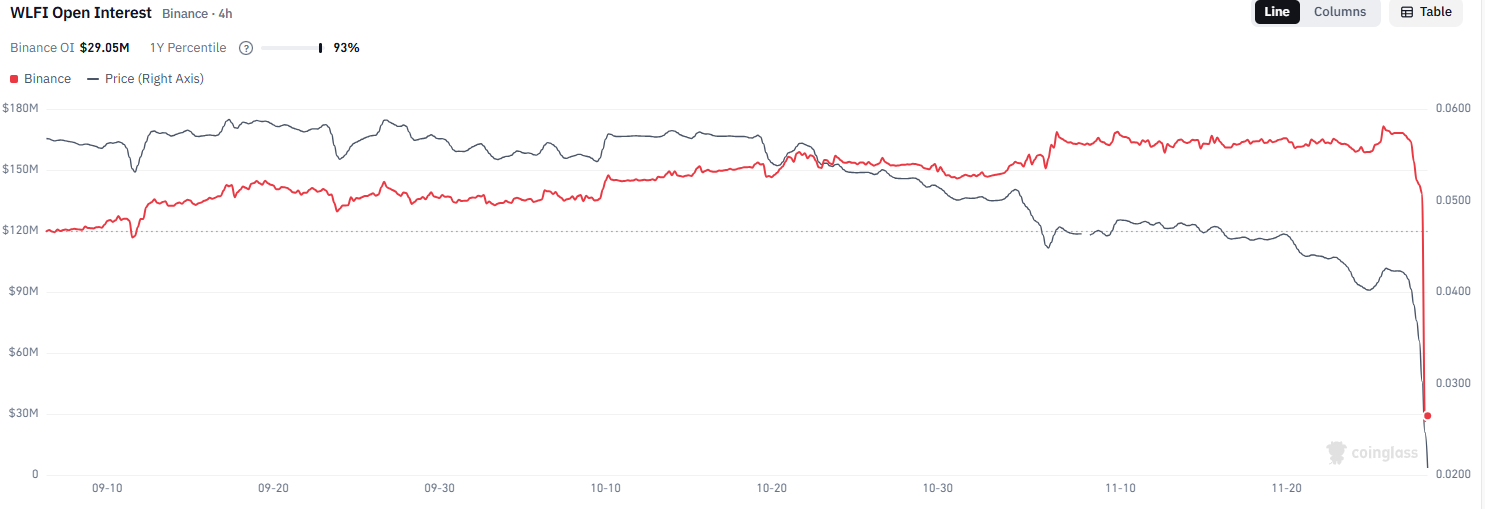
- •Binance perpetual futures open interest rose from $157.7 million on November 25 to $167.8 million on November 26, and the crash liquidated $16.77 million in leveraged positions, roughly 90% of them longs.
- •The token had already lost more than 60% of its value since the start of the year by the time a buyback was announced on November 6, and it later broke below the $0.042 lower boundary of a descending wedge pattern after declines of 15.60% on November 27 and over 40% on November 28.
- •Tron founder Justin Sun accused the project of unauthorized insider selling and circular lending and urged exchanges to delist $WLFI and USD1, though his allegations have not been independently verified.
World Liberty Financial — the decentralized finance venture associated with the Trump family — saw its $WLFI token fall to an all-time low of $0.0158 on November 28 after the project's strategic reserve wallet sold $20.06 million worth of Ethereum-related assets. The transaction, however, only capped a series of warning signs that had accumulated in advance: derivatives exposure was rising, spot buying support remained thin, and investor sentiment had steadily deteriorated.
Liquidity and Leverage Left the Token Exposed
Five days before the collapse, the market was already showing signs of a liquidity imbalance. PumpGlass data from November 23 showed that sell orders within 3% of $WLFI's market price totaled $3.8 million, while buy orders within the same band stood at just $1.6 million. An order book weighted that heavily toward sellers offered little standing demand to absorb even routine selling — a structure that leaves prices more sensitive to large transactions.
The disparity extended into leveraged positions. Approximately $2.2 million in potential long liquidations sat within that price range, compared with only $306,000 in potential short liquidations, leaving far more leveraged capital exposed to a decline than to a recovery.
Despite those conditions, open interest in Binance's $WLFI perpetual futures rose from $157.7 million on November 25 to $167.8 million on November 26, CoinGlass data showed. Funding rates also remained positive at 0.005%, meaning traders holding long positions continued paying those holding shorts. Growing leveraged exposure against thinning spot demand meant the token's near-term direction increasingly rested on derivative positioning rather than outright buying.
When the price eventually collapsed on November 28, it was the recovery bets that bore the brunt. CoinGlass data showed $16.77 million in leveraged positions liquidated over 24 hours, with longs accounting for about 90% of the total.
Weak Sentiment Preceded the Reserve Sale
The November 28 sell-off followed an extended period of losses for $WLFI holders. By the time World Liberty Financial announced its token buyback program on November 6, the cryptocurrency had already lost more than 60% of its value since the beginning of the year. Buyback programs are a common tool among crypto projects seeking to signal support for a token during downturns.
The project's borrowing activity had also attracted attention as early as April, when World Liberty Financial pledged five billion $WLFI tokens as collateral for a $75 million loan through Dolomite, a decentralized lending protocol. Although the project later announced a $25 million repayment, its financial activities returned to the spotlight after the latest reserve sale.
On November 28, blockchain tracker Lookonchain reported that the strategic reserve wallet had sold 10,600 ETH and 1,378 mETH, a liquid-staking token. The sale came amid renewed criticism from Tron founder Justin Sun, who accused World Liberty Financial of unauthorized insider selling and circular lending, and called on cryptocurrency exchanges to delist $WLFI and USD1, the project's dollar-backed stablecoin. His allegations have not been independently verified.
Price Action Had Foreshadowed Downside Risk
From a technical perspective, the token's decline was also visible on the daily Binance chart well before Saturday's crash. Successive rallies produced lower highs, while each subsequent decline pushed the token toward lower price levels, forming a descending wedge. Although such formations can precede bullish reversals, $WLFI eventually broke below the wedge's lower support near $0.042 and failed to reclaim that level.
Losses then accelerated, with a further decline of 15.60% on November 27. Selling pressure intensified the following day, when the token fell more than 40% during the session.
The episode highlights how weak liquidity, rising leveraged exposure, and deteriorating investor confidence can amplify selling pressure. The strategic reserve sale has added to scrutiny surrounding the project, while the breakdown below $0.042 confirmed the bearish technical structure. Whether $WLFI can stabilize will depend on renewed buying interest, improved market liquidity, and its ability to regain the lost support level.

