WLFI Holds Near $0.056 After World Liberty Wins OCC Approval
Key Takeaways
- •The OCC conditionally approved World Liberty Trust Company on Aug. 14, permitting it to issue and custody the USD1 stablecoin under direct federal supervision.
- •The national trust charter is limited-purpose and bars the company from accepting deposits or extending traditional loans.
- •The OCC has recently granted charters to crypto firms such as Ripple Labs, Kraken, and Circle while denying applications from Bunq and Wise.
- •WLFI has fallen more than 80% from its all-time high, and USD1 supply has declined from over $5.4 billion in February to about $4 billion.
- •Because the approval is conditional, World Liberty Financial must complete the proposed structure before USD1 issuance can move in-house.
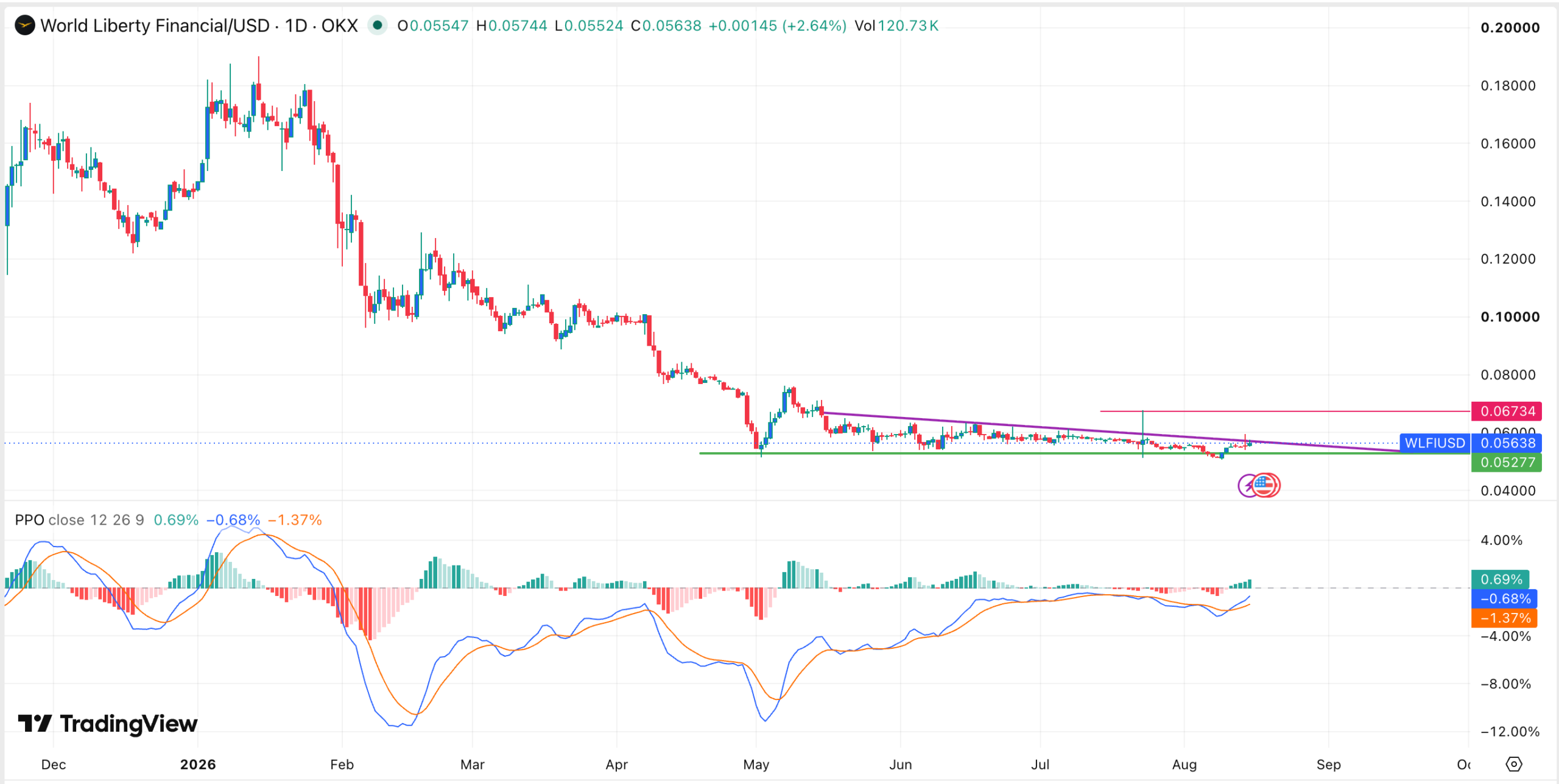
WLFI traded near $0.056 on Saturday after World Liberty Financial, the crypto venture linked to President Trump’s family, received conditional federal approval for a national trust bank.
The Office of the Comptroller of the Currency, the Treasury bureau that charters and supervises national banks, conditionally approved World Liberty Trust Company on Aug. 14. Under the proposed structure, the trust bank would issue and custody USD1 under direct federal supervision.
The approval does not create a conventional commercial bank. The trust company will not be able to accept deposits or make traditional loans. National trust charters are limited-purpose vehicles typically used for custody and fiduciary services rather than deposit-taking.
The announcement put WLFI back in focus after months of narrow price action. The token remained slightly above its 2026 low near $0.050.
US Gives World Liberty Financial a Banking License
The WLFI token drew attention after the OCC granted World Liberty Financial a provisional banking charter. The milestone would allow the company to create a new trust bank that can manage and hold assets on behalf of customers. It would also make faster payment settlement possible.
The move could also reduce the custody costs the company currently pays to Paxos, one of the major custodians in the US and the issuer of PayPal’s PYUSD stablecoin. Most notably, the charter would allow World Liberty Financial to issue its USD1 stablecoin directly and keep it in-house.
The OCC has been notably active in granting bank charters to crypto-related firms. It has already approved charters for several companies, including Ripple Labs, Kraken, and Circle Internet Group, the issuer of USDC. The decisions have drawn criticism from major banking lobbyists, who argue that such charters could endanger funds.
At the same time, the agency has denied charters to two well-known firms, Bunq and Wise. It cited insufficient capitalization, management inexperience, and past anti-money laundering compliance gaps. The charter push also comes as stablecoin issuers adapt to the GENIUS Act, the U.S. stablecoin law signed in July 2025, which requires payment stablecoins to be issued by regulated entities.
Some politicians have also criticized the agency for awarding provisional charters to crypto companies. By approving World Liberty Financial, figures such as Elizabeth Warren are likely to accuse the OCC of favoring a company associated with President Trump.
Key USD1 Metrics Are Falling
The new charter arrived as World Liberty Financial’s business faces significant pressure. WLFI, its main governance token, has fallen more than 80% from its all-time high, wiping out billions of dollars in value.
USD1, the company’s main product, is also under strain. Its supply has dropped from more than $5.4 billion in February to about $4 billion, its lowest level since January this year. Daily USD1 transfer volume has also fallen to $740 million from a peak of $7.9 billion a few months ago.
The decline in USD1 supply matters because it is the main source of revenue for the company. World Liberty Financial invests the USD1 supply in short-term government bonds and earns interest income from those holdings. Although short-term interest rates have risen, the higher yields have not been enough to offset the weaker USD1 supply. The reserve-interest model mirrors how the industry’s largest issuer, Tether, generates most of its revenue from interest on the U.S. government debt backing USDT.
USD1 supply also faces another risk because $2 billion of the funds are tied to the MGX investment in Binance. If those funds are converted into US dollars, the move could affect the business.
Another risk is that World Liberty could face scrutiny if Democrats regain control of either the House of Representatives or the Senate.
WLFI Remains Inside a Narrow Trading Range
The daily WLFI chart shows the token still trading within its established range. WLFI was slightly above support at around $0.052, a level that has previously attracted buyers.
The Percentage Price Oscillator lines formed a bullish crossover and continued to point higher. The Relative Strength Index also recovered from lower readings.
Those indicators suggest improving momentum, but they do not confirm a broader breakout. The descending trendline remains the main resistance standing between WLFI and a stronger recovery.
A confirmed move above that barrier could shift attention toward $0.067, a level that acted as resistance during the July recovery.
By contrast, a sustained break below $0.052 would weaken the current structure.
For now, the OCC approval provides a new fundamental catalyst for World Liberty Financial. Because the approval is conditional, the company still has to complete the proposed structure before USD1 issuance can move in-house. WLFI still needs a technical breakout to confirm a wider recovery.

