Wistron Opens Fort Worth Plant to Produce NVIDIA AI Systems
Key Takeaways
- •Wistron's D1 plant in Fort Worth, Texas, marks the company's first U.S. manufacturing facility, spanning 324,000 square feet on a greenfield site.
- •The facility is currently producing NVIDIA's GB300 Grace Blackwell Ultra Superchip and will also manufacture the upcoming Vera Rubin Superchip, scaling to tens of thousands of boards per month this year.
- •NVIDIA characterized the project as a $700 million commitment to U.S. advanced manufacturing, creating over 500 jobs with plans to reach 1,000 employees by year-end.
- •Wistron designed and fully simulated the entire factory in a digital twin environment built on NVIDIA's open platform before any physical construction began.
- •The Fort Worth plant supports NVIDIA's broader pledge to manufacture up to $500 billion in advanced AI platforms within the United States.
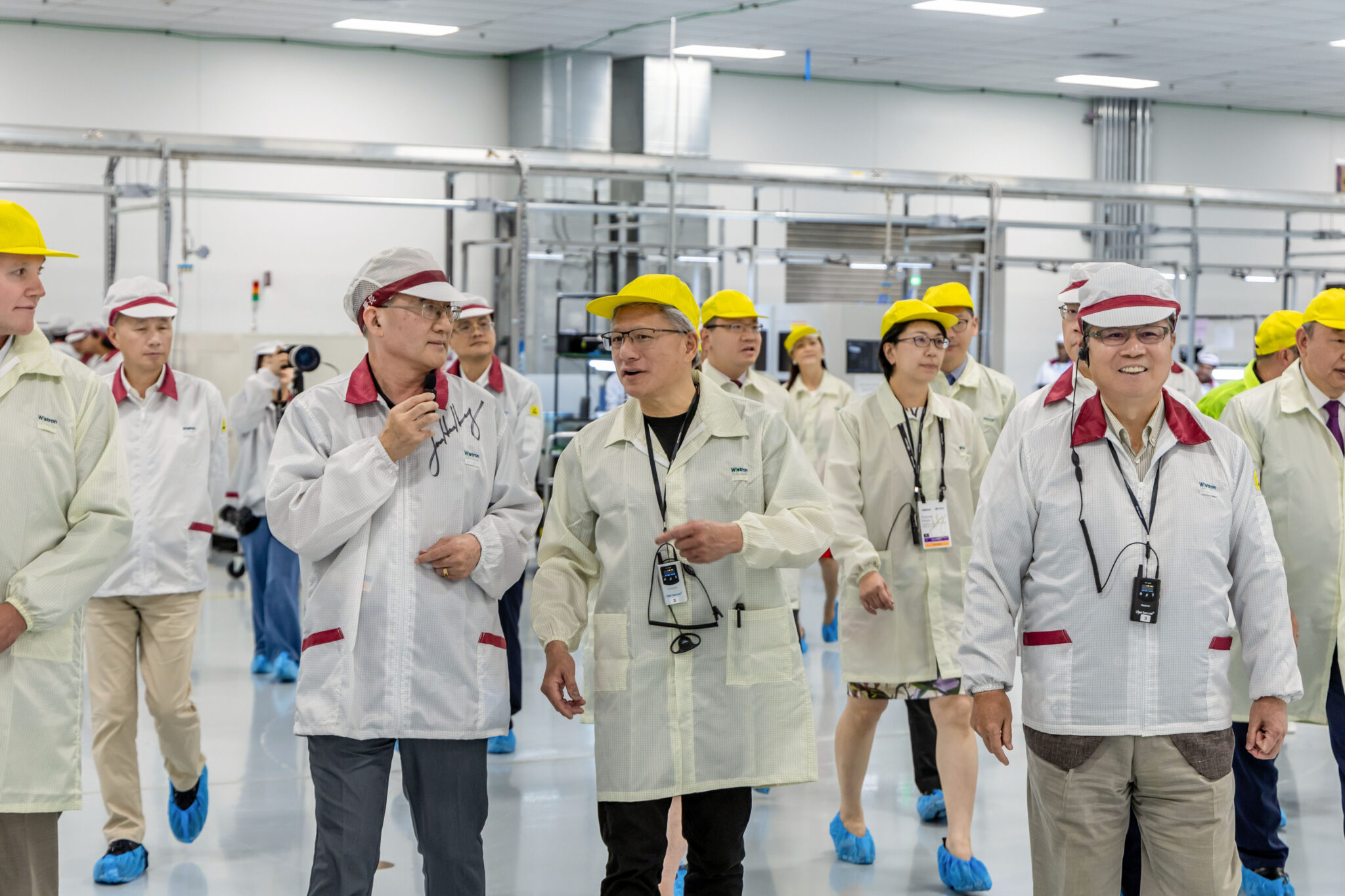
Wistron, one of Taiwan's largest electronics manufacturers and a longtime NVIDIA production partner, opened its first U.S. manufacturing facility in Fort Worth, Texas, a 324,000-square-foot greenfield plant that will produce superchips used in advanced AI systems.
The opening ceremony brought together Wistron executives, Taiwan government officials and Fort Worth local leaders. NVIDIA founder and CEO Jensen Huang joined Wistron Chairman Simon Lin on stage to discuss the role of U.S.-based manufacturing in building infrastructure for the AI era.
"Manufacturing is an essential pillar for every economy and every country," Huang said. "Building chip plants, packaging plants, computer system plants like this, and AI factories all over the United States, has allowed the United States to really reindustrialize for the first time in a long time."
The facility, known as Wistron's D1 plant, currently operates two manufacturing cells. One is producing the NVIDIA GB300 Grace Blackwell Ultra Superchip, NVIDIA's latest generation of its Grace Blackwell platform designed for large-scale AI training and inference workloads, while the other will produce the NVIDIA Vera Rubin Superchip, a future platform NVIDIA has positioned as its next major architecture for AI factories. NVIDIA said D1 is scaling this year to produce tens of thousands of boards per month using what it described as the industry's most advanced technology.
The company said manufacturing AI systems at scale requires more than chips and software. It also depends on factories, supply chains and skilled workers, along with a domestic manufacturing base capable of producing at volume and adapting as technology changes. NVIDIA described the Fort Worth plant as a site where that capacity is being established.
A $700 Million Manufacturing Commitment
NVIDIA said the facility represents a $700 million commitment to advanced manufacturing in the United States. The Texas site has created more than 500 new jobs, with plans to expand to 1,000 jobs by the end of the year.
"It's creating jobs in plumbing, construction, manufacturing and electricians," Huang said. "So many different types of jobs here in the United States."
Lin said the project connects broader AI infrastructure development with local and national benefits.
"From the macro view of the whole AI world, down to community and country — it's a great vision," Lin said. "I think we're going to enjoy the next era of AI life. I hope that we will be happier and healthier."
NVIDIA has said it is committed to manufacturing up to $500 billion in advanced AI platforms in the United States, a pledge that aligns with a broader wave of semiconductor and AI manufacturing investments across Texas and other states. The company identified Wistron's Fort Worth factory as one of the projects supporting that commitment.
Facility Simulated Before Construction
Before construction began, Wistron designed and fully simulated the entire facility in a digital twin built on NVIDIA's open platform. The platform included Nemotron and Cosmos frontier models, Omniverse and Metropolis libraries, and open frameworks including PhysicsNeMo.
NVIDIA said the approach enabled Wistron engineers to validate assembly line layouts, optimize production processes and train workers on standard operating procedures in a virtual environment before any system began operating in the physical factory. The digital twin methodology is part of NVIDIA's broader push to apply its AI and simulation technologies to industrial operations, an area where the company has partnered with manufacturers across automotive, robotics and electronics.
Building Across the AI Stack
NVIDIA said AI infrastructure development extends beyond semiconductors to include systems and the factories that build them.
"Just as agriculture is a fundamental infrastructure of society, in the future these AI factories will be a fundamental infrastructure of society," Huang said. "Today we have roads and agriculture and railroads. In the future we'll have AI factories and the internet. Electricity comes in … and the tokens get generated in the factories."
During the ceremony, Wistron unveiled the first NVIDIA GB300 Grace Blackwell Ultra Superchip produced at the Fort Worth site. Huang signed the chip at the event.
Huang described the system built around the NVIDIA GB300 Grace Blackwell Ultra Superchip as "the most powerful AI supercomputer in the world."
"It has one-and-a-half million parts inside — two tons, 4 million dollars — and we're producing them like phones, right here in Wistron, cranking them out in volume because the world needs all of these machines to drive the intelligence infrastructure," Huang said.
Huang also participated in interviews with Mike Allen of Axios and, separately, with Lana Ferguson of The Dallas Morning News. Ferguson also covered Coherent's groundbreaking of a new manufacturing facility in Sherman, Texas, in June, reflecting the growing concentration of advanced manufacturing investment across the state.
NVIDIA said Wistron's Fort Worth plant is part of its broader effort to build in America, for America. The company said the project is intended to strengthen U.S. supply chains, create high-skilled jobs and give American communities a direct role in building AI infrastructure.
