Will FOMC Minutes Lock In Another Hike After Boom PMIs and AI Capex in Week 41?
Key Takeaways
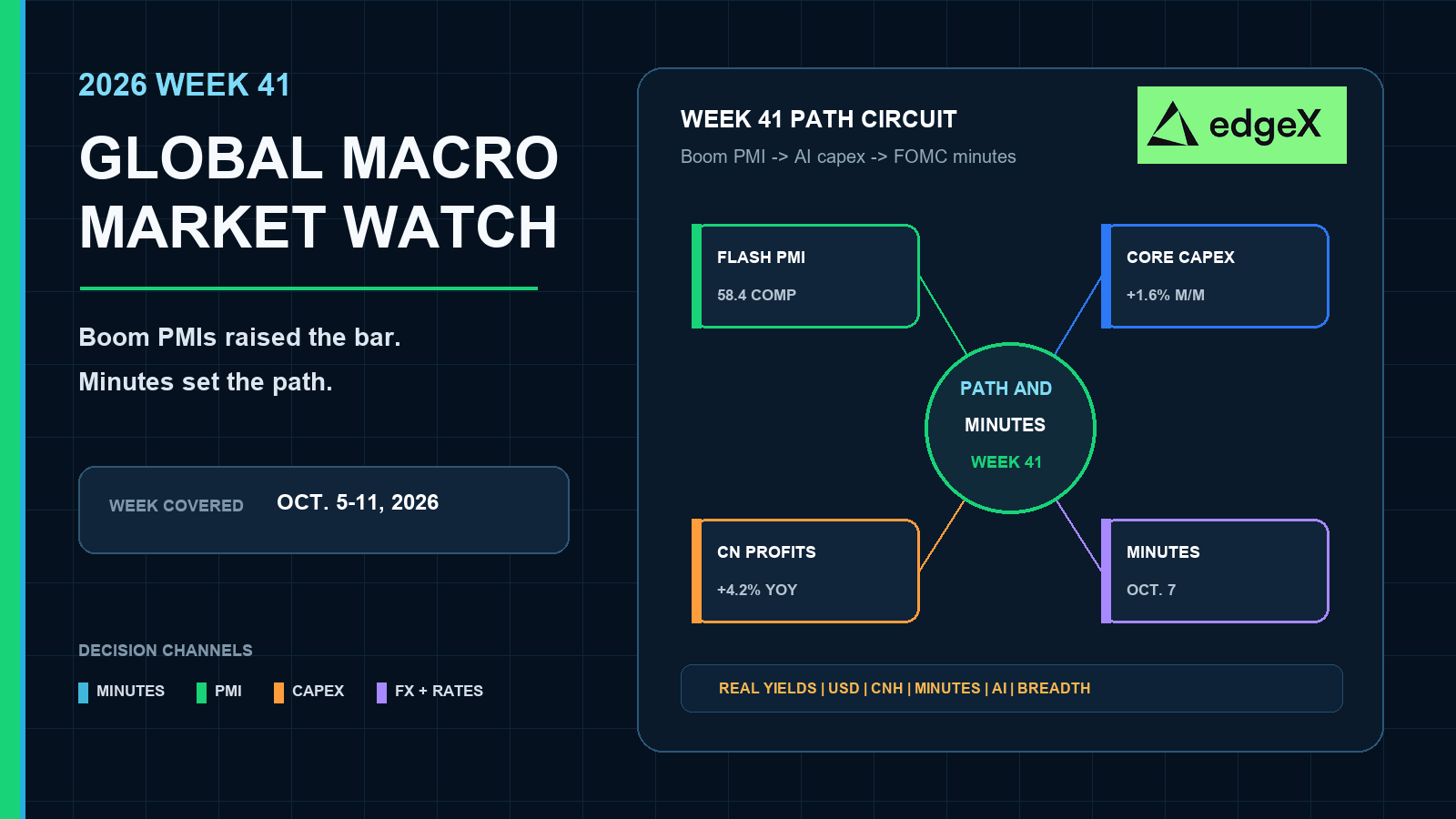
- •S&P Global's September 23 flash estimates put the U.S. Composite PMI at 58.4, the highest since July 2021, and manufacturing at 57.0, with input prices at 66.4, after the Fed had already raised rates to 3.75%–4.00%.
- •Headline durable goods orders were unchanged at about $338.6 billion, but core capital goods orders excluding aircraft rose 1.6% month over month and 10.6% year over year, led by computers and communications equipment.
- •University of Michigan final September sentiment fell to 48.1 from 51.7 while one-year inflation expectations climbed to 4.6% from 4.0%, leaving households more anxious than businesses.
- •The U.S. current-account deficit widened by $33.4 billion, or 15.7%, to $246.0 billion in the second quarter, while China's August industrial profits growth slowed to 4.2% year over year from 11.2% in July.
- •Week 41 also features euro-area retail trade and import prices on October 5, Japan's BOJ Consumption Activity Index and Regional Economic Report on October 7–8, and China's means-of-production price report on October 9, ahead of the October 28–30 G3 policy cluster.
Quick Answer
Week 41 is a global policy-path week, not a U.S.-only note. Week 39 delivered multi-year-high U.S. flash PMIs, a firmer euro-area composite around 53.1, hotter business price pressures, and another AI-heavy capital-goods rebound. If the October 7 minutes treat that boom-and-bottleneck mix as a reason to keep tightening, real yields, the dollar, and late-October hike odds stay firm, with EUR, JPY, and CNH trading the spillover. If the minutes stress two-sided risks after flat headline durable goods, a wider current-account deficit, and slowing China industrial profits, markets get more room to digest as long as unfinished Week 40 PCE, payrolls, and China PMI do not overheat. Score Europe’s October 5 retail and import-price prints and Japan’s October 7–8 demand reports with the U.S. minutes, not after them.
Why Week 41 Is a Minutes-and-Path Test
Week 38 delivered the first Fed hike in more than three years. Week 39 then answered the digestion question the hard way. Private activity sped up. Supply chains tightened. AI-linked equipment orders stayed firm even as consumers turned more anxious. Week 40 was supposed to be the first clean inflation-and-labor check, but those prints were still unfinished at the September 28 cutoff. Week 41 does not wait for the next rate decision. It asks a simpler question: after the boom PMI evidence, do the September minutes lock in another hike path?
Trade the stages separately. A rate decision can reprice front-end yields in one afternoon. A lasting policy stance needs the minutes. Did officials treat demand and pipeline pressure as one-sided? Or did they still give weight to China margin stress, factory risks, and external balances? Week 41 is built for that second stage.
The Week 39 boom raised the bar again
The September 23 flash PMI package, covered in the Reuters wrap via KELO, landed after the Fed had already moved the funds range to 3.75%–4.00%. Composite at 58.4, manufacturing at 57.0, and input prices at 66.4 left markets with three live messages: demand still mattered, capacity was binding, and business inflation risk was back. Week 41 has to decide whether the minutes read that mix as a green light for another hike into late October.
Week 41 Global Macro Calendar
| Date | Region | Scheduled Event | Why Markets Care |
|---|---|---|---|
| October 5 | Euro area | Industrial import prices and retail trade, August 2026 | Tests whether Europe’s goods and shop demand still back the Week 39 PMI rebound. |
| October 5–11 | United States | Weekly claims and secondary high-frequency prints | Keep a running labor-and-demand check between payrolls and CPI. |
| October 7 | United States | FOMC minutes, September 15–16 meeting | First full written record of the first hike in more than three years, after boom PMIs and AI capex. |
| October 7 | Japan | BOJ Consumption Activity Index | Same-day Japan demand color while U.S. minutes reset the hike path. |
| October 8 | Japan | BOJ Regional Economic Report | Checks whether Japan’s regional demand picture still supports the post-hike yen tape. |
| October 9 | China | NBS late-September means-of-production price report | Early China pipeline-price check after the September 28 industrial-profits adjacency. |
| October 14 | United States / China | U.S. CPI; China CPI and PPI, September 2026 | Adjacent Week 42 inflation checkpoint after the minutes set the path debate. |
| October 15 | United States | Retail sales and PPI, September 2026 | Tests whether consumer demand and pipeline prices still back the Week 39 boom. |
| October 28–30 | United States / Euro area / Japan | FOMC decision; ECB monetary-policy meeting; BOJ monetary-policy meeting | Next live G3 policy cluster after the minutes window. |
FOMC Minutes Reset the Post-Hike Reaction Function
The Federal Reserve FOMC calendar, the October 2026 U.S. release calendar, and minutes release schedule tools put the September 15–16 minutes on October 7 at 2:00 p.m. Eastern. That is Week 41’s cleanest policy catalyst after Week 39’s demand surge and before the late-October G3 decision cluster. The week is not U.S.-only: Eurostat has euro-area retail trade and import prices on October 5, the BOJ schedule has Japan’s Consumption Activity Index on October 7 and the Regional Economic Report on October 8, and China’s NBS calendar times the late-September means-of-production price report for October 9.
The minutes matter because the data already moved after the hike. Officials tightened before Week 39 delivered stronger flash PMIs, rising business price pressures, and another jump in core capital goods orders. A hawkish tone that leans on capacity strain and upside demand risk supports higher real yields and a firmer dollar. A more balanced tone that still flags two-sided risks around factories, external balances, and China absorption leaves October 28 more data-dependent.
Minutes will be read against unfinished Week 40 confirmation
By the time the minutes print, markets should already have Week 40’s unfinished confirmation set in hand: JOLTS, August PCE on the BEA release schedule, the Q2 GDP third estimate, China official PMI, and September payrolls on the BLS calendar. Those are not finished Week 40 review facts at the September 28 cutoff, but they still shape how traders score the minutes. Hotter PCE or overheating payrolls make hawkish minutes easier to price; softer labor or cooler core PCE raises the bar. Pair the minutes with front-end yields and the dollar, not with a single equity open.
Boom PMIs and AI Capex Keep Demand Alive
Week 39’s completed survey and orders data are why Week 41 is not just a technical U.S. minutes event. S&P Global’s flash U.S. package showed the private sector accelerating after the hike, not cooling into it. New orders at 58.2 and input prices at 66.4 turned the post-hike debate into a demand-plus-bottleneck problem. Euro area composite PMI also firmed to about 53.1, so the advanced-economy rebound was broader than one country even if the U.S. still led.
The Census durable-goods report, covered in the Reuters capital-goods wrap via KELO, then split the factory tape. Headline durable goods orders were unchanged at about $338.6 billion after a revised 0.9% July gain. Core capital goods orders excluding aircraft jumped 1.6% month over month and 10.6% year over year, with computers and communications equipment still strong. That is an AI-and-equipment boom inside a flatter headline goods print. It is not a broad factory collapse. Week 41’s euro-area retail trade and import-price prints on October 5 test whether Europe’s demand color still supports that broader PMI rebound while the FOMC minutes set the dollar path.
Sentiment worsened while inflation expectations rose
University of Michigan final September sentiment fell to 48.1 from 51.7. One-year inflation expectations rose to 4.6% from 4.0%. Households looked more anxious even as businesses reported booming orders. That split can keep AI-linked investment firm and still reprice policy tighter if the minutes lean hawkish, while unfinished Week 40 labor data keep a growth scare live.
External Balances and China Margins Still Cut Against a Clean Boom Story
The BEA international transactions release showed the U.S. current-account deficit widening by $33.4 billion, or 15.7%, to $246.0 billion in the second quarter. That is not a Week 41 catalyst by itself. It still matters for dollar and twin-deficit debates once the minutes reopen the hike path.
China is the other incomplete half of the global boom story. At the Week 40 open, the NBS industrial profits package, timed against the NBS 2026 release calendar, showed August profits up only 4.2% year over year after 11.2% in July. January–August growth eased to 15.7% from 17.6%. Tech manufacturing profits stayed extremely strong. Consumer-linked categories lagged. Treat that print as an early adjacency baseline, not a finished Week 40 review. Official PMI on September 30 was still incomplete at cutoff. Score it later against the same factory-household split.
Transmission still runs through EUR, JPY, CNH, metals, and AI cyclicals
A minutes-led hike lock-in with soft China margins keeps CNH, copper, and Asia-linked equities more selective than a pure U.S. boom tape. Japan’s same-week Consumption Activity Index and Regional Economic Report matter for JPY into the October 29–30 BOJ meeting. Europe’s October 5 retail and import-price prints matter for EUR and for whether the Week 39 euro-area PMI rebound had real goods demand behind it. Week 41 does not need any one region to dominate every market. It does need Europe, Japan, and China as live risk filters around the October 7 U.S. policy release.
Week 39 Review: Activity Boomed, Bottlenecks Tightened, and Capex Stayed AI-Heavy
Week 39, September 21–27, was the latest completed weekly window available at the September 28 production cutoff. The core message was simple: post-hike digestion did not cool demand. Private-sector activity accelerated. Survey price pressures rebuilt. AI-linked equipment orders stayed firm even as consumers grew more pessimistic.
The week centered on September 23. S&P Global’s flash U.S. Composite PMI rose to 58.4 from 56.0, the highest since July 2021. Manufacturing climbed to 57.0 from 53.9. New orders jumped to 58.2. Supplier delays became the most widespread since July 2022. Input prices paid surged to 66.4, the highest since October 2022. S&P Global linked capacity strain and delivery delays partly to the Middle East conflict and showed price pressures rebuilding through the business survey channel. Euro area composite PMI also firmed to about 53.1, so the advanced-economy expansion broadened even if the U.S. still led.
September 24–25 filled in the external and factory detail. The BEA reported a $246.0 billion second-quarter current-account deficit after a $33.4 billion widening. Census durable goods orders were unchanged, but core capital goods orders excluding aircraft jumped 1.6% and 10.6% year over year. Computer and communications equipment still carried the AI investment story. Michigan sentiment fell to 48.1 and one-year inflation expectations rose to 4.6%, leaving households more anxious than businesses. Market pricing around a roughly 68.6% chance of another near-term hike stayed part of the same week’s policy color.
At the September 28 cutoff, the completed Week 39 record and the Week 40-open China profits adjacency left four live messages: U.S. private demand was booming, bottlenecks and business price pressures were back, AI-linked capex was still carrying equipment investment, and China margin stress plus a wider U.S. external deficit kept the global mix from looking clean. Boom PMIs and firm core capital goods raise the bar for any minutes-led relief rally that needs a simple pause story. Flat headline durables, weaker sentiment, and slowing China profits keep the two-sided risk channel open if unfinished Week 40 PCE or payrolls disappoint.
Cross-Asset Decision Map
| Week 41 Mix | Crypto | Stocks | Commodities | FX and Rates |
|---|---|---|---|---|
| Hawkish minutes after boom PMIs and firm core PCE/payrolls | Higher real yields and tighter liquidity pressure leveraged crypto positions. | Long-duration and high-beta shares underperform; AI leaders can still diverge. | Gold faces a yield headwind; industrial metals absorb rate risk. | Real yields and USD rise; front-end hike odds into October 28 firm. |
| Balanced minutes with cooler unfinished Week 40 inflation/labor | Lower path noise can support BTC and ETH if spot demand confirms. | Breadth can improve if cyclicals participate beyond AI megacaps. | Industrial metals gain from digestion; gold depends on real yields. | USD softens selectively; front-end volatility fades. |
| Minutes stay hawkish while China margins/PMI worsen | Asia risk-off can hit high-beta crypto even if U.S. AI stays firm. | China-sensitive multinationals and industrial exporters lag. | Copper and related metals weaken on absorption risk; energy stays two-sided. | CNH softens; commodity currencies diverge; safe-haven USD demand can persist. |
| Soft labor after boom PMIs, with minutes still two-sided | Rate-path relief helps only if deleveraging does not dominate. | Earnings revisions and margin risk become central; defensives can outperform cyclicals. | Gold can outperform industrial commodities. | Curves can twist; policy-path uncertainty stays elevated across USD and JPY. |
What Would Confirm the Week 41 Signal?
The base case is path noise, not a clean one-way trend. Week 41 confirmation should show up in the joint move of the October 7 minutes, euro-area retail and import prices, Japan’s demand reports, front-end yields, the dollar, EUR, JPY, unfinished Week 40 PCE and payrolls, CNH, and industrial metals. A minutes market that moves only the U.S. tape is less durable than a synchronized global adjustment that survives the early-October policy record.
China needs its own checklist. Read the September 28 profits adjacency and the October 9 means-of-production price report against the unfinished September 30 official PMI and the earlier factory-household split, not in isolation. Stable or firmer China signals support containment around a hawkish U.S. path. Another margin or PMI squeeze keeps Asia selective even if AI capex stays strong. A durable risk-on result needs non-overheating U.S. inflation and labor confirmation, minutes that do not force an immediate second-hike panic, Europe demand that does not roll over, Japan demand that stays orderly into the late-October BOJ meeting, and China signals that stop the supply-demand imbalance from dominating global cyclicals. Week 39 already set that bar.
Trade with an Edge
In fast-moving markets, execution matters just as much as direction. That's why more traders are turning to decentralized venues like edgeX for perpetuals and spot trading.
Unlike traditional centralized platforms, edgeX is built around self-custody, meaning you keep control of your assets and authorize fund movements yourself. For active traders, that offers a meaningful advantage: market access without handing custody to an exchange.
edgeX also combines the core benefits of DeFi with a trading experience designed for serious execution. The platform emphasizes deep liquidity, high-speed order matching, and low-slippage performance, helping traders stay responsive during volatile conditions. With support for high leverage, it gives experienced market participants more flexibility in how they express macro views and manage risk.
Beyond execution, decentralized trading infrastructure can offer structural advantages: greater transparency, on-chain verification, and reduced dependence on centralized intermediaries. For traders who want performance without giving up control, that model is increasingly compelling.
edgeX is built for that balance: bringing together a professional trading experience with the core principles of decentralized markets.
Traders looking to explore a more capital-efficient, self-custodial way to trade can take a closer look at edgeX.
Frequently Asked Questions
What is the biggest event in Global Macro Week 41?
The highest-impact catalyst is the October 7 release of FOMC minutes from the September 15–16 meeting. Markets will still read those minutes against a global week: Week 39’s U.S. and euro-area PMI rebound, AI-linked capital-goods strength, unfinished Week 40 PCE, JOLTS, payrolls, and China PMI confirmation, plus Japan’s same-week demand reports and China’s October 9 pipeline-price check.
Why review Week 39 instead of Week 40?
Production closed on September 28, while Week 40 was still in progress. JOLTS, August PCE, the Q2 GDP third estimate, China official PMI, and September payrolls had not yet completed as finished weekly results. Week 39, September 21–27, was the latest completed weekly window and is labeled explicitly.
Why do boom PMIs matter after the first hike?
S&P Global’s flash U.S. Composite PMI rose to 58.4 and manufacturing to 57.0 after the Fed had already tightened to 3.75%–4.00%. New orders and input prices also jumped, turning the post-hike debate into a demand-plus-bottleneck problem rather than a simple cooling story.
How can the October 7 minutes change the path into October 28?
Hawkish minutes that emphasize capacity strain and upside inflation risk can keep real yields and hike odds elevated into the next FOMC. More balanced minutes would leave the October 28 decision more dependent on the unfinished Week 40 inflation and labor cluster.
What did Week 39 change for the Week 41 outlook?
Week 39 delivered multi-year-high U.S. flash PMIs, hotter business price pressures, unchanged headline durable goods with a 1.6% core capital-goods surge, weaker consumer sentiment, and a wider Q2 current-account deficit. That mix raised the bar for uncomplicated pause pricing and made Week 41 confirmation dependent on the minutes and the unfinished Week 40 data path.
What is the constructive Week 41 scenario?
The constructive combination is minutes that do not force an immediate second-hike panic, unfinished Week 40 inflation and labor prints that stay firm without overheating, Europe demand that does not roll over, Japan demand that stays orderly, and China signals that stop the factory-household split from dominating. Confirmation should show up in contained front-end volatility, selective dollar/EUR/JPY/CNH behavior, and steadier industrial commodities around the AI-led equity tape.

