Why Bitcoin Trades at Different Prices Across Crypto Exchanges
Key Takeaways
- •Bitcoin trades around the clock on hundreds of independent exchanges, so each venue can display a different, simultaneously accurate price for the same asset.
- •Liquidity depth, bid-ask spreads, and slippage determine how closely large orders fill at the quoted price, and thin order books magnify price impact.
- •Fees and embedded spreads can reverse apparent bargains; in one hypothetical example, a quote $200 lower on one exchange ended up costing $449.80 more after higher fees.
- •Stablecoin-denominated quotes should not be treated as dollar amounts because USDT and USDC can trade above or below $1, according to Circle.
- •Research by Makarov and Schoar found that price gaps can persist between exchanges and are wider between countries than within them, reflecting market segmentation and limits on capital movement.
Bitcoin has never had one official price. The asset trades around the clock on hundreds of independent marketplaces, and each venue maintains its own pool of buyers, sellers and resting orders. As a result, the same coin can carry slightly different price tags at the same moment — a quote of $100,000 on one platform alongside $100,250 on another can both be entirely correct. Because trading never stops, each book updates continuously on its own, with no single session synchronizing quotes across venues.
This report examines the numbers behind those gaps, covering order books, liquidity, trading fees, stablecoin pairs, regional premiums, arbitrage and the aggregation tools that average prices across markets. Most of the examples are hypothetical and are identified as such; the verifiable figures are drawn from published research and exchange documentation, listed at the end of the article.
The Key Numbers at a Glance
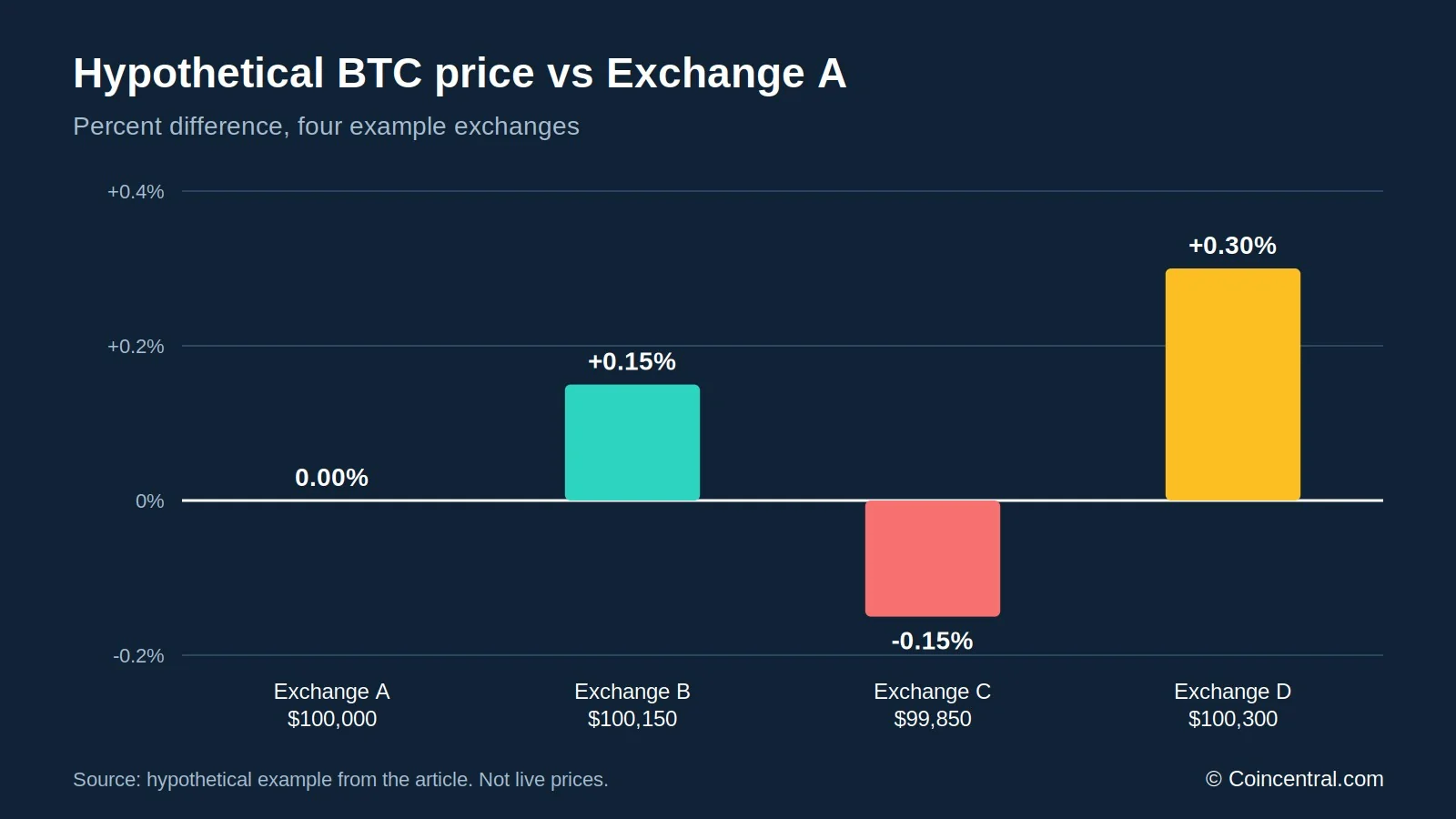
A simple illustration shows how small the differences can be. Across a hypothetical set of four exchanges, quotes run from $99,850 to $100,300 — a range of $450, or 0.45% of a $100,000 reference price. Before fees, a buyer on the cheapest venue would pay $450 less than a buyer at the most expensive one. These figures are illustrative and are not live quotes.
Arbitrage traders are the force that keeps such gaps narrow: they buy where a coin is cheaper and sell where it trades higher. Even so, gaps can persist. Research by Igor Makarov and Antoinette Schoar, published in the Journal of Financial Economics in 2020, documented price gaps that reappeared again and again, and found that they were wider between countries than between exchanges within the same country. For a buyer, the practical consequence is that any on-screen number is a property of the venue, not of Bitcoin itself.
How Order Books Set the Price
Most large centralized exchanges match customers through an electronic order book — a live list of the prices at which users are willing to buy and sell. Buy orders are known as bids; sell orders are known as asks.
Picture Bitcoin trading near $100,000, with the highest bid at $99,950 and the lowest ask at $100,050. The distance between them, $100 in this example, is the bid-ask spread. A market buy order executes against the lowest asks, while a market sell order executes against the highest bids. As orders are filled, canceled or replaced, the quoted price moves.
Every exchange keeps its own book. One venue may be dominated by institutional buyers while another carries mostly retail sellers, so even two healthy markets can hold different balances of supply and demand. Kraken's documentation notes that market orders can fill at different prices depending on how deep the order book is. Nothing obliges every exchange to display the same price at every moment.
Liquidity and Price Impact
Liquidity describes how easily a coin can be bought or sold without shifting its price. Kraken identifies order-book depth and the bid-ask spread as the key measures, and deeper markets allow buyers to fill larger orders closer to the price shown on screen.
Imagine a buyer who wants 5 BTC. Exchange A lists 100 BTC for sale near the market price; Exchange B lists only 2 BTC near that level. On Exchange A, the order fills with little effect on the price. On Exchange B, the first 2 BTC exhaust the nearby sellers, and the remaining 3 BTC fill at progressively higher prices, lifting the average cost. That effect is known as price impact.
Slippage and Trading Volume
Slippage is the difference between the price a trader expects and the price actually obtained. According to Binance.US, the main drivers are order size, liquidity and market volatility, and large market orders are the most exposed because they can sweep through several price levels at once.
High trading volume, however, does not guarantee good fills. Two venues with similar daily Bitcoin volume can hold very different liquidity near the current price, and an exchange could report $1 billion in daily volume while still offering thin depth for a particular trade.
Smaller Coins and Volatile Markets
The problem intensifies for new altcoins and meme coins. A token might display a market value of $10 million while only $50,000 of liquidity is available to trade, meaning even a modest sale can move the price a long way.
Volatility compounds the gaps. Crypto markets never close, and fast-moving news can shift one exchange before the others catch up. During sharp sell-offs, liquidity providers may withdraw orders or widen spreads, allowing a thin market to fall further than a deep one. A sudden extreme print on a single platform does not mean Bitcoin traded at that level across the whole market.
Fees and Spreads Change What You Actually Pay
The market price and the price a customer ultimately pays are not always the same. Some exchanges display an order book and charge fees separately; others offer simplified buy buttons that build a spread directly into the quote.
Coinbase operates both models. Its documentation states that simple purchases include a spread in the quoted price, which lets the platform lock in a rate while it processes the order, whereas Coinbase Advanced provides direct order-book access and charges a volume-based fee instead.
The fee layer can reverse an apparent bargain. In one hypothetical setup, Exchange A quotes a price $200 lower than Exchange B, yet its higher fee leaves the final purchase $449.80 more expensive — and that example leaves out additional spreads, withdrawal costs and slippage. The takeaway is to compare total execution cost: the lowest headline price is not always the cheapest way to buy.
Trading Pairs and Stablecoins
Bitcoin trades against many quote assets, including BTC/USD, BTC/EUR, BTC/USDT and BTC/USDC, and each pair constitutes a separate market. Even after conversion into a single currency, the prices may not align exactly.
Suppose Bitcoin changes hands at $100,000 on a dollar market and €86,000 on a euro market. At an exchange rate of €0.86 per dollar the two quotes are equivalent, but if the rate moves — or demand strengthens in one market — the converted prices can drift apart, and conversion fees add to the cost.
Stablecoins add a further layer. USDT and USDC are designed to track the US dollar, yet their own market prices can fluctuate. Circle, the issuer of USDC, says the coin can trade above or below $1 on third-party platforms. If Bitcoin trades at 100,000 USDT and one USDT is worth $0.995, the implied price is roughly $99,500 — assuming the conversion itself costs nothing. A BTC/USD market could show a different figure at the same time. For that reason, a quote denominated in USDT or USDC should not be treated as the same number of dollars. Comparing a stablecoin-denominated quote with a dollar quote therefore means checking two prices — the Bitcoin pair and the stablecoin's own dollar value.
Regional Premiums and Exchange Restrictions
Prices can also diverge between countries, where local demand, banking limits, currency controls and regulation keep markets from lining up. The best-known case is South Korea's kimchi premium — the phenomenon of Bitcoin trading higher on South Korean exchanges than on global ones. If Bitcoin costs $100,000 globally and $105,000 on a Korean exchange after currency conversion, the premium is 5%. It can reflect strong local demand or restrictions on moving money across borders, and the figures drawn from research are historical rather than current premiums.
In theory, a trader could buy cheaper Bitcoin abroad and sell it in South Korea. In practice, that may require local bank accounts, foreign exchange services and compliant trading accounts, and limits on cross-border transfers can make the plan difficult or impossible. Makarov and Schoar tied lasting price gaps to market segmentation and constraints on capital movement — an apparent gap is not always a free profit.
Restrictions can cut the other way as well, making a coin look artificially cheap. If an exchange shows Bitcoin 5% below the global market but has paused withdrawals, a buyer may be unable to move the coins elsewhere, so the discount reflects risk rather than opportunity. CoinMarketCap's methodology says it may exclude prices from its calculations when exchange restrictions or regional barriers mean they are not freely accessible.
Decentralized Exchanges and Pool Pricing
Not every venue uses an order book. Platforms such as Uniswap rely on automated market makers, or AMMs, where users trade against liquidity pools governed by smart contracts. According to Uniswap's documentation, the classic model applies the rule x × y = k, where x and y are the quantities of the two tokens in the pool; the formula determines how the price shifts as tokens are swapped. Newer versions also support concentrated liquidity.
Consider a pool holding 10 ETH and 20,000 USDC. The starting price is 2,000 USDC per ETH and k equals 200,000. If a buyer removes 1 ETH, the pool is left with 9 ETH and must hold about 22,222 USDC to keep k constant. The buyer therefore pays roughly 2,222 USDC — 11.1% above the starting price — in a simplified calculation that ignores pool fees.
A single coin can trade across several pools at once. Because each pool holds different reserves and sees different activity, prices can diverge for a time, and arbitrage traders buy from cheaper pools and sell into pricier ones. Gas fees, slippage and the ordering of transactions on the blockchain add costs and risks, and Uniswap cautions that some trades can fall victim to maximal extractable value, including sandwich attacks.
Arbitrage: Can the Gaps Be Captured?
Buying on one exchange and selling higher on another — arbitrage — attempts to profit from short-lived price differences. In the hypothetical trade referenced earlier, the trade earns $250 before taxes, provided both prices hold and both orders fill as planned.
Real trading is harder. Bitcoin transfers need blockchain confirmations, and exchanges may delay withdrawals; prices can move before the second leg fills. Spreads, currency conversion charges and funding costs can erase the gain, and professional traders who pre-position funds on several exchanges to avoid transfer delays take on added custody and counterparty risk.
Makarov and Schoar found that arbitrage opportunities could persist for long periods, especially between countries. A 2024 working paper by John, Li and Liu examined 80 exchanges and found wide variation in arbitrage spreads, with larger gaps among less trustworthy and more fragmented venues. These findings describe past markets and say nothing about profits available to retail traders today.
Aggregators, Futures and Trust Scores
CoinMarketCap and CoinGecko can show a price that differs from any single exchange because they measure something different. CoinMarketCap uses a volume-weighted average of eligible market-pair prices, so markets with more trading volume exert more influence, and it also screens for unusual prices. CoinGecko likewise combines trading data, though its market coverage and data rules may differ. In October 2026 it said regional premiums and decentralized exchange activity can explain gaps between its reference price and exchange quotes, and its data passes through outlier and liquidity checks. A reference price is a measurement — not necessarily a price a customer can actually trade at.
Futures introduce yet another set of prices. Spot trading involves the coin itself, while futures give exposure to a future or reference price, and a contract can trade above or below spot. Binance's documentation says its mark price draws on data from several markets to limit the effect of short-lived dislocations.
CoinGecko also updated its Trust Score methodology in 2026. Liquidity carries half of the weight, and the model considers volume consistency and order-book depth — though a strong score does not prove an exchange is financially sound. Price gaps alone are not evidence of wrongdoing, but wash trading, spoofing and fake volume do exist, and a coin trading far below the global price on an unfamiliar exchange may signal poor liquidity, withdrawal limits or operational problems.
How to Compare Prices Before You Buy
The soundest way to compare exchanges is to evaluate the entire transaction. Start with the same trading pair on each platform — comparing BTC/USD with BTC/USDT without adjusting for the stablecoin can mislead. Next, check the spread and the depth of the order book, then add commissions, payment fees, any spread embedded in the quote and withdrawal fees if you plan to move coins to a wallet.
For larger purchases, a limit order caps the highest price a buyer will pay, offering more control at the cost of possibly not filling. Coinbase Advanced also offers time-weighted average price orders for eligible users, which split a large trade into smaller scheduled parts to reduce market impact.
Bottom Line
Crypto exchanges show different prices because each runs an independent market with its own buyers, sellers and liquidity. Bitcoin has no single global price. For liquid assets such as Bitcoin and Ethereum, competition and arbitrage generally keep quotes close together, but gaps widen with volatility, thin liquidity or regional restrictions. Research in the Journal of Financial Economics shows those gaps can persist, particularly across borders with capital controls, and fees, spreads and order execution further separate the displayed price from the price actually paid.
Three numbers encapsulate the examples in this article: a $100 bid-ask spread, a $449.80 cost swing caused by fees, and a 20.8% regional premium — each illustrating a distinct cause of price gaps, and none alone telling a buyer which exchange is best. Prices also move by the second, so any figure here is a snapshot or an example. Readers should check live quotes, fees and order-book depth on their own platform before placing a trade.
Disclaimer: This article is for educational purposes only and is not financial or investment advice. Crypto prices, spreads, liquidity and exchange fees change constantly. All hypothetical examples are illustrative and are not live quotes or guaranteed opportunities.
Sources
- MIT Sloan / Journal of Financial Economics (2020): Trading and Arbitrage in Cryptocurrency Markets
- American Economic Association (2019): Price Discovery in Cryptocurrency Markets
- Bank for International Settlements: Regulating Cryptocurrencies: Assessing Market Reactions
- CoinMarketCap (January 2026): How Cryptocurrency Prices Are Calculated
- CoinGecko (October 2026): Why CoinGecko Prices Differ From Exchange Prices
- CoinGecko (October 2026): Exchange Trust Score Methodology
- Coinbase: Cryptocurrency Pricing and Fee Disclosures
- Coinbase: Coinbase vs Coinbase Advanced
- Kraken: Cryptocurrency Trading Glossary
- Kraken: Why Liquidity Matters in Cryptocurrency Markets
- Binance.US (June 2026): Understanding Price Impact and Slippage
- Uniswap: How Uniswap Determines Token Prices
- Uniswap: Price Impact vs Price Slippage
- Circle: USDC Terms and Stablecoin Price Risks
- Binance Futures (2026): Mark Price and Price Index Explained
- John, Li and Liu (2024): Pricing and Arbitrage Across 80 Cryptocurrency Exchanges
- Blockonomi: Why Crypto Exchanges Show Different Prices: The Statistics Behind It

