WhatsApp Begins Testing Third-Party AI Agent Chats on Android, Without End-to-End Encryption
Key Takeaways
- •WhatsApp's new beta feature allows external AI agents from any provider to operate in dedicated one-on-one chats, with a limit of five agents per account.
- •Agent chats are not end-to-end encrypted because messages pass through a Meta service on behalf of the developer, who can see them while the service is running.
- •Each agent is restricted to its own chat thread and cannot access other conversations, contacts, or media files, and agents cannot currently be added to groups or communities.
- •The feature reverses WhatsApp's earlier stance of banning accounts that connected bots, as Telegram had instead embraced agent platforms.
- •The rollout is currently limited to select Android beta users on version 2.26.35.3, with a wider release expected over coming months but no confirmed global launch date.
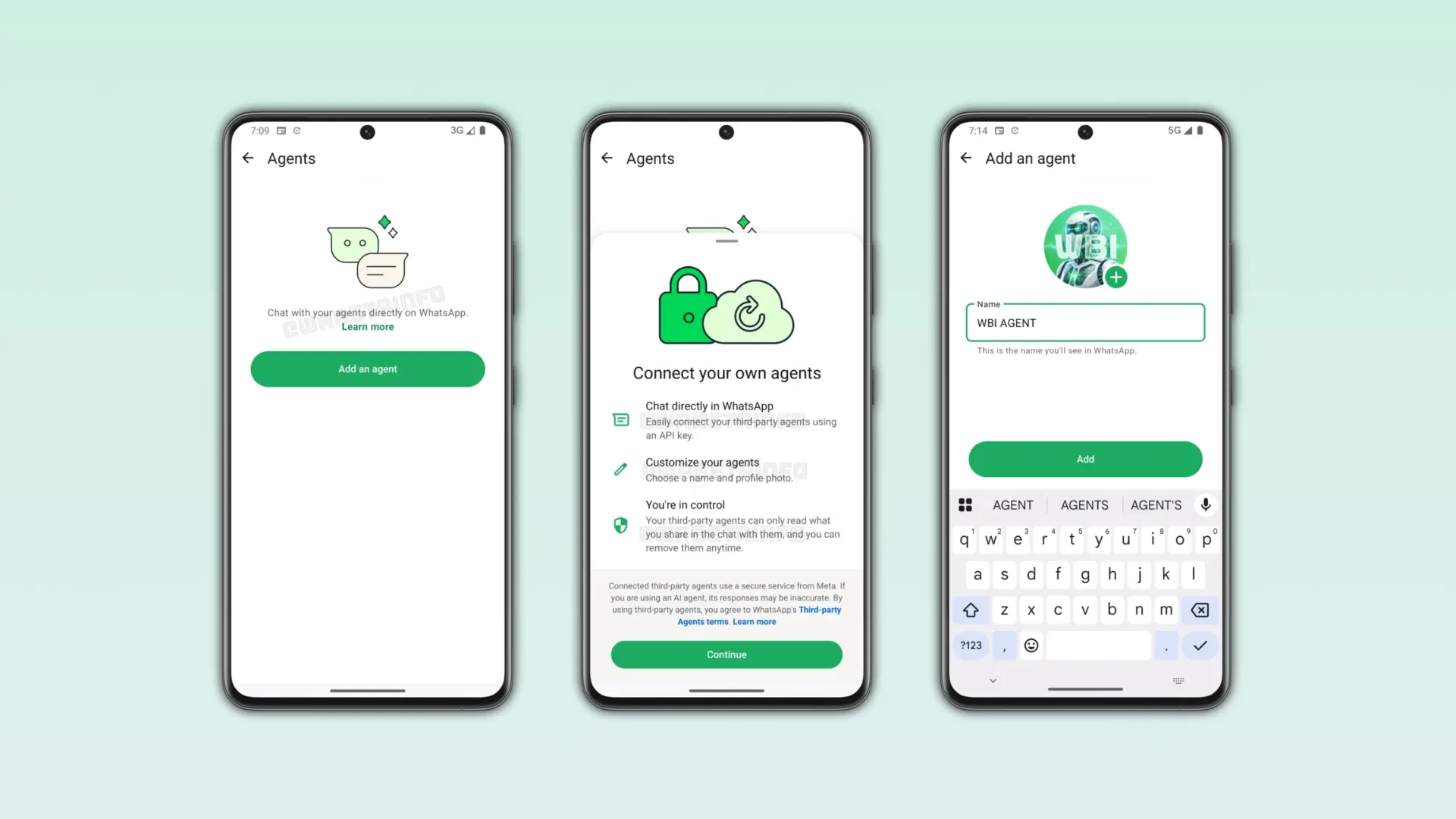
WhatsApp has started rolling out a feature that lets external AI agents join the app in dedicated chats, with no single agent tied to a specific AI provider. The code surfaced in the Android beta on September 4.
Millions of users already run agents on rival platforms such as Telegram. Now AI labs will be able to reach WhatsApp’s user base — which Meta says spans more than two billion people, making it the world’s most widely used messaging app — using nothing more than an API key. Opening that audience to outside developers marks a shift for a service that has historically kept third parties at arm’s length in the name of privacy.
An API key links an external AI agent
The connection works through a key generated inside WhatsApp. Using the New Agents entry in settings, a user can set up an agent, give it a name, and pick a profile photo.
WhatsApp then issues an API key, which the user pastes into the platform hosting the agent to complete the link.
A new key can be created at any time to sever and reestablish the connection. WhatsApp allows up to five agents per account.
Each agent operates in its own one-on-one chat, isolated from the rest of the account. It can only read messages within its own thread and has no access to other chats, contacts, or media files.
For now, agents are limited to one-on-one chats and cannot be added to groups or communities. WhatsApp also cautions that AI agent answers may be inaccurate and that users should verify anything the agent tells them.
Removing an agent disconnects it but does not delete the thread. Old messages remain visible, though reconnecting later requires starting over with a new key.
Agent chats skip WhatsApp’s end-to-end encryption
Messages exchanged with external AI agents are not end-to-end encrypted, because they pass through a Meta service acting on behalf of the agent’s developer.
While the service is running, the developer can see those messages. Meta says this does not expose the chats to unrelated third parties and that normal calls and messages between people remain fully encrypted.
The gap matters because end-to-end encryption has been WhatsApp’s defining privacy promise since 2016, when the app switched it on by default for all chats. The agent chats operate outside that default, a trade-off Meta is asking users to accept in exchange for interoperating with the AI ecosystem at large.
The move reverses WhatsApp’s earlier stance. As agent platforms grew, it was found that connecting a bot to a WhatsApp account could result in the account being banned.
Telegram embraced the trend and became a popular home for talking to both cloud and local agents.
The rollout is currently limited to a small pool of Android users in select countries on beta version 2.26.35.3, with a wider release expected over the coming months and no firm date for a global launch. What to watch next is whether WhatsApp extends agent support to group chats and business workflows, and whether encryption terms or developer access rules change as the feature moves from beta to general availability.
Meta is now competing directly with Google, Anthropic, and OpenAI. In June the company launched a business agent that handles payments, bookings, and sales across WhatsApp, Instagram, and Messenger, along with a platform for firms to build custom agents, as reported by Cryptopolitan.
The plan was to move beyond “rule-based automations” and have the software do the work itself, said Meta’s product head, Naomi Gleit.
