What Stablecoin Holders May Receive if an Issuer Fails
Key Takeaways
- •Reserve backing supports a token’s value but does not itself establish a holder’s ownership of particular cash, Treasury bills or other reserve assets.
- •Direct redemption typically requires issuer eligibility, account verification, compliance checks and compliance with applicable terms.
- •Customers holding tokens on exchanges may first have a contractual claim against the exchange if withdrawals are suspended or the platform fails.
- •A stablecoin can trade below its reference value even while eligible users retain access to issuer redemption, and a depeg may precede formal insolvency.
- •MiCA requires qualifying e-money tokens to be issued at par and provides holders with issuer claims whose details must be disclosed in the relevant white paper.
Reserve backing does not normally give a stablecoin holder title to a specific reserve asset, and the rights involved differ from bank-deposit protection. What a holder may recover depends on where the tokens are held, whether direct redemption by the issuer is available, and how reserves are treated if the company cannot meet its obligations.
Key points
- Reserve backing is not the same as direct ownership of reserve assets.
- Direct redemption often requires the holder to meet issuer eligibility requirements.
- Exchange users may have a claim against the exchange rather than directly against the issuer.
- A depeg can occur before an issuer formally fails.
- The EU’s Markets in Crypto-Assets Regulation gives certain holders defined claims against issuers.
First identify what has failed
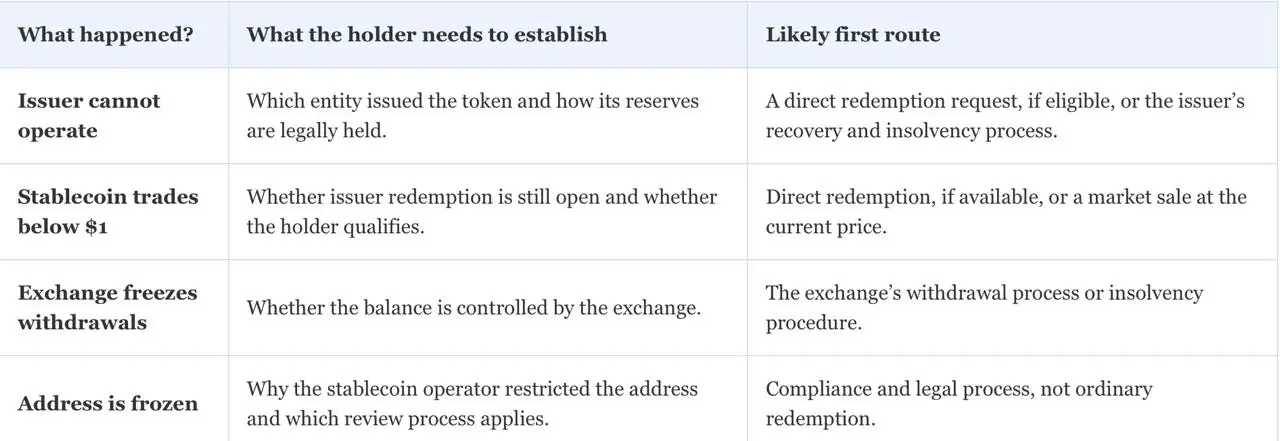
“The stablecoin failed” can describe several different events. The issuing company may become insolvent. A bank or custodian holding part of the reserves may come under pressure. An exchange where a customer stores the token may suspend withdrawals. Alternatively, the token may trade below its reference currency while issuer redemption remains available to eligible customers.
The recovery route depends on which part of the arrangement has failed: the issuer, the exchange, a reserve custodian or the market price.
What reserve backing does—and does not—give holders
When a company says that its stablecoin is backed one-to-one, it is describing an economic relationship: reserve assets are intended to support the tokens in circulation. That statement does not necessarily mean that each holder owns a specified portion of every reserve asset or can choose which asset to receive upon redemption.
If an issuer fails, the relevant legal documents determine whether a holder can demand redemption, benefit from statutory protection or participate with other creditors in an insolvency process. Those documents also determine whether reserve assets are separated from the company’s other property and whether other creditors can reach them.
Reserve quality and legal ownership answer different questions. Cash, Treasury bills and money-market fund holdings may be highly liquid, but liquidity alone does not determine who gets paid first when a company enters insolvency. The Bank for International Settlements’ stablecoin framework says reserve assets should be rapidly liquidated and held in bankruptcy-remote structures. The framework is a benchmark for assessing stablecoin design; it does not establish that every existing issuer uses the same structure. (Source: BIS stablecoin framework)
Redemption rights depend on how the token is held
A verified direct customer, a self-custody holder and an exchange customer may own the same token while having different practical routes to dollars or euros.
Direct redemption generally involves returning tokens to the issuer and receiving the reference currency at par, subject to the issuer’s terms. Circle’s USDC terms, for example, link direct one-for-one redemption to a registered Circle Mint account and other conditions, including the absence of regulatory, court or law-enforcement action restricting redemption.
A self-custody holder without an issuer account may still sell the token on a liquid venue, complete issuer onboarding where available or use an eligible service provider. Such an intermediary may charge fees, impose limits or suspend conversions during market stress. Holding the token does not automatically provide the same operational access as being a verified issuer customer.
For a user holding stablecoins on an exchange, the first problem may not involve the issuer. The exchange controls the wallet and may be the customer’s contractual counterparty. If the exchange pauses withdrawals or enters insolvency, the customer may need to use the exchange’s claims process before gaining control of the tokens or attempting direct redemption.
Verified issuer customer: May submit a direct redemption request, subject to current eligibility, terms and compliance checks.
Self-custody holder: Controls the tokens but may need a qualified route to convert them into fiat currency.
Exchange customer: May have a claim against the exchange before gaining control of the underlying tokens.
What a depeg can mean—and what it cannot
A depeg is a market-price event. If a dollar stablecoin trades at $0.97, the market is valuing immediate access to the token at less than one dollar. The discount may reflect concerns about reserves, slow or unavailable redemption for some users, thin exchange liquidity or a rush to sell.
During a depeg, the practical questions are whether eligible customers can still redeem at par and whether the issuer is processing those requests. Circle’s USDC risk disclosures acknowledge that USDC can trade above or below one dollar on third-party platforms. A lower exchange price alone does not prove that reserve assets are missing.
A token may remain close to $1 because traders expect direct redemption to remain available. If that expectation weakens, exchange prices can fall before a formal insolvency process begins. Selling during a depeg means accepting the market price available at that time. Redeeming at par means using an issuer route that may involve account eligibility, minimum amounts, banking access, compliance checks and processing time.
USDC and USDT: compare the holder route, not the marketing claim
This comparison does not determine what a court would do in an insolvency. It identifies the questions a holder should examine before assuming that two dollar stablecoins provide identical redemption rights.
In its June 30, 2026 filing, Circle said that approximately 84% of USDC reserves were held in the Circle Reserve Fund. The figure is dated, and reserve composition can change. It provides context about how reserves were allocated at that point but does not replace the terms applicable to an individual holder. (Source: Circle filing)
Tether states that its tokens are redeemable for the underlying fiat currency under its published terms and FAQs. However, its relevant information document limits issuer services to customers that have completed KYC. For exchange users, access to USDT trading does not itself establish direct redemption access with Tether.
MiCA gives EU holders a clearer starting point
For e-money tokens issued under the EU’s Markets in Crypto-Assets Regulation, holders have a claim against the issuer. The MiCA regulation requires issuance at par value upon receipt of funds. An issuer’s white paper must describe the redemption right and the conditions for exercising it.
Circle’s MiCA USDC white paper says that funds received by Circle SAS for issuance are protected from recourse by its other creditors in enforcement or insolvency proceedings. It also describes a recovery and redemption plan. Those statements apply specifically to the Circle SAS structure and should not automatically be applied to USDC issued by another entity or held under a different agreement.
A similar separation is described in South Korea, where individual card issuers considering stablecoins would maintain their own reserve pools and redemption systems, according to a review of the projects. A holder must identify the entity behind the token balance rather than rely only on the broader brand name.
An exchange’s regulatory status is a separate issue. A platform operating under EU rules does not turn every stablecoin it lists into an EU-issued token. The distinction became more visible as the MiCA licensing deadline pushed exchanges to clarify their European operations.
Reserve-bank stress is different from issuer failure
A stablecoin can experience delayed redemptions even when its issuer remains solvent. Problems at a reserve bank or custodian can slow transfers, verification or access to funds while the issuer uses other sources of liquidity. The relevant questions are where the reserve assets are held, whether they are legally segregated and whether the issuer can access alternative liquidity quickly.
Europe’s reserve and liquidity rules have made the relationship between stablecoin issuers and banks more visible. For holders, stablecoin risk includes the institutions that safeguard and settle reserve assets, not only the company whose name appears on the token.
What to preserve before something goes wrong
A failure process is easier to navigate when a holder can demonstrate what was owned, where it was held and how it was acquired. On-chain transfers can show the movement of tokens, but they may not establish the full legal relationship with an issuer or exchange.
If the stablecoin was never withdrawn to a private wallet, exchange account statements may be particularly important. A blockchain explorer may show a balance in an exchange wallet, but it may not show that the exchange owed those assets to a specific customer.
Holders should also check whether any issuer account they use is active and verified. Completing identity and banking checks only after a depeg begins may leave a holder dependent on exchange liquidity.
What holders may receive if an issuer fails
A stablecoin holder does not automatically receive a named portion of the issuer’s cash, Treasury bills or other reserve assets. The holder may instead receive a claim defined by the issuer’s terms and the law governing the token.
The strongest possible outcome is continued redemption at par or a claim against legally protected reserve assets. A weaker outcome is a delayed and potentially partial recovery alongside the issuer’s other creditors. A customer who kept tokens on an exchange may first need to recover from the exchange rather than claim directly against the stablecoin issuer.
Reserve backing can support a stablecoin’s value, but it does not by itself determine who gets paid if the issuer fails. The practical answer depends on the issuing entity, the holder’s redemption eligibility, where the tokens are held and whether the reserves are legally separated from the issuer’s other assets.
This article is for informational purposes only and does not constitute legal, financial or investment advice. Stablecoin terms, reserve arrangements and regulations can change. Readers should review the issuer’s current legal documents and seek qualified advice regarding a specific claim or insolvency situation.
Source: Coindoo

