What Is DeFAI? AI DeFi Agents, Wallets, and Execution Risk in 2026
Key Takeaways
- •DeFAI products can range from read-only research tools to autonomous agents that execute transactions within preset wallet limits.
- •The main security question is how much financial authority a product receives, not how advanced its AI appears.
- •A proper DeFAI transaction flow should disclose the protocol, chain, amount, fees, contract calls, and resulting position before and after execution.
- •HeyAnon, HeyElsa, Bankr, Giza, and Almanak illustrate different DeFAI operating models rather than one universal agent design.
- •The article says users should start with read-only access and verify spend limits, allowlists, session expiry, audit trails, and revocation paths before funding an agent.
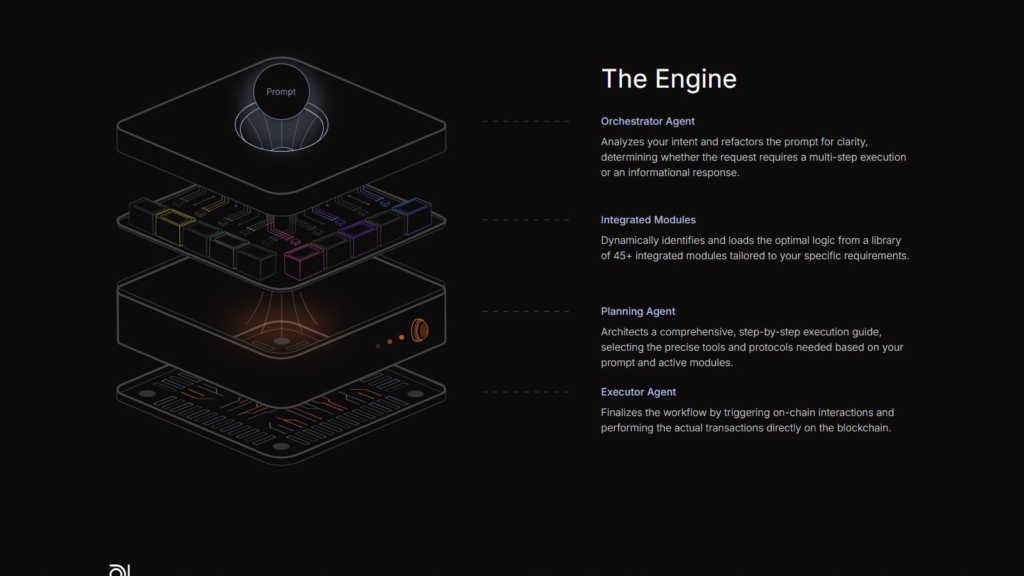
DeFAI — a contraction of decentralized finance plus artificial intelligence — describes products that use AI to research, plan, or carry out onchain financial actions. The category spans read-only research assistants, transaction copilots, automated strategy tools, and agents that can operate a wallet within preset limits.
What separates DeFAI products from much of the broader AI crypto project market is what happens between a user’s instruction and a financial action. A tool that only explains a lending position has no spending authority; an autonomous portfolio agent can move funds, and therefore needs stricter permissions, transaction previews, and a reliable way to revoke access.
What Is DeFAI?
DeFAI is the application layer that makes DeFi easier to use through natural-language requests and automated analysis. A user might ask a product to compare lending rates, explain a wallet position, prepare a cross-chain swap, or keep a portfolio within a chosen allocation. The AI interprets that request and turns it into either an answer, a recommended action, or an exact transaction for a wallet.
The AI itself should not be the final security boundary. Addresses, token amounts, approved protocols, and spending limits need to be checked by deterministic software or wallet policy before funds can move. An AI agent coin may provide access, incentives, or coordination, but a token is optional and does not prove that the product can execute safely.
The category covers four operating models:
- Research copilot — explains markets, protocols, and wallet positions without creating or signing a transaction.
- Transaction assistant — prepares a swap, bridge, or deposit for review, but the user signs every transaction.
- Strategy executor — repeats a defined rule, such as rebalancing, within a limited account controlled by wallet policy.
- Autonomous portfolio agent — selects and executes actions within bounded authority while smart-account rules enforce limits and revocation.
A trading bot follows predefined conditions — buying when a price crosses a threshold, for example — without interpreting a broader objective. An intent-based interface accepts an outcome such as “move 1,000 USDC to a lower-risk lending market” and finds a route, but it may rely on fixed solvers rather than AI reasoning. A DeFAI agent, by contrast, can interpret the user’s goal, compare changing market context, and choose among available actions; if it can also submit transactions, wallet policy must independently restrict what it is allowed to sign.
All four models can be described as DeFAI, but the risk changes sharply once a product can sign or submit a transaction. The important distinction is therefore not how intelligent the interface appears, but how much financial authority it receives.
How a DeFAI Transaction Works
In practical use, a 1,000 USDC lending move should begin with a plain instruction: move the funds only if the destination produces a better return after withdrawal costs, network fees, and any change in collateral risk.
The product can compare markets in the background, but its proposal must name the current protocol, destination protocol, blockchain, amount, estimated fees, and expected balance after the move. A message such as “optimizing your yield” is not enough information to approve a transaction.
The wallet confirmation screen should then expose the exact contracts being called and the USDC allowance being requested. If the strategy only needs 1,000 USDC, an unlimited token approval creates authority the task does not require. The same screen should make a wrong chain, an unfamiliar contract, or a larger-than-requested amount obvious before the user signs.
After execution, the interface should show the transaction hash, USDC withdrawn, USDC deposited, total fees, and the resulting lending position. If the route fails, the product should report where it failed rather than silently trying a different protocol. These details let the user compare the original proposal with the onchain result — and revoke the agent if its behavior changes.
Five DeFAI Products and Operating Models
These products are not ranked by token performance. They illustrate five operating models, from conversational execution to autonomous capital management. AiCryptoCore reviewed their public product surfaces on 2026-08-19 without connecting a wallet or deploying capital; product claims and interface figures remain vendor-reported unless independent evidence is stated.
HeyAnon
HeyAnon presents DeFAI as an orchestration layer rather than a single trading bot. Its public product surface separates Anon for transactions, Gemma for research, and HUD for trading assistance — a useful split, because a research answer, a prepared order, and a signed transaction can each receive a different permission level.
Anon is the transaction-facing component: it turns a natural-language request into a planned sequence of swaps, bridges, deposits, or trades, while Gemma supplies research context and HUD assists traders. The value is orchestration across several steps; the risk is that one prompt can span multiple protocols, approvals, and fee surfaces.
A bridge or swap preview should reveal the venue, destination chain, amount, estimated output, fees, and approval requirement. Connected-venue counts matter less than whether the user can inspect and stop a bad route.
Ease did not mean completeness for one participant in a May 2025 DeFAI platform discussion, who described HeyAnon as smooth to use but still missing features needed for regular trading. That single account does not measure reliability or identify the missing functions, so readers should test their exact route and order type before moving meaningful funds.
HeyElsa
HeyElsa uses a conversational interface for portfolio discovery, swaps, bridges, and automated orders. The project reports more than 945,000 wallets, 18.9 million prompts, and $503 million in volume on its public site — figures that describe claimed usage rather than the quality of individual recommendations.
Elsa combines chat, portfolio construction, and transaction routing in one surface. Its multichain design is most useful when it can collapse a bridge-plus-swap workflow without hiding the two actions, their destination contracts, or the approvals required on each chain.
The useful test is whether one request produces a transparent route, a risk warning, and a transaction matching the stated amount and chain. A clean conversation cannot replace decoded execution details.
A June 2025 hands-on HeyElsa walkthrough first failed to swap unsupported VADER, then completed a 10 USDC-to-ETH swap on Base and a LINK bridge after reducing the default token approval from unlimited to the transfer amount. The test covers one wallet and an older product version, but it yields a concrete rule: verify asset support and edit allowances before confirmation.
Bankr
Bankr illustrates a wallet-native agent across web and messaging surfaces. The same agent can retain preferences, report balances, and prepare transactions without several disconnected dashboards.
The product differs from a single trading bot because the same wallet agent can appear in a web terminal, X, Farcaster, Telegram, or Base App. That portability reduces app switching, but it makes identity linkage, active sessions, and a trusted recovery surface part of the product rather than secondary settings.
That convenience makes channel security central. A social command should not inherit unlimited wallet authority; the setup needs visible sessions, an isolated wallet, action history, and cancellation from a trusted interface.
Channel portability also creates uneven failure modes. In an April 2026 Bankr availability thread, a free-tier user said Base App chat stopped replying after weeks of normal use while Talk to Bankr continued working. The isolated report does not establish an outage rate; it shows why an alternate trusted access path should be tested before relying on social execution.
Giza
Giza’s ARMA and Pulse were onchain AI agents that historically used self-custodial smart accounts and limited session keys to automate lending and yield positions on Base. Both products were retired in March 2026 and user funds were returned, so their past activity should not be presented as a currently available service.
The successor, Giza World, should be evaluated as a new product surface rather than continuity proof. Its public interface needs to demonstrate live agent balances, current market integrations, and a working withdrawal path before historical assets-under-agent figures can support a present-day product claim.
The account boundary matters more than projected yield. The agent should not send funds to arbitrary addresses, enter unapproved protocols, or continue after revocation; decision traces need enforcement outside the model.
Withdrawal design was a practical limitation in a Giza product review checked in August 2026: ARMA-era users reportedly had to stop an agent completely because partial withdrawals were unavailable, even though stablecoin allocation was generally described as reliable. This is attributed historical feedback, not a measured Giza World failure rate; verify partial exits and independent revocation on the live successor before funding it.
Almanak
Almanak represents builder-focused DeFAI. Its workflow moves from strategy design to simulation, deployment, and monitoring through scoped Safe roles, making the strategy reviewable before live execution.
The current public app states that Almanak is sunsetting vaults and no longer accepts new deposits, although withdrawals remain available. That changes the relevant product test: prospective builders can examine strategy tooling and permissions, while existing vault users should confirm their withdrawal route rather than compare stale deposit yields.
Backtests should include fees, slippage, and losing periods; fork simulation should exercise the intended contract calls. Live monitoring must show position health, failed actions, and policy breaches — not just profit.
During a 2025 hands-on Almanak walkthrough, the reviewer created a strategy and wallet but could not complete a sample deployment because the interface returned an insufficient-funds error despite funds in the Safe. The test predates the vault sunset and cannot describe today’s build; it identifies deployment validation and readable error handling as checks to complete before assigning capital.
The Execution Stack Behind a DeFAI Interface
A DeFAI product normally depends on compute, data, and account systems also found across AI infrastructure crypto networks, although those components are not themselves financial agents. Account infrastructure packages transactions, a smart account enforces authority, and a toolkit exposes blockchain actions to the model.
Calling every component a DeFAI project blurs who actually makes the decision. Compute, data, and account providers can support an agent, but supporting infrastructure does not establish end-user demand for a DeFAI workflow.
For a high-value action, the model should propose while the smart account enforces. Contract allowlists, token limits, per-transaction caps, daily caps, and session expiry remain useful even when the model behaves correctly, because they also contain compromised credentials and integration errors.
Conclusion
DeFAI can remove genuine friction from research, routing, portfolio monitoring, and repetitive execution. The category becomes most useful when the system explains what it intends to do, converts that intent into inspectable calls, and operates inside permissions that a model cannot rewrite.
HeyAnon, HeyElsa, Bankr, Giza, and Almanak show that even among today’s top AI crypto projects, DeFAI is splitting into different operating models rather than one universal agent. Readers should compare the authority granted, evidence produced, and recovery path before comparing claimed intelligence or token upside; no category label replaces verifiable transaction records and enforceable wallet controls.
Frequently Asked Questions
Is every AI crypto trading bot a DeFAI agent?
No. A fixed-rule bot can automate trades without interpreting goals or adapting a plan. A DeFAI agent normally combines model-based reasoning or natural-language intent with DeFi data and an execution path, although the amount of autonomy varies.
Does a DeFAI product need its own token?
No. A token may pay for access, coordinate operators, or secure a network, but it is not required for an AI-assisted DeFi workflow. Product utility and token value should be evaluated separately.
Is a smart account itself a DeFAI product?
No. A smart account is an enforcement and execution component. It becomes part of a DeFAI system when an agent uses it under defined permissions, but the account does not supply the strategy or reasoning by itself.
What is the safest starting configuration?
Use read-only access first. Move to a separate low-value account only after verifying the proposed transaction, spend limits, contract allowlist, session expiry, audit trail, and independent revocation path.
Disclaimer: The information provided on AiCryptoCore.com is for educational and informational purposes only and does not constitute financial, investment, or trading advice. Cryptocurrency investments involve risk and may result in financial loss. Always conduct your own research and consult with a qualified financial advisor before making any investment decisions.

