Unknown Whale Transfers 6,494 BTC to Binance-Linked Wallet, Raising Sell-Off Concerns
Key Takeaways
- •A single Bitcoin address received 45 confirmed incoming outputs totaling approximately 6,494 BTC between July 19 and August 8, then spent its entire balance.
- •Twenty-three of the address's 25 spending transactions routed funds to a wallet identified as Binance-controlled in both a 2022 proof-of-reserves report and a U.S. federal court record.
- •On-chain analytics platform Lookonchain described the address owner as a possible miner, but the transaction data does not independently confirm a mining counterparty.
- •The total value of the transferred Bitcoin was approximately $423 million at the time of the analysis, with Bitcoin trading near $65,178.
- •Analysts caution that a single address-level transfer cannot definitively signal sell pressure, as the public ledger cannot distinguish between a customer deposit and an exchange's internal wallet reorganization.
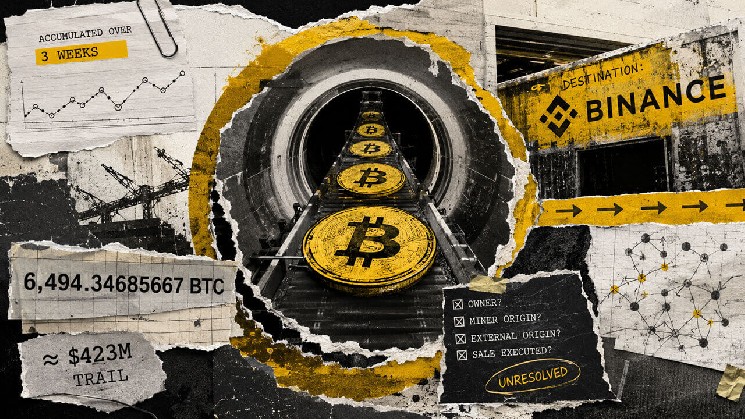
Unknown Whale Transfers 6,494 BTC to Binance-Linked Wallet, Raising Sell-Off Concerns
Over a three-week period, a Bitcoin address accumulated more than 6,494 BTC and subsequently moved its entire confirmed balance. Nearly all of the traced coins passed through transactions that also paid a wallet historically attributed to Binance — the world's largest cryptocurrency exchange by spot trading volume — according to on-chain records.
The total flow was valued at approximately $423 million, placing a significant block of BTC within reach of exchange infrastructure. Movements of this magnitude to exchange-linked addresses are closely watched by traders and on-chain analysts as a proxy for potential sell pressure, though the signal is inherently noisy. The public ledger cannot identify a single owner, distinguish between a customer deposit and Binance's own internal wallet staging, or reveal any trades executed within the exchange.
On-chain analytics platform Lookonchain surfaced the address early Sunday, describing its owner as a "mysterious whale" who was possibly a miner. While the transaction history confirms the scale and routing of the funds, those ownership characterizations remain uncorroborated. The possibility of a miner-originated flow would be consistent with a pattern in which mining operators periodically route block rewards through intermediate addresses before consolidating proceeds, but the address's incoming outputs do not by themselves confirm a mining counterparty.
Transaction Breakdown
The Bitcoin address received 45 confirmed incoming outputs totaling 6,494.34685667 BTC between July 19 and August 8. Across its 70 confirmed transactions, the address spent the same total amount and held a zero confirmed balance at the time of reporting.
Of the 25 transactions that spent coins from the address, 23 also paid the address bc1qm34lsc65zpw79lxes69zkqmk6ee3ewf0j77s3h, collectively consuming 6,494.33835675 BTC from the subject address. The remaining two transactions involved a combined 0.00849992 BTC.
The 6,494 BTC figure represents the Bitcoin address's contribution to those transactions rather than the precise amount credited to the destination wallet, as some transactions combined coins from multiple addresses.
The final confirmed receipt in the reconstructed set delivered 1,000.00882659 BTC on August 8. A subsequent transaction spent those funds within two and a half hours, directing them to the same destination address.
Binance Wallet Attribution
A 2022 proof-of-reserves report listed that destination address among those Binance controlled at the time. A later US federal court record also identified it as a Binance-controlled address on the Bitcoin network. These historical records establish a strong public attribution as of their respective dates, though they do not confirm current control as of August 2026.
The observed transaction pattern is consistent with deposit-and-sweep activity — a process exchanges use to consolidate coins from incoming addresses. Both an external holder preparing to trade and an exchange reorganizing its own wallets can produce a similar public trail.
This ambiguity complicates the market signal. Exchange-addressed BTC creates sell-side optionality because the assets are positioned at a point where they could enter the market, while the blockchain trail ends at the exchange's boundary. In practice, aggregate exchange BTC balances — tracked by firms such as Glassnode and CryptoQuant — are widely used as a supplementary gauge of whether supply is flowing toward or away from venues where it can be sold. A single address-level transfer, however, does not shift the aggregate enough to be dispositive on its own.
Bitcoin traded near $65,178 at the time of the analysis. The next informative signals would include additional confirmed flows involving the same Bitcoin address along the same route, along with changes in broader exchange balances and spot trading volume. Together, those metrics would indicate whether the supply is expanding and whether the market is absorbing it.

