Western Heat Ignites Natural Gas Cash as Spot Prices Soar Across Much of the U.S.
Key Takeaways
- •Late-season heat strengthened U.S. spot natural gas cash markets on Sept. 8, with gains concentrated in the West and extending into Appalachia and the Northeast.
- •California recorded outsized price increases, reflecting its status as one of North America's most volatile spot gas markets during extreme heat and air-conditioning demand.
- •Wyoming Interstate Company declared force majeure, meaning it cannot fully meet contractual transportation commitments and may curtail shippers' nominated flows in the Rockies.
- •Price strength rotated geographically, easing along the Gulf Coast and in the Southeast while advancing from producing regions such as the Permian Basin toward demand centers.
- •Sustained heat is keeping power burn elevated, and market participants are monitoring weather conditions and WIC's operational recovery to determine whether the regional pattern persists.
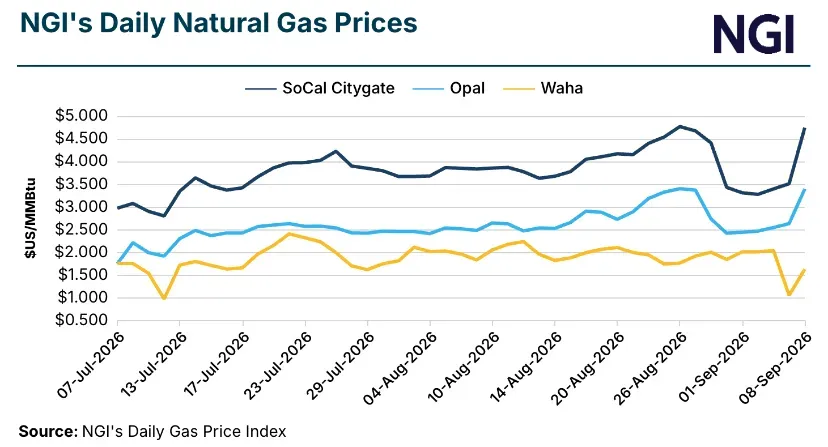
Spot natural gas prices strengthened across much of the United States on Tuesday, Sept. 8, as late-season heat ignited cash markets in the West, with gains spreading from the Permian Basin and the Rockies into Appalachia and the Northeast, according to Natural Gas Intelligence.
The strength was broadest in the western half of the country. California posted outsized gains, in keeping with its standing as one of the most volatile spot gas markets in North America, where prices can swing sharply when extreme heat drives up air-conditioning load. Regional averages flagged in NGI's report — covering California, the Rocky Mountains, and West Texas/southeast New Mexico — underscored the West's central role in the day's trading.
A notable operational development also emerged in the Rockies: Wyoming Interstate Company (WIC) declared force majeure. Such declarations mean an interstate pipeline cannot fully meet its contractual transportation commitments, typically because of an operational disruption, and they can curtail shippers' nominated flows. The event added a physical-supply wrinkle to an already firm Rocky Mountain cash market.
The geography of strength rotated through the session. Elevated prices along the Gulf Coast and in the Southeast reversed course and eased back, even as gains advanced out of producing areas such as the Permian Basin, a leading U.S. oil and gas producing region, and into demand centers in Appalachia, the country's largest natural gas-producing region, and the Northeast.
Near-term demand remains strong. Persistent heat sustains elevated power burn, as natural gas is a leading fuel for electricity generation during peak cooling periods. Cash, or spot, prices reflect next-day physical deliveries and respond immediately to localized weather and pipeline events, in contrast to futures benchmarks such as Henry Hub, which price expectations further out on the calendar.
For the physical market, the key developments to monitor are the duration of the heat and any change in WIC's ability to meet transportation commitments. Those factors, alongside the movement of prices between producing regions and demand centers, will help determine whether the regional pattern reported by NGI persists in subsequent cash markets.
NGI senior natural gas reporter Jodi Shafto reported the story, which draws on the outlet's Daily Gas Price Index, produced with Entropic Analytics.
Source: Western Heat Ignites Natural Gas Cash as Prices Soar, Natural Gas Intelligence, Sept. 8, 2026.
