Week 38 Crypto Market Watch: Fed Hike, CLARITY Failure, and Bitcoin’s Reclaim of $81,000
Key Takeaways
- •The Federal Reserve lifted the federal funds target range to 3.75%-4.00%, its first hike in more than three years, and the Senate failed to advance the CLARITY Act, together triggering a midweek crypto sell-off.
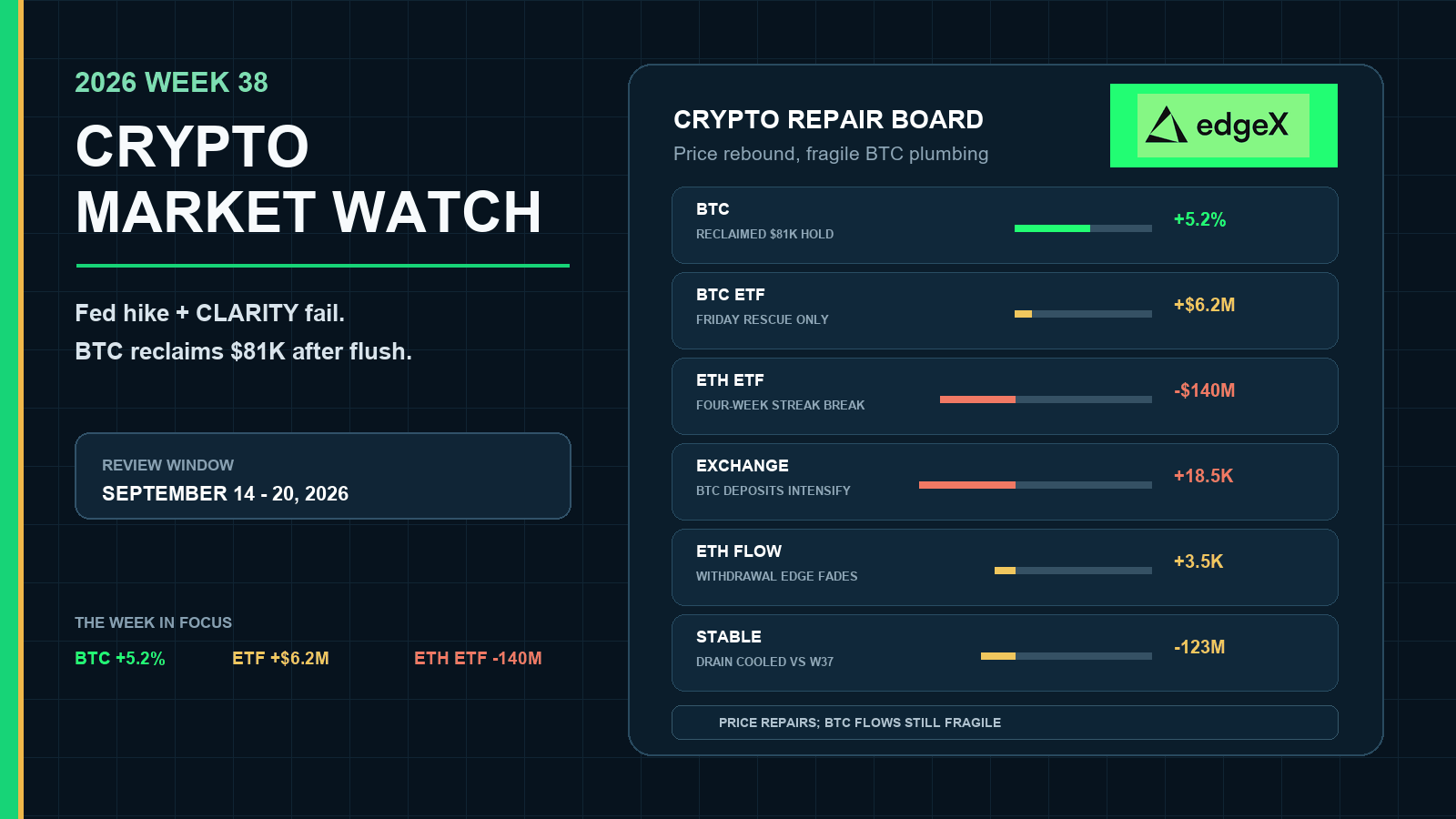
- •Bitcoin and Ether each gained roughly 5% for the week after flushing to lows near $75,383 and $2,388 and rebounding through $81,000 and $2,600 respectively.
- •Bitcoin spot ETFs finished only about $6.21 million net positive despite a $433.03 million Friday inflow led by Fidelity's FBTC and BlackRock's IBIT.
- •Ethereum ETFs recorded roughly $140 million in outflows that broke a four-week inflow streak, while Solana, XRP, and HYPE wrappers stayed net positive.
- •Bitcoin exchange netflow showed about 18,513 BTC in net deposits during the week, leaving rising on-exchange supply unconfirmed against the price reclaim and framing Week 39's validation question.
Quick Answer
Week 38 answered Week 37’s open policy binary with a market story, not a neat flow resolution. Traders sold the Fed hike and the CLARITY Act failure first, then bought the absorption once the headlines were out. Bitcoin and Ether both printed that two-act path: midweek flush into the mid-$75,000s and high-$2,300s, then a second-half reclaim through $81,000 and $2,600.
The rebound was real. The confirmation was not complete. Bitcoin ETFs needed a $433 million Friday to finish only about $6 million green. Ether ETFs lost about $140 million and snapped their creation streak. Bitcoin kept migrating onto exchanges even as price rose. Arc’s launch and selective alt-wrapper demand help explain why breadth exploded while Bitcoin’s institutional bid stayed only barely alive. Week 39 therefore starts with a better price tape and the same unfinished question: can Bitcoin plumbing catch up to the reclaim?
Fed Hike, CLARITY Failure, and Arc: The Three Forces That Drove the Week
Week 38 is easiest to misread if you start with the scoreboard. Start with the three narratives that forced it.
The Fed hike sold as a risk event, then traded as digested news
The Federal Reserve’s September decision lifted the funds range to 3.75%–4.00%, the first hike in more than three years. For crypto, that mattered less as a one-day surprise and more as a regime signal. After months of debating whether inflation and oil would force policy tighter, markets finally got the delivery. The dollar’s move back above 100 reinforced the first reaction: tighter financial conditions and a classic de-risking impulse into the September 15–16 cluster.
That is why Bitcoin and Ether did not initially trade the hike as a “buy the event” tape. They sold it. The midweek lows near $75,383 and $2,388 were the market’s first draft of the Fed story: higher policy rates, firmer dollar, and unfinished geopolitics/oil risk still in the background. BTCC’s wrap also kept Middle East shipping stress on the radar, so the flush was rates plus residual hard-asset uncertainty.
The second draft arrived later in the week. Once the hike was out, gold and silver rebounded with crypto rather than against it, and traders treated the worst of the policy shock as absorbed rather than still ahead. That shift—from “the Fed is about to hurt risk” to “the Fed has delivered”—is the hinge of Week 38’s price repair. It does not mean financial conditions suddenly turned easy. It means the market stopped paying the same premium for anticipation.
CLARITY’s failure kept the institutional ceiling lower than the spot rebound
If the Fed explained the flush, the Senate’s failure to advance the CLARITY Act helps explain why the rebound never fully recruited Bitcoin’s institutional wrappers. CLARITY was the week’s clearest U.S. market-structure disappointment. Spot traders can buy a washout on technical and macro-absorption logic. ETF allocators still care whether Washington is clarifying the rules of the road or leaving them contested.
That distinction shows up in the week’s split personality. Bitcoin price reclaimed $81,000. Bitcoin ETFs only finished about +$6.21M green after a violent two-way path. The market could repair the chart without repairing the confidence channel that would have turned the rebound into broad wrapper demand. CLARITY did not invent that fragility—Week 37 had already broken Bitcoin ETF persistence—but it made a clean institutional re-rating harder while price looked healed.
Arc launched into the disappointment and split the narrative tape
Circle’s Arc mainnet going live is the third force, and it is why Week 38 cannot be reduced to “hawkish Fed equals crypto down.” Arc arrived as an institutional infrastructure and stablecoin-network headline in the same window CLARITY failed. That created a split screen: U.S. legislative disappointment on one side, and a live product milestone for the institutional crypto-rail complex on the other.
Markets often resolve splits like that by becoming selective. That is exactly what Week 38 did. Selective ETF wrappers—especially Solana, with XRP and HYPE also net positive—kept attracting cash. High-beta alts staged catch-up moves. At the same time, Bitcoin’s ETF complex stayed only barely positive and Ether wrappers flipped red. Arc did not “cause” every NEAR or ARB spike. It did help create a week in which infrastructure optimism could coexist with unfinished U.S. regulatory disappointment.
The Arc meme tape made the same point more loudly. Names tied to the Arc ecosystem, including the spike-then-fade set around LONG, ARGUS, TOLLY, and ARCAT, dominated social attention without fixing Bitcoin ETF persistence or exchange-dollar structure. Useful color; not the investable conclusion. The durable Arc point is narrower: infrastructure headlines can support selective demand and breadth even when the headline regulatory story is negative.
How Price Traded Those Narratives
Once the three forces are clear, the BTCC price path reads like evidence rather than a disconnected percentage. Bitcoin’s completed week near +5.2% hides the more important sequence. Price cracked around the September 15–16 policy cluster, briefly printed near $75,383, then reversed through $81,000 by September 18–20. That is a different ending from Week 37’s failed $80,000 hold. The market bought the Fed/CLARITY event after selling the anticipation.
Ether followed the same narrative shape. The week’s about +5.9% gain came after a September 15-area low near $2,388 and a rebound through $2,600. Ether confirmed a complex-wide response to policy digestion, not a Bitcoin-only short cover. The second-half bounce still traded under an unfinished macro overlay: a firmer dollar, residual oil and shipping risk, and live 2026 tightening risk after the hike. Week 38’s rebound should therefore be read as absorption inside an active macro tape, not as proof that crypto had been re-rated into easy liquidity.
What Institutional Flows Said About the Same Story
Flows are where the Fed/CLARITY/Arc split becomes measurable.
Bitcoin ETFs showed absorption only after the damage was done
Bitcoin wrappers did not lead the reclaim. They lagged it, then rescued the weekly total late.
| Session (SoSoValue $) | BTC ETF net | Narrative read |
|---|---|---|
| Mon Sep 14 | +$160.04M | Early support before the policy cluster |
| Tue Sep 15 | −$450.33M | Hike/CLARITY flush hit institutional demand |
| Wed Sep 16 | −$295.98M | Second heavy outflow day into the lows |
| Thu Sep 17 | +$159.45M | First repair after the headlines landed |
| Fri Sep 18 | +$433.03M | Rescue session that saved the week |
| Week total | +$6.21M / ~+0.17K BTC | Barely green; path more important than sign |
The Block’s week wrap matches that near-flat finish: Tuesday–Wednesday outflows left the complex deep underwater before Thursday’s repair and Friday’s large +$433.03M intake, led by Fidelity’s FBTC (~+$310.7M) and BlackRock’s IBIT (~+$108.4M). Cumulative Bitcoin ETF inflows remained near $55.16B, with net assets about $102.53B on Friday. Read through the week’s narratives, that path makes sense. The Fed/CLARITY shock hit compliance-sensitive demand hardest midweek. The later Arc-and-absorption rebound repaired spot faster than it repaired wrapper confidence.
Ether ETFs broke just as Ether price looked repaired
Ethereum ETF dollars flipped from Week 37’s still-positive bid to about −$140.00M / −58.69K ETH. The prior four green weeks had collected about $1.94B combined, so Week 38 is a genuine streak break. Ether ETF net assets still sat near $16.72B. The analytical point is the divergence: Ether price reclaimed $2,600 while Ether wrappers finished red. That is what a narrative-led rebound without full institutional confirmation looks like.
Selective wrappers behaved more like the Arc/breadth sleeve than like Bitcoin
Solana ETFs were the clearest product-demand winner at about +$60.8M / +600.38K SOL, including a +468.60K September 18 spike with the late-week risk rebound. XRP ETFs added about +$9.56M / +7.13M XRP. HYPE flipped back to net creations at about +$3.06M / +40.22K HYPE. Aggregate U.S. crypto spot ETF AUM recovered from about $117.49B at the Week 37 end to about $123.96B by September 18. Capital did not abandon crypto products after the Fed hike and CLARITY failure. It became pickier, favoring wrappers tied to ongoing product demand and catch-up beta over a broad Bitcoin re-rating.
Venue Liquidity Only Half-Confirmed the Reclaim
Exchange and stablecoin data keep the same story honest. CryptoQuant’s all-exchange BTC netflow for September 14–20 totaled about +18,513 BTC, far heavier than Week 37’s already-warning +3,648 BTC. If the Fed/CLARITY flush had been followed by clean off-exchange absorption, visible Bitcoin supply should have been falling into the reclaim. Instead, deposits intensified. That can support short-covering. It does not confirm that long-form demand removed supply from the market.
ETH exchange netflow finished near +3,546 ETH after Week 37’s −106,267 ETH withdrawal week, so the ETH complex lost the cleaner institutional split it held one week earlier. All-stablecoin exchange netflow totaled about −$122.91M. Versus Week 37’s −$840.15M, that is a major de-escalation and one reason the late rebound could happen at all. It is still not a rebuilt dry-powder week.
| Week 38 signal | Reading | Narrative meaning |
|---|---|---|
| BTC price | ~+5.2%; low ~$75,383; finish ~$81,000 | Fed/CLARITY flush absorbed; $80k shelf reclaimed |
| ETH price | ~+5.9%; low ~$2,388; reclaim >$2,600 | Complex-wide repair after the policy cluster |
| BTC ETF flow | ~+$6.21M / +0.17K BTC | Institutional confidence lagged the chart |
| ETH ETF flow | ~−$140M / −58.69K ETH | Price repaired while wrappers broke streak |
| SOL / XRP / HYPE ETFs | +600.38K / +7.13M / +40.22K | Selective demand survived the split tape |
| BTC exchange netflow | ~+18,513 BTC | Rebound without clean supply absorption |
| Stablecoin netflow | ~−$122.91M | Drain cooled; dry powder not rebuilt |
| Aggregate ETF AUM | ~$117.49B → $123.96B | Mark-to-market plus mixed creations |
Why Breadth Exploded Anyway
If Bitcoin plumbing stayed fragile, why did altcoins look strong? Because Week 38’s narrative split favored catch-up beta once the policy flush was absorbed. The CoinGecko listing snapshot into September 21 showed broad repair after Week 37’s underperformance. Seven-day percentages span late Week 38 into the early Week 39 open, so they rank relative breadth rather than replace BTCC’s locked Bitcoin and Ether weekly scores.
| Asset | Snapshot | 7d % | Story |
|---|---|---|---|
| SOL | ~$116.87 | +14.5% | Reclaimed $100 with strong ETF support |
| XRP | ~$1.49 | +6.3% | Price finally participated with still-positive wrappers |
| BNB | ~$790.59 | +9.2% | Large-cap beta repaired |
| HYPE | ~$95.87 | +19.5% | Recovered as ETF flows flipped back to creations |
| ZEC | ~$1,554 | +37.3% | Privacy leadership returned |
| SUI | ~$1.021 | +40.8% | Steep large-cap recovery |
| UNI | ~$8.92 | +41.4% | DeFi high-beta leadership |
| AVAX | ~$11.42 | +52.9% | L1 catch-up leadership |
| NEAR | ~$4.19 | +73.1% | Standout weekly leader |
| ARB | ~$0.229 | +68.7% | L2 leadership |
Solana was the cleanest large-cap repair outside Bitcoin: near $117, about +14.5% over seven days, and back above the $100 shelf lost in Week 37. XRP finally stopped lagging its wrapper near $1.49. Below the top shelf, NEAR, ARB, AVAX, SUI, and UNI did the sprint. That is what a market looks like when traders believe the immediate policy shock has been survived and infrastructure headlines give them permission to re-risk selectively. BTCC’s Arc-ecosystem meme burst showed the noisier version of the same split: attention can detach from investable structure without answering whether Bitcoin ETF demand can persist after CLARITY’s disappointment.
Week 39 Outlook: Make the Reclaim Earn Its Keep
Week 39 covers September 21–27, 2026. The base case is post-hike digestion after a policy-flush recovery, not an automatic trend handoff. The Fed has delivered. CLARITY has disappointed. Arc has launched. The market now has to decide which of those forces dominates positioning after the first bounce.
The constructive path
First, Bitcoin ETF sessions need a cleaner second net-positive week without another −$450M-style interior drawdown. Second, BTC exchange netflow should roll back toward withdrawals. Third, stablecoin exchange netflow should flip from mild drain to rebuild. Fourth, Ether ETFs need to stop the post-streak bleed if ETH is going to lead rather than only follow. The constructive case is BTC holding the low-to-mid $80,000s, ETH defending $2,600–$2,700, SOL staying above $100, and leaders such as NEAR, ARB, AVAX, SUI, and ZEC consolidating instead of immediately mean-reverting.
The downside path
A second barely-green or red Bitcoin ETF week, another heavy BTC deposit impulse, or a post-hike package that re-tightens financial conditions would raise the odds that Week 38 was mainly policy absorption inside a still-broken demand regime. The first warnings would be BTC losing $80,000 again while exchange balances keep rising, ETH ETFs staying red, SOL failing back through $100, and high-beta leaders reversing faster than Bitcoin. In narrative terms, that would mean the Fed/CLARITY shock still defines the medium-term tape more than Arc optimism does.
The decision criterion for Week 39 is not whether altcoins can spike after a flush. It is whether Bitcoin wrapper demand and exchange-dollar structure can validate the $81,000 reclaim under a live post-hike, post-CLARITY, post-Arc regime.
Trade Crypto With Leverage - Without Giving Up Custody
Decentralized perpetual exchanges have moved well past niche status. According to CoinGecko's 2025 Annual Crypto Report, DEX perpetual trading volume surged 346% last year, reaching $6.7 trillion, while centralized exchange open interest fell 20.8% over the same period. Traders are committing serious capital to on-chain derivatives, and the reasons are straightforward: counterparty risk is real, custodial failures happen, and censorship resistance matters.
edgeX is a decentralized perpetual futures exchange built for traders who want market access without sacrificing control.
Here's what sets it apart:
- No KYC, no barriers. Connect a wallet and start trading. No identity verification or account approvals are required.
- True self-custody. edgeX combines off-chain order matching with verifiable on-chain settlement secured by Ethereum. Forced-withdrawal mechanisms keep funds recoverable directly from the blockchain even if the operator goes offline.
- Deep liquidity, tight spreads. edgeX maintains $10 million of market depth within a one-basis-point spread, with sub-0.1-basis-point slippage on trades exceeding $100,000.
- Up to 100x leverage. Traders can scale positions to match their risk framework, whether hedging exposure or trading momentum.
- 140% trading fee rewards. Active traders can earn rewards on their trading activity, reducing the net cost of frequent strategies.
- Institutional-grade infrastructure. edgeX processes up to 200,000 orders per second with matching latency below 10 milliseconds.
Start trading crypto perpetual futures on edgeX and put your market view to work.
Frequently Asked Questions
What dates does the Week 38 Crypto Market Watch cover?
The review covers September 14 through September 20, 2026, using UTC dates. Week 39 refers to September 21–27, 2026.
How did the Fed hike, CLARITY failure, and Arc launch affect crypto?
The Fed hike to 3.75%–4.00% and a firmer dollar drove the midweek flush. CLARITY’s failure kept U.S. market-structure uncertainty alive and helped explain why Bitcoin ETF demand stayed only barely positive. Arc’s mainnet launch split the tape by giving infrastructure and selective product demand a positive headline in the same week, supporting alt breadth and wrappers such as SOL even as Bitcoin plumbing stayed fragile.
Why did Bitcoin rebound after the Fed hike?
Bitcoin sold the hike and CLARITY Act failure into a midweek low near $75,383, then recovered as markets absorbed the policy shock. BTCC’s wrap put the completed week near +5.2%, with price back around $81,000 by September 20.
What did the ETF data show?
Bitcoin spot ETFs finished only about +$6.21M / +0.17K BTC after a +$433.03M Friday rescue. Ethereum spot ETFs lost about $140M / 58.69K ETH and ended a four-week inflow streak. Solana, XRP, and HYPE ETF wrappers stayed net positive.
Did exchange flows confirm the rebound?
Only partly. BTC exchange netflow stayed deeply positive at about +18,513 BTC of net deposits, so visible supply rose into the rally. ETH exchange netflow finished near +3,546 ETH after losing Week 37’s large withdrawal edge. Stablecoin exchange netflow was about −$122.91M, improved from Week 37’s −$840.15M but still not a full rebuild.
What should traders watch in Week 39?
Watch whether Bitcoin ETF demand can post a cleaner second positive week, whether BTC exchange netflow stops depositing, whether stablecoin balances rebuild, whether Ether ETFs stabilize after the streak break, and whether SOL above $100 plus high-beta leaders can consolidate under a live post-hike, post-CLARITY, post-Arc regime.

