Will U.S. Inflation and the ECB Reset the Global Rate Outlook in Week 37?
Key Takeaways
- •U.S. August CPI on September 11 is viewed as the week's largest global rate catalyst, with its meaning dependent on the prior day's PPI and the ECB decision.
- •The ECB decision on September 10 can reprice European yields, EUR, sovereign spreads, and global funding conditions independently of U.S. inflation data.
- •China's August CPI and PPI will test whether nominal demand is broadening, after July profit growth at major industrial firms slowed to 11.2%, the weakest in seven months.
- •Japan's second Q2 GDP estimate, following initial growth of 0.3% quarterly, will indicate whether the expansion is supported by domestic demand rather than net exports or inventories.
- •Week 35 data showed U.S. headline PCE inflation at 3.7% year over year with Q2 GDP at a 1.5% annualized pace, signaling resilient demand but insufficient disinflation.
Quick Answer
Week 37 is a global inflation-and-policy test. Softer U.S. producer and consumer prices, a measured ECB stance, firmer Chinese pricing, and an upward-quality revision to Japan's GDP would support lower real yields and broader risk appetite. Sticky U.S. inflation combined with ECB tightening and weak Chinese demand would produce a harsher mix: higher discount rates in developed markets and weaker earnings confidence in Asia. Week 35's completed data already warned against a simple soft-landing narrative because U.S. inflation remained elevated while growth signals diverged sharply across countries.
Why Week 37 Can Reprice More Than One Market
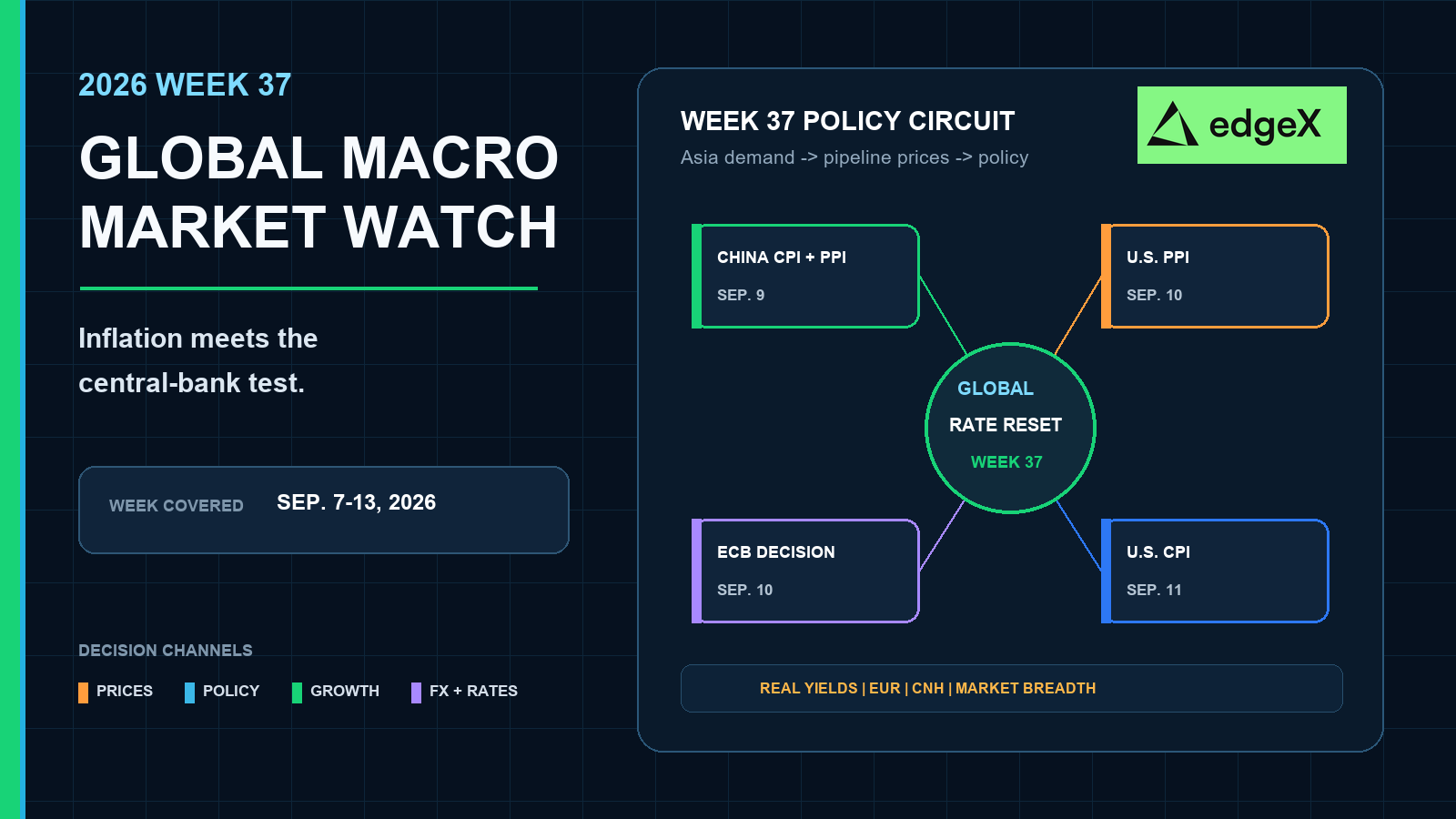
The week moves from Asian growth and pricing evidence into a two-day developed-market policy shock. Japan's revised national accounts and China's inflation report establish whether Asian demand is improving beneath strong technology exports. U.S. PPI then measures pipeline pressure, the ECB sets the European policy response, and U.S. CPI determines whether households are experiencing the same inflation impulse.
Those releases do not carry equal information. Producer prices can rise because of energy, trade costs, margins, or supply bottlenecks without passing fully into consumer inflation. An ECB rate decision can tighten European financial conditions even if U.S. inflation is easing. China can report positive factory-gate inflation while household demand remains weak. Week 37 therefore depends on transmission, not a single headline.
The sequence turns inflation into a cross-asset test
Markets will compare U.S. goods, shelter, and services inflation with the ECB's assessment of wages, energy, credit, and demand. If both regions show persistent inflation, global duration risk rises and highly valued equities face a higher discount rate. If U.S. inflation cools while the ECB remains firm, EUR and European rates may carry more of the adjustment.
China and Japan add an earnings channel. Better Chinese consumer pricing accompanied by stable producer margins would support domestic-demand expectations. A stronger-quality Japanese GDP revision led by consumption or investment would reinforce regional growth. Weak demand in both economies would leave lower yields looking more like a growth warning than a liquidity benefit.
Week 37 Global Macro Calendar
| Date | Region | Scheduled Event | Why Markets Care |
| September 8 | Japan | Second preliminary estimate of Q2 GDP | Reassesses consumption, business investment, inventories, trade, JPY, JGBs, and the BOJ normalization case. |
| September 9 | China | August CPI and PPI | Tests household demand, food and energy effects, factory margins, CNH, Asian equities, and industrial commodities. |
| September 10 | United States | August Producer Price Index | Measures pipeline inflation across goods, services, trade margins, and intermediate demand before CPI. |
| September 10 | Euro area | ECB monetary-policy decision and press conference | Can reprice European curves, EUR, banks, credit, sovereign spreads, and global duration exposure. |
| September 11 | United States | August Consumer Price Index | The week's largest global rate catalyst across headline, core, shelter, goods, and services inflation. |
| September 11 | United Kingdom | July monthly GDP | Tests services, production, construction, GBP, gilts, and the durability of the UK's Q2 expansion. |
U.S. PPI and CPI Must Tell a Consistent Story
The Bureau of Labor Statistics schedules August PPI for September 10 and CPI for September 11, both at 8:30 a.m. Eastern. July PPI for final demand was unchanged, with services up 0.2% and goods down 0.7%. July CPI rose 0.2% for core items on a seasonally adjusted basis and 2.5% over the year, while the later PCE report showed a firmer inflation profile. The different baskets and weights make Week 37 a reconciliation exercise.
Pipeline pressure matters most when it reaches categories with durable consumer pass-through. A rise in trade services, transportation, energy, or processed goods may squeeze corporate margins before it reaches CPI. Persistent shelter and labor-intensive services inflation would be more directly relevant to the Federal Reserve's reaction function.
Producer prices reveal where margin pressure begins
A benign PPI would combine contained final-demand services with limited goods-price pressure. That would reduce the risk that companies need to raise consumer prices or accept weaker margins. A hot report concentrated in volatile energy is less threatening than broad gains in trade margins and service inputs, but it can still move breakeven inflation and Treasury yields before CPI.
Equity consequences depend on pricing power. Companies with strong demand can pass through costs; weaker businesses may protect volumes by absorbing them. Credit spreads and small-cap breadth can reveal whether investors see inflation as manageable or as a margin shock.
CPI decides whether the pressure reached households
CPI must be decomposed into headline, core goods, shelter, and services. Softer shelter and services would carry more policy weight than a temporary decline in energy. Broad disinflation could lower real-yield pressure and support equities, gold, and liquidity-sensitive crypto. Sticky services would keep front-end yields firm even if headline inflation benefits from energy.
The most difficult result would be rising core inflation alongside softer real activity. That combination limits policy flexibility while weakening earnings confidence. A strong CPI reaction in bonds without confirmation from equity breadth, credit, and the dollar would remain vulnerable to reversal.
The ECB Adds a Separate Policy Shock
The ECB Governing Council's September meeting places a monetary-policy decision between U.S. PPI and CPI. European officials must balance inflation risk, energy exposure, bank lending, and uneven regional growth. The decision, statement, and press conference can therefore change the global rate picture before U.S. consumer inflation is known.
A restrictive ECB outcome would lift European front-end yields and could support EUR, but the currency response depends on growth credibility. Tightening into weak lending or soft demand may flatten curves and pressure banks after an initial yield-driven gain. A measured stance that acknowledges inflation without overcommitting could reduce sovereign-spread risk.
Europe can reinforce or counter the dollar move
If U.S. PPI is firm and the ECB is restrictive, developed-market yields could rise together, increasing the valuation pressure on long-duration assets. If U.S. inflation cools while the ECB remains hawkish, EUR may strengthen and the dollar may soften selectively. If both sides emphasize growth risk, bonds can rally while cyclicals and commodities weaken.
The press conference matters because policy-rate changes alone do not describe the transmission mechanism. Comments on wages, balance-sheet policy, bank credit, energy, and fiscal conditions can move Italian spreads, European banks, and global funding markets independently of the headline decision.
China and Japan Test the Asian Demand Story
China's August CPI and PPI are the week's required China event. July CPI rose 0.5% year over year and PPI increased 3.5%, but July activity and profit data showed an uneven economy. Consumer pricing, core inflation, food, energy, and factory-gate prices must be read together to determine whether nominal growth is broadening or merely reflecting selected supply and export sectors.
China's pricing mix transmits globally through CNH, Asian equities, industrial metals, energy, and multinational earnings. Firmer CPI with improving core demand would be more constructive than food-driven inflation. Stable PPI can support industrial margins, but rapid input-price gains without stronger final demand would pressure downstream manufacturers.
Japan's revision separates trade support from domestic demand
Japan's first Q2 estimate showed 0.3% quarterly growth, or 1.1% annualized, with net exports contributing while consumption was flat and business investment declined. The second estimate can change the quality of that expansion even if the headline moves only modestly.
An upgrade driven by consumption and investment would strengthen the case that Japan can absorb gradual BOJ normalization. An inventory-led revision would be less durable. The market response should be checked against JPY, JGB yields, bank shares, exporters, and domestic-demand equities rather than GDP alone.
Week 35 Review: Sticky Prices Met Uneven Growth
Week 35, August 24-30, supplied the completed baseline available at the September 1 production cutoff. U.S. July personal income rose 0.4%, while headline PCE inflation was reported at 3.7% year over year and core PCE at 3.3%. Second-quarter GDP remained at a 1.5% annualized pace, and July durable-goods orders increased 1.1% to $339.3 billion. The combination showed positive demand but insufficient disinflation for an uncomplicated easing narrative.
Fed Chair Kevin Warsh's August 28 Jackson Hole remarks reinforced that caution by emphasizing inflation risk without giving markets a simple near-term rate signal. Treasury yields and the dollar therefore remained important filters for risk assets: resilient spending could support earnings, but persistent prices kept discount-rate pressure alive.
Outside the United States, Australia CPI slowed to 3.5% from 3.8% but exceeded the reported 3.3% estimate. Canada grew 0.8% in Q2, equivalent to a 3.3% annualized pace, led by exports. Japan's unemployment rate improved to 2.4% from 2.5%. These results argued against a synchronized global slowdown, although each economy carried a different policy constraint.
China supplied the main qualification. Profits at major industrial firms rose 17.6% in the first seven months, but July profit growth slowed to 11.2%, the weakest pace in seven months. AI-linked and export-oriented sectors outperformed businesses tied more closely to domestic demand. That divergence is why Week 37's China CPI and PPI must confirm not merely positive prices, but broader nominal demand and sustainable margins.
The Week 35 implication is conditional. Strong Canadian growth and improving Japanese labor data support global activity, while sticky U.S. and Australian inflation limit policy relief. The downside risk is a split regime in which developed-market yields remain high as Chinese domestic demand loses momentum. Week 37 can improve that balance only if inflation cools without a renewed deterioration in orders, margins, or household demand.
Cross-Asset Decision Map
| Week 37 Mix | Crypto | Stocks | Commodities | FX and Rates |
| U.S. inflation cools, ECB stays measured, China pricing broadens | Lower real yields and better breadth can support BTC and ETH if spot demand confirms. | Duration pressure eases and leadership can broaden toward cyclicals and smaller companies. | Copper and crude gain demand support; gold can hold as real yields fall. | Treasury yields ease; USD softens; CNH, EUR, and JPY gain selective support. |
| U.S. inflation stays sticky, ECB tightens, China demand remains weak | Higher funding costs and narrow liquidity pressure leveraged positions. | Banks may gain briefly, but long-duration and China-sensitive shares face valuation and earnings pressure. | Gold faces a yield headwind while copper and crude absorb demand concerns. | Developed-market yields rise; USD stays firm; CNH remains vulnerable. |
| Inflation cools because growth weakens broadly | Easier-rate expectations help liquidity, but deleveraging risk limits conviction. | Defensives and quality growth outperform cyclicals; earnings revisions become central. | Gold outperforms industrial commodities and energy. | Bonds rally; safe-haven demand can keep USD supported despite lower yields. |
| China improves while U.S. and Europe remain restrictive | Asian risk assets and selected commodities can outperform developed-market duration. | China-sensitive exporters and Asian cyclicals gain relative strength. | Industrial metals outperform gold if demand evidence is credible. | CNH and commodity currencies improve; U.S. and European curves stay restrictive. |
What Would Confirm the Week 37 Signal?
The base case is volatility around inflation composition rather than a clean directional move. PPI should be checked against CPI, and both should be compared with real yields, inflation breakevens, the dollar, credit spreads, and equity breadth. An inflation surprise that moves only one market is less durable than a synchronized adjustment across rates, currencies, and cash equities.
Asia requires its own confirmation. China needs evidence that consumer demand and industrial margins are improving together, while Japan needs domestic demand to contribute more than inventories or net exports. UK monthly GDP then tests whether Europe's growth backdrop can absorb the ECB's stance. A durable risk-on result requires cooling developed-market inflation without collapsing activity, plus a broader Asian nominal recovery.
Trade with an Edge
In fast-moving markets, execution matters just as much as direction. That's why more traders are turning to decentralized venues like edgeX for perpetuals and spot trading.
Unlike traditional centralized platforms, edgeX is built around self-custody, meaning you keep control of your assets and authorize fund movements yourself. For active traders, that offers a meaningful advantage: market access without handing custody to an exchange.
edgeX also combines the core benefits of DeFi with a trading experience designed for serious execution. The platform emphasizes deep liquidity, high-speed order matching, and low-slippage performance, helping traders stay responsive during volatile conditions. With support for high leverage, it gives experienced market participants more flexibility in how they express macro views and manage risk.
Beyond execution, decentralized trading infrastructure can offer structural advantages: greater transparency, on-chain verification, and reduced dependence on centralized intermediaries. For traders who want performance without giving up control, that model is increasingly compelling.
edgeX is built for that balance: bringing together a professional trading experience with the core principles of decentralized markets.
Traders looking to explore a more capital-efficient, self-custodial way to trade can take a closer look at edgeX.
Frequently Asked Questions
What is the biggest event in Global Macro Week 37?
U.S. August CPI on September 11 is the largest single global rate catalyst, but its meaning depends on the previous day's PPI and ECB decision. China inflation and Japan's GDP revision determine whether the developed-market signal has Asian demand confirmation.
Why review Week 35 instead of Week 36?
Production closed on September 1, while Week 36 was still in progress. Week 35, August 24-30, was the latest completed weekly window. The review is labeled explicitly and does not treat partial Week 36 data as a completed week.
Why does China's August inflation report matter globally?
China's CPI and PPI connect household demand and industrial margins to CNH, Asian equities, commodities, and multinational earnings. Positive factory prices are constructive only if downstream demand can absorb them.
How can the ECB decision affect U.S. markets?
The ECB can move EUR, European yields, sovereign spreads, and global funding conditions between the U.S. PPI and CPI releases. Those moves can reinforce or offset the dollar and duration response to U.S. inflation.
What did Week 35 change for the Week 37 outlook?
Week 35 showed sticky U.S. inflation, strong Canadian growth, improving Japanese unemployment, uncomfortable Australian inflation, and slower Chinese profit growth. That mix raises the bar for a broad risk rally: Week 37 needs cooler developed-market prices and stronger Asian demand at the same time.
What is the constructive Week 37 scenario?
The constructive combination is softer U.S. producer and consumer inflation, a measured ECB stance, broader Chinese nominal demand, and a Japan GDP revision supported by consumption or investment. Confirmation should appear in lower real yields, a softer dollar, wider equity breadth, and firmer industrial commodities.
