Can Global Growth Hold as U.S. Jobs, China PMI, and Inflation Take the Stage?
Key Takeaways
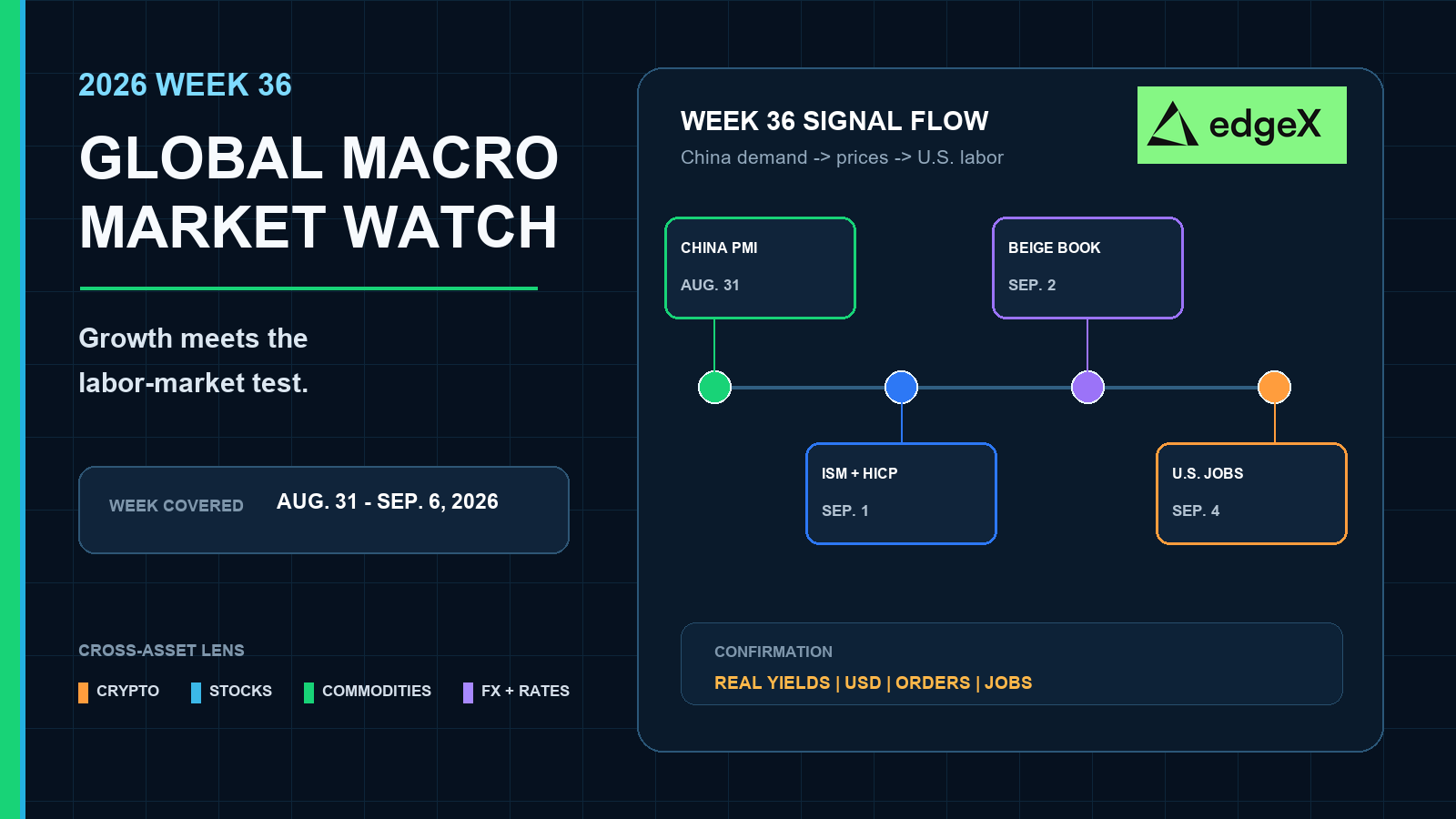
- •China's official August PMI report, due Monday, August 31 at 9:30 Beijing time, is a directional test of industrial momentum after July's manufacturing reading of 49.2 came in below the 50 expansion threshold.
- •The U.S. August Employment Situation, scheduled for Friday, September 4 at 8:30 a.m. Eastern time, is the week's highest-impact release, with payrolls, unemployment, wages, participation, and revisions all in focus.
- •Eurostat's August flash inflation estimate arrives September 1 after annual euro-area inflation rose to 2.9% in July from 2.8% in June, leaving European rates sensitive to upside price risks.
- •The Federal Reserve's Beige Book on September 2 will provide district-level evidence from all twelve districts on spending, hiring, wages, prices, credit, real estate, and manufacturing.
- •The week's cross-asset impact spans cyclicals, industrial metals, gold, the dollar, and crypto, with the most durable risk-on setup requiring both improving activity and easing inflation rather than falling yields alone.
Quick Answer
Week 36 asks whether global growth can remain resilient as manufacturing, inflation, and labor data arrive almost simultaneously. The constructive mix would be a China PMI recovery, stable U.S. employment, softer inflation, and evidence from the Beige Book that demand is cooling gradually rather than breaking. A weak China factory reading, sticky euro-area prices, and a U.S. payroll miss would create a more difficult combination: less confidence in earnings, limited room for aggressive easing, and greater pressure on cyclical assets.
Why Week 36 Matters
The week begins with a regional growth signal and ends with the most closely watched labor report in global markets. China’s PMI arrives before Western markets have fully digested the previous week’s positioning, so its new-orders and employment components can influence Asian equities, industrial metals, the renminbi, and the opening tone for risk assets. The U.S. employment report then determines whether the market’s rate view can survive a broader cross-check from inflation, manufacturing, and central-bank regional intelligence.
This sequence is important because a single data point can mislead. A stronger U.S. payroll number would be constructive for demand only if wage pressure and inflation expectations remain contained. Likewise, a better China headline PMI would carry more weight if new orders, services activity, and private-sector confidence improve together. The week therefore rewards confirmation across data families rather than a simple risk-on or risk-off reaction to one headline.
The opening signal comes from China
The National Bureau of Statistics schedules its August PMI report for Monday, August 31, at 9:30 Beijing time. The manufacturing index, production, new orders, export orders, employment, and input-price components will show whether industrial momentum is stabilizing. The non-manufacturing survey adds construction and services, which are essential for judging whether domestic demand is broadening beyond export-linked production.
China’s July manufacturing PMI was 49.2, according to the NBS release. That sub-50 reading makes the August result a directional test rather than a minor monthly update. A recovery in new orders and services activity could support copper, iron ore, Asian equities, and the broader global-growth narrative. A renewed decline would keep pressure on margins and strengthen the case for targeted support.
Week 36 Global Macro Calendar
| Date | Region | Scheduled Event | Why Markets Care |
| August 31 | China | August official manufacturing and non-manufacturing PMIs | Opens the week with evidence on factory orders, services, construction, employment, prices, CNH, Asian equities, and industrial commodities. |
| September 1 | United States | August ISM Manufacturing PMI | Tests orders, production, employment, supplier conditions, and input-price pressure before the jobs report. |
| September 1 | Euro area | August inflation flash estimate | Can reprice European rates, EUR, bank shares, and the regional real-income outlook. |
| September 2 | United States | Federal Reserve Beige Book | Provides district-level evidence on consumption, labor, wages, prices, credit, real estate, and manufacturing. |
| September 2 | Australia | Second-quarter national accounts | Tests domestic consumption, investment, trade, AUD, Australian rates, and the regional China-growth link. |
| September 3 | United States | August ISM Services PMI | Tests the larger services economy through business activity, new orders, employment, and prices before payrolls. |
| September 3 | Canada | July international merchandise trade | Connects North American demand to energy, manufacturing, the trade balance, and CAD. |
| September 4 | United States | August Employment Situation | The week’s main rate-volatility catalyst across payrolls, unemployment, wages, participation, and revisions. |
| September 4 | Canada | August Labour Force Survey | Adds an external labor-market check for North American growth and Bank of Canada expectations. |
The First Two Days Set the Global Growth Baseline
China’s PMI is followed on September 1 by the U.S. ISM Manufacturing PMI and the euro-area flash inflation estimate. The ISM report is watched through new orders, production, employment, supplier deliveries, and prices paid. A manufacturing recovery with cooling prices would be supportive for cyclical assets. Strong prices without stronger orders would instead suggest that companies are absorbing cost pressure without receiving equivalent demand.
The euro-area flash estimate provides a separate policy test. Eurostat reported annual inflation of 2.9% in July, up from 2.8% in June, and schedules the August flash estimate for September 1. Markets will examine energy, food, services, and core dynamics rather than relying only on the headline. A softer services profile could revive expectations for policy flexibility, while a renewed acceleration would keep European rates sensitive to upside inflation risk.
Manufacturing strength must be broad-based
The U.S. and China surveys should be compared through the same lenses: new orders, employment, output, and prices. If both economies show improving orders, the demand impulse can reach industrial metals, freight, machinery, and exporters. If output improves while employment and orders lag, the signal may reflect inventory or supply normalization rather than durable demand.
The distinction matters for equities. Semiconductor and software shares can tolerate a mixed manufacturing report if financial conditions ease, but small caps, banks, materials, and machinery need evidence that volumes are improving. In commodities, copper and crude require credible demand confirmation; gold is more directly tied to real yields, the dollar, and defensive positioning.
Beige Book and Australia Add Regional Evidence
The Federal Reserve’s September calendar lists the Beige Book for September 2. It compiles information from the twelve Federal Reserve districts on consumer spending, labor availability, wages, prices, real estate, manufacturing, and credit. The report will not deliver a single national number, but its value is in identifying whether weakness is spreading across regions or remaining concentrated in rate-sensitive sectors.
The Beige Book follows the ISM and euro-area inflation releases, giving officials’ regional contacts a role in interpreting the first two days of market volatility. Reports of slower discretionary spending, easier hiring, or fewer pricing increases could reinforce a gradual-disinflation narrative. Persistent wage and service-price pressure would make a soft landing less comfortable even if headline inflation improves.
Australia’s second-quarter national accounts are scheduled for September 2 at 11:30 a.m. Canberra time, according to the Australian Bureau of Statistics future-release calendar. Consumption, housing, government demand, business investment, and trade will matter for the Reserve Bank of Australia’s reaction function. Because Australia is closely linked to China through commodities and regional trade, a weak domestic report combined with a soft China PMI would be more negative for AUD and miners than either signal alone.
Regional confirmation changes the policy interpretation
A synchronized slowdown can bring lower yields but does not automatically create a bullish risk environment. If the slowdown is orderly and inflation is easing, bonds and quality growth may benefit. If it is accompanied by falling orders, weaker employment, and deteriorating credit, the market will price lower rates because earnings risk is rising.
That difference is especially important for crypto. Lower yields and a softer dollar can support BTC and ETH, but only when liquidity improves without a broad liquidation of risk positions. A weak-growth shock that drives investors into cash can overwhelm the mechanical benefit of lower policy expectations.
The U.S. Jobs Report Decides Whether the Week’s Signals Align
The U.S. Bureau of Labor Statistics schedules the August Employment Situation for Friday, September 4, at 8:30 a.m. Eastern time. Nonfarm payrolls, the unemployment rate, average hourly earnings, labor-force participation, and revisions will determine whether the Federal Reserve can respond to cooling inflation without signaling concern about a sharper slowdown.
Payrolls should be read alongside the ISM employment component and the Beige Book. A modest payroll gain with stable participation and easing wage growth would fit a controlled slowdown. A strong payroll report with accelerating wages could push yields and the dollar higher, particularly if the euro-area inflation data are also firm. A weak report would support rate-cut expectations, but the market response would depend on whether the weakness looks like normalization or a break in household income.
The ISM Services PMI on September 3 supplies the final business-side check before payrolls. Services account for the larger share of U.S. activity, and the survey’s employment and prices indexes connect directly to the Federal Reserve’s dual mandate. Firmer services orders with cooling prices would be constructive; weaker employment with persistent prices would be a stagflationary warning.
Canada’s trade balance on September 3 and Labour Force Survey on September 4 provide a useful external check. Canada’s employment, wages, participation, and sector mix can influence Bank of Canada expectations and CAD, while the trade result connects domestic demand to energy and global goods flows. A weak Canadian labor report alongside soft U.S. payrolls would strengthen the growth-warning interpretation; stronger Canadian data would suggest that the slowdown is not universal.
Cross-Asset Market Impact Map
| Macro Mix | Crypto | Stocks | Commodities | FX and Rates |
| China PMI improves, inflation cools, U.S. jobs remain steady | Lower real-yield pressure and better liquidity can support BTC and ETH if spot demand confirms. | Cyclicals, semiconductors, financials, and China-sensitive exporters can broaden leadership. | Copper, iron ore, and crude gain demand support; gold can hold if real yields ease. | U.S. yields drift lower; USD softens selectively; CNH, AUD, and CAD gain confirmation. |
| China PMI weakens, U.S. jobs stay firm, inflation remains sticky | Higher yields and narrow breadth can pressure leveraged crypto even if U.S. demand holds. | Quality growth and defensives may outperform materials, small caps, and China-sensitive stocks. | Gold benefits from defensive demand; industrial metals and crude face demand concerns. | USD and front-end yields rise; CNH and AUD remain vulnerable. |
| Global manufacturing weakens, jobs cool, inflation eases | Easing expectations help liquidity, but weak risk appetite limits upside and raises volatility. | Bonds and quality growth may outperform cyclicals; earnings revisions become central. | Gold can outperform copper and crude as growth risk rises. | Bonds rally; USD response depends on safe-haven demand; high-beta currencies weaken. |
| Orders recover, wages and services inflation accelerate | Strong activity is offset by restrictive-rate expectations and higher funding costs. | Banks and value can outperform long-duration growth, while rate-sensitive housing lags. | Industrial commodities gain demand support, but gold faces a real-yield headwind. | Yields and USD rise; curves may flatten as policy stays restrictive. |
What Traders Should Watch Next
Start with China’s new orders, services activity, and employment rather than the headline alone. On September 1, compare U.S. ISM orders and prices with the euro-area inflation composition. The Beige Book then shows whether the early-week message is visible in regional spending, hiring, and credit conditions. Australia’s GDP and Canada’s data provide cross-checks on the China and U.S. signals.
Friday’s U.S. jobs report is the final decision point, but confirmation should come from real yields, the dollar, equity breadth, copper, crude, gold, and crypto spot demand. A market move that appears only in futures leverage and not in cash markets is less durable. The most robust risk-on setup requires improving activity and easing inflation together; the most fragile setup is a narrow rally built on falling yields while orders and employment deteriorate.
Trade with an Edge
In fast-moving markets, execution matters just as much as direction. That’s why more traders are turning to decentralized venues like edgeX for perpetuals and spot trading.
Unlike traditional centralized platforms, edgeX is built around self-custody, meaning you keep control of your assets and authorize fund movements yourself. For active traders, that offers a meaningful advantage: market access without handing custody to an exchange.
edgeX also combines the core benefits of DeFi with a trading experience designed for serious execution. The platform emphasizes deep liquidity, high-speed order matching, and low-slippage performance, helping traders stay responsive during volatile conditions. With support for high leverage, it gives experienced market participants more flexibility in how they express macro views and manage risk.
Beyond execution, decentralized trading infrastructure can offer structural advantages: greater transparency, on-chain verification, and reduced dependence on centralized intermediaries. For traders who want performance without giving up control, that model is increasingly compelling.
edgeX is built for that balance: bringing together a professional trading experience with the core principles of decentralized markets.
Traders looking to explore a more capital-efficient, self-custodial way to trade can take a closer look at edgeX.
Frequently Asked Questions
What is the most important event in Week 36?
The U.S. August Employment Situation on September 4 is the highest-impact release, but its meaning depends on the earlier China PMI, U.S. ISM, euro-area inflation, and Beige Book signals.
Why does China’s PMI matter at the start of the week?
It is the first major read on factory orders, services activity, employment, and prices after July’s manufacturing PMI came in below 50. It can influence Asian equities, CNH, industrial metals, and global growth expectations.
How should investors read the U.S. jobs report?
Payrolls, unemployment, participation, wage growth, and revisions should be read together. A strong headline with cooling wages is different from strong hiring with accelerating wage pressure.
What does the Beige Book add?
It provides district-level evidence on spending, hiring, wages, prices, credit, real estate, and manufacturing. It helps determine whether national data describe a broad trend or a narrow sector effect.
How could Week 36 affect crypto markets?
Real yields, the dollar, liquidity expectations, and the breadth of risk appetite will matter most. Easier policy expectations can support crypto, but a growth scare or broad deleveraging can offset that benefit.

