2026 Week 35 Global Macro Market Watch: Jackson Hole Meets PCE, GDP, and Global Demand
Key Takeaways
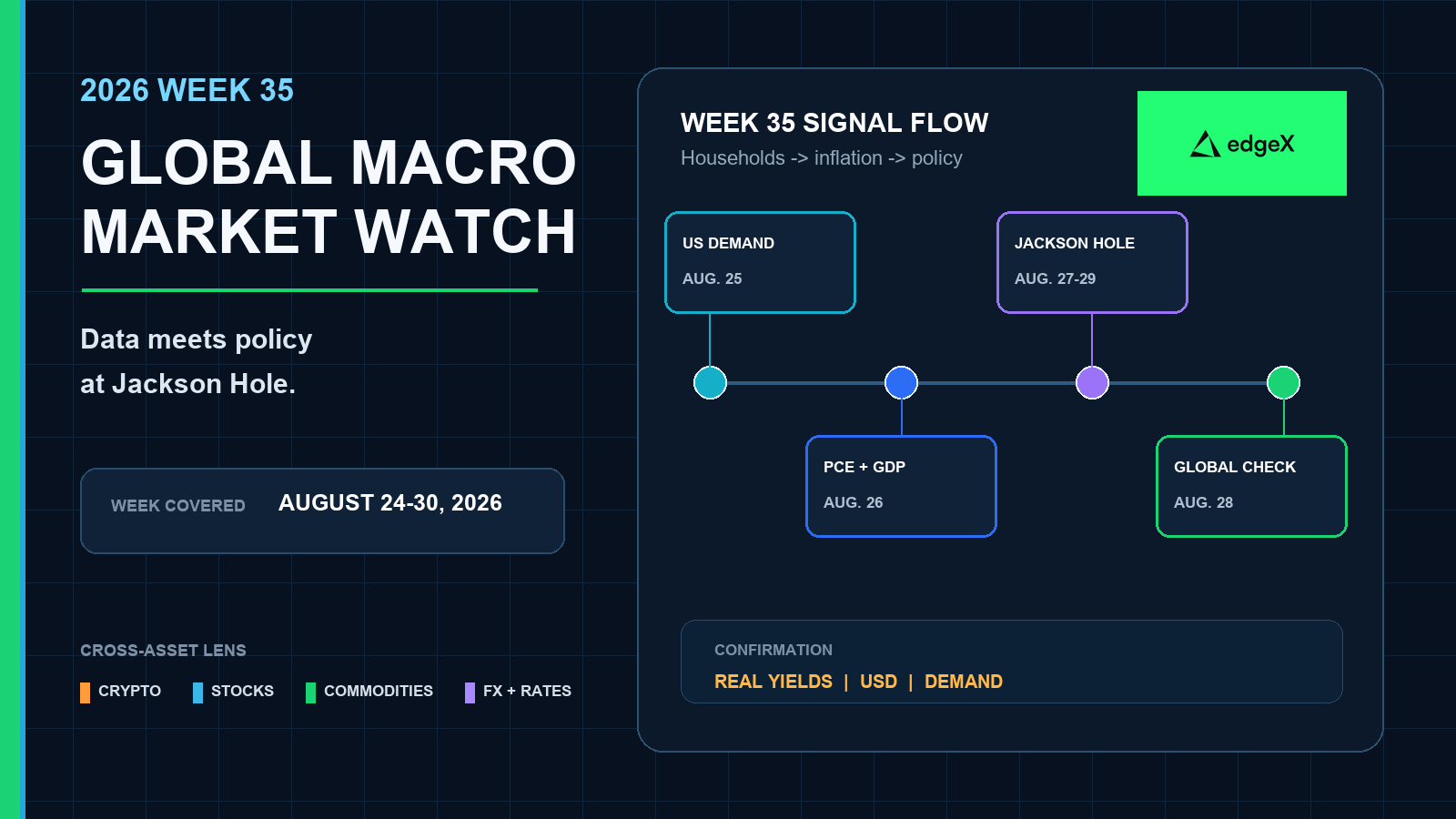
- •The August 26 U.S. data cluster combines July personal income and spending, PCE inflation, the second estimate of second-quarter GDP, and preliminary durable-goods orders, making it the week's primary market catalyst.
- •The Jackson Hole Economic Policy Symposium runs August 27-29, 2026, with the Kansas City Fed listing the theme as "Financial Innovation: Implications for Payments and Policy."
- •Core capital-goods orders, measured as nondefense orders excluding aircraft, offer a cleaner read on business investment than the headline durable-goods number, which is often dominated by aircraft and defense.
- •Global releases during the week include Australia's July CPI, China's July industrial profits, Canada's second-quarter current account and GDP, and Japan's July unemployment rate.
- •The article outlines four outcome scenarios, ranging from cooler PCE with stable demand supporting a soft landing to hot PCE paired with weak demand, described as the most difficult mix of limited policy relief and deteriorating activity.
Quick Answer
Week 35 asks whether inflation is cooling without a material loss of demand. A benign outcome would combine moderate U.S. PCE inflation, resilient income and spending, stable GDP, firmer capital-goods orders, and Jackson Hole communication that preserves policy flexibility. Hot inflation with strong demand would keep yields restrictive, while weak spending, soft orders, and disappointing Canadian or Japanese data would turn easier-policy expectations into a growth warning.
Why Week 35 Matters
Week 35 compresses the global macro debate into a small number of releases with unusually broad cross-asset reach. The U.S. August 26 package covers household cash flow, consumption, inflation, output, and business investment in one session. Jackson Hole then gives central bankers an opportunity to explain how financial innovation, payments, market structure, inflation, and economic resilience fit into the policy outlook.
The sequence matters. Markets will form an initial view from U.S. housing and confidence on Tuesday, reprice sharply around Wednesday's data cluster, and then test that move against central-bank communication, Canadian growth, Japanese labor conditions, and Friday's U.S. business and consumer surveys.
Policy communication follows the data shock
Jackson Hole begins one day after the most important U.S. data release of the week. That timing raises the value of every speech because officials can respond to a fresh read on PCE inflation and demand. A calm inflation report with stable spending would support a gradual policy adjustment; sticky prices or unexpectedly weak consumption would make the communication task harder.
Week 35 Global Macro Calendar
| Date | Region | Scheduled Event | Why Markets Care |
|---|---|---|---|
| August 25 | United States | June S&P CoreLogic Case-Shiller home prices; July new-home sales; August consumer confidence; Richmond Fed manufacturing | Tests household confidence, mortgage-rate sensitivity, residential demand, and regional factory momentum. |
| August 25 | Japan | Final June leading indicators | Updates the direction of production, employment, consumer expectations, and external demand. |
| August 26 | United States | July personal income and spending, including PCE inflation | Measures household cash flow, real consumption, and the Federal Reserve's preferred inflation gauge. |
| August 26 | United States | Second estimate of second-quarter GDP | Revises the composition of growth across consumption, investment, inventories, government, and trade. |
| August 26 | United States | Preliminary July durable-goods orders | Tests aircraft volatility, capital expenditure, and business confidence through core capital-goods demand. |
| August 26 | Australia | July Consumer Price Index | Can reprice RBA expectations, Australian yields, AUD, banks, housing-sensitive shares, and regional risk appetite. |
| August 27-29 | United States | Jackson Hole Economic Policy Symposium | Central bankers discuss financial innovation, payments, policy, and the wider economic outlook. |
| August 27 | China | July industrial profits | Tests factory-sector earnings, margin pressure, industrial demand, and the strength of China's nominal recovery. |
| August 27 | Canada | Second-quarter current account | Shows how trade, investment income, and financing flows are shaping external balances and CAD sensitivity. |
| August 28 | Canada | Second-quarter GDP and June GDP by industry | Tests domestic momentum, household demand, business activity, CAD, Canadian rates, and Bank of Canada expectations. |
| August 28 | Japan | July unemployment rate | Adds a labor-market check relevant to wage pressure, household demand, JPY, JGBs, and BOJ normalization. |
| August 28 | United States | August Chicago PMI and final University of Michigan consumer sentiment | Provides late-week confirmation on business activity, household confidence, and inflation expectations. |
The U.S. Data Cluster Sets the Week’s Price
The August 26 U.S. release calendar places several normally separate market arguments into the same window. Personal income shows whether wages, transfers, and investment income are supporting households. Spending reveals whether that income is reaching the real economy. The PCE price indexes determine how much of the nominal gain reflects inflation rather than volume.
Markets will focus on both headline and core PCE, but the composition matters as much as the monthly rate. Goods prices can move with energy, trade costs, and inventories; services inflation is more closely tied to wages, housing-related costs, and domestic demand. Firm services inflation alongside resilient spending would keep front-end Treasury yields supported even if goods inflation eases.
The second estimate of second-quarter GDP can change the growth narrative without changing the headline dramatically. Revisions to consumption and business investment carry more durable information than inventories or net exports. Stronger final demand would support earnings and cyclical assets, but it could also limit the speed of policy easing if inflation remains sticky.
Durable goods separate investment from headline noise
Preliminary durable-goods orders can be dominated by aircraft and defense. Core capital-goods orders and shipments offer a cleaner read on business investment. Improving core orders would suggest that companies are still committing capital despite financing costs and policy uncertainty. Weakness would reinforce a defensive interpretation of slower growth, especially if consumer spending also cools.
The combination creates four distinct outcomes. Cooler PCE with stable demand supports a soft landing. Hot PCE with strong demand lifts the risk of restrictive rates lasting longer. Cooler PCE with weak spending encourages easing expectations but raises earnings risk. Hot PCE with weak demand produces the most difficult mix: limited policy relief and deteriorating activity.
Jackson Hole Connects Innovation to Monetary Policy
The 2026 Jackson Hole symposium runs from August 27 through August 29. The Kansas City Fed lists the theme as "Financial Innovation: Implications for Payments and Policy." That framing reaches beyond a conventional rate-path discussion. Digital payments, tokenization, stablecoins, bank funding, settlement technology, and changes in market structure can affect monetary-policy transmission and financial stability.
Markets will still parse every comment for the inflation and employment outlook. The most consequential question is whether officials describe policy as sufficiently restrictive, increasingly balanced, or still constrained by persistent price pressure. Any discussion of the payments system will also matter for banks, fintech companies, crypto markets, and firms building tokenized financial infrastructure.
A payments theme can move traditional and digital assets
Financial innovation can improve settlement speed and competition, but it can also change deposit behavior, liquidity demand, and the channels through which stress moves across institutions. Central-bank comments on these trade-offs may affect expectations for regulation, access to payment rails, and the role of private digital money.
Crypto markets could respond to both sides of the symposium. Softer real yields and a weaker dollar would support liquidity-sensitive assets, while cautious language on stablecoins or market structure could create sector-specific pressure. Bank and fintech shares may react to the balance between innovation opportunities and tighter supervisory expectations.
Housing and Confidence Provide the Early Warning
Tuesday's U.S. releases establish whether rate-sensitive sectors are weakening before the larger Wednesday package. New-home sales respond to mortgage rates, affordability, builder incentives, and local inventory. The Case-Shiller index adds a lagged view of home prices, which influence household wealth and shelter expectations.
Consumer confidence can move ahead of actual spending when households become more concerned about jobs, inflation, or financing costs. A sharp confidence decline would make resilient July spending less reassuring because it could point to softer demand later in the quarter. Stable confidence with better home sales would support the idea that households are absorbing restrictive rates.
The Richmond Fed manufacturing index adds a regional factory check. It should not be treated as a national forecast on its own, but new orders, shipments, employment, and prices can confirm or challenge the durable-goods signal arriving the next day.
Australia, Canada, and Japan Test the Global Pattern
Australia's July CPI arrives on August 26. The inflation mix will shape expectations for the Reserve Bank of Australia and influence AUD, government bonds, banks, property-sensitive shares, and regional currencies. Persistent services or housing inflation would keep policy caution alive. Broader disinflation would provide more room to support demand if labor or household conditions soften.
China’s July industrial profits are scheduled for August 27 at 09:30 Beijing time. The report provides a direct read on the earnings health of large industrial firms and can reveal whether changes in output, producer prices, and input costs are translating into better margins. Stronger profit growth would support the case for stabilizing manufacturing demand and could help Asian equities, industrial metals, and growth-sensitive currencies. Renewed weakness would point to persistent pricing pressure or soft final demand, reinforcing expectations for additional policy support.
Canada's second-quarter current account on August 27 is followed by second-quarter and June GDP on August 28. The quarterly report will show the broad growth composition, while monthly GDP identifies where momentum ended the quarter. Household consumption, housing, energy, manufacturing, and services will determine whether the economy is stabilizing or losing speed.
A weak Canadian result could lower domestic yields and weigh on CAD, although the currency response will also depend on oil and the U.S. dollar. Stronger growth would support Canadian banks and cyclical shares but could reduce expectations for rapid Bank of Canada easing.
Japan’s July unemployment rate provides a narrower but important labor signal. A tight labor market supports wage growth and consumption, reinforcing the case for gradual BOJ normalization. A softer labor picture would weaken domestic-demand confidence and could reduce support for the yen if global yields remain high.
Cross-Asset Market Impact Map
| Macro Mix | Crypto | Stocks | Commodities | FX and Rates |
|---|---|---|---|---|
| Moderate PCE, resilient spending, balanced Jackson Hole | Lower real-yield pressure and steady risk appetite can support BTC and ETH if spot demand confirms. | Growth, financials, consumer shares, and cyclicals can participate as soft-landing confidence broadens. | Copper and crude gain demand support; gold can hold if real yields ease. | Treasury yields may drift lower, USD softens selectively, and AUD/CAD/JPY depend on local data. |
| Hot PCE, strong GDP and orders, restrictive policy tone | Higher yields can outweigh stronger activity and pressure leveraged positioning. | Banks and value may outperform long-duration growth, while rate-sensitive housing and small caps lag. | Industrial demand remains firm, but gold faces a real-yield headwind. | Front-end U.S. yields and USD rise; curves may flatten if policy stays restrictive. |
| Soft PCE, weak spending and Canadian growth | Liquidity expectations improve, but weak breadth can limit conviction. | Defensives and quality growth may outperform consumer, industrial, and Canadian cyclical exposure. | Gold can outperform crude and industrial metals as demand concerns rise. | Bonds rally; CAD and other growth-sensitive currencies remain vulnerable. |
| Sticky inflation, weak demand, cautious innovation message | Tight financial conditions and regulatory uncertainty create a difficult mix. | Valuations and earnings expectations face simultaneous pressure. | Gold depends on safe-haven demand versus USD strength; industrial commodities weaken. | USD can strengthen, real yields stay elevated, and policy-sensitive curves flatten. |
What Traders Should Watch Next
Tuesday's housing and confidence data provide the first check on household resilience. Wednesday then requires separating nominal strength from real demand: income and spending should be read alongside PCE inflation, while GDP revisions should be decomposed into final demand, inventories, and trade. Durable-goods details will show whether businesses are still investing.
Jackson Hole is the interpretation stage rather than a substitute for the data. Cross-asset confirmation should appear in real yields, the dollar, equity breadth, bank and fintech shares, gold, copper, crude, and crypto spot demand. Friday's Canada GDP, Japanese unemployment, Chicago PMI, and Michigan sentiment will reveal whether the initial U.S. reaction fits a wider global pattern.
Trade with an Edge
In fast-moving markets, execution matters just as much as direction. That's why more traders are turning to decentralized venues like edgeX for perpetuals and spot trading.
Unlike traditional centralized platforms, edgeX is built around self-custody, meaning you keep control of your assets and authorize fund movements yourself. For active traders, that offers a meaningful advantage: market access without handing custody to an exchange.
edgeX also combines the core benefits of DeFi with a trading experience designed for serious execution. The platform emphasizes deep liquidity, high-speed order matching, and low-slippage performance, helping traders stay responsive during volatile conditions. With support for high leverage, it gives experienced market participants more flexibility in how they express macro views and manage risk.
Beyond execution, decentralized trading infrastructure can offer structural advantages: greater transparency, on-chain verification, and reduced dependence on centralized intermediaries. For traders who want performance without giving up control, that model is increasingly compelling.
edgeX is built for that balance: bringing together a professional trading experience with the core principles of decentralized markets.
Traders looking to explore a more capital-efficient, self-custodial way to trade can take a closer look at edgeX.
Frequently Asked Questions
What is the most important macro event in Week 35 of 2026?
The August 26 U.S. data cluster is the immediate market catalyst because it combines PCE inflation, income, spending, GDP revisions, and durable-goods orders. Jackson Hole is the policy interpretation point, especially where officials connect inflation and growth to financial innovation and payments.
When is the 2026 Jackson Hole symposium?
The Federal Reserve Bank of Kansas City lists the symposium for August 27-29, 2026. Its theme is "Financial Innovation: Implications for Payments and Policy."
Why can U.S. PCE and GDP send different signals?
PCE inflation measures price pressure, while GDP measures output. Growth can remain firm while inflation cools, or inflation can stay sticky as demand weakens. The composition of consumption, investment, inventories, and trade determines whether the combination is constructive.
Why does Australia's July CPI matter globally?
It can reprice RBA expectations and move Australian yields and AUD, which often transmit information about Asian growth, commodity demand, and global risk appetite. Housing and services inflation will be especially important for the policy outlook.
How can Week 35 affect crypto markets?
PCE inflation, real yields, the dollar, and Jackson Hole communication can change global liquidity expectations. The symposium's financial-innovation theme may also affect stablecoin, payments, tokenization, and market-structure expectations directly.

