2026 Week 32 Stocks Market Watch: Rate-Cut Bets Lift Stocks as AI Earnings Keep the Rally Selective
Key Takeaways
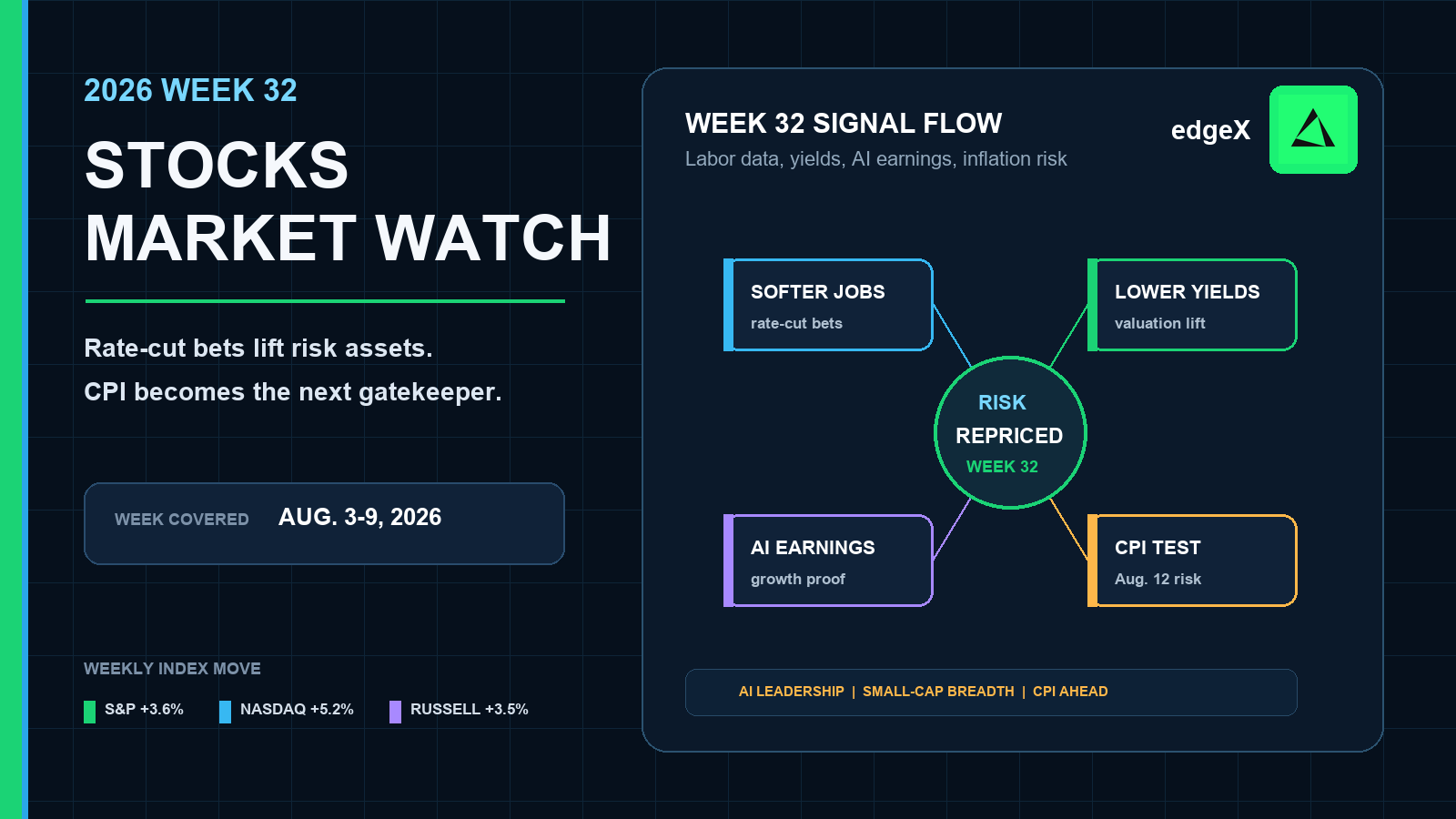
- •The S&P 500 and Nasdaq Composite both closed at record highs on Friday, with weekly gains of 3.6% and 5.2% respectively, driven by declining Treasury yields following a softer July employment report.
- •Small-cap stocks joined the rally as the Russell 2000 gained 3.5%, signaling improved market breadth beyond mega-cap technology names.
- •Strong second-quarter results from Palantir and AMD demonstrated that AI-related revenue growth remained a key driver of investor confidence in the technology sector.
- •Brent crude oil moved above $100 per barrel during the week, keeping geopolitical and energy-cost risks relevant even as equities advanced.
- •The July CPI report scheduled for release on August 12 will be the decisive factor in determining whether the rate-cut expectations supporting the rally can be sustained.
Quick Answer
Week 32 was a strong week for stocks because investors treated weaker labor-market data as a reason to expect easier monetary policy. That helped lower yields, supported growth valuations, and gave large-cap technology another push. The rally was broad enough to include small caps, but it was still dependent on a delicate mix: slower growth that is not too slow, inflation that keeps cooling, and AI earnings that continue to justify premium multiples. The market enters Week 33 with momentum, but CPI is now the key risk event.
Stocks Rallied Because the Rate Story Changed
Week 32 was the kind of week that shows how quickly equity narratives can flip. One week earlier, investors were still wrestling with a divided Federal Reserve, elevated inflation, and whether higher long-term yields would pressure expensive growth stocks. By Friday, the dominant story had changed. The market was no longer asking only whether profits were strong enough. It was asking whether weaker labor data had finally moved the Fed closer to cutting rates.
AP's August 8 market recap showed the scale of the move. For the week, the S&P 500 gained 3.6%, the Nasdaq Composite rose 5.2%, the Dow Jones Industrial Average added 3.0%, and the Russell 2000 advanced 3.5%. The S&P 500 and Nasdaq finished Friday at record highs, while the Dow ended just below its own record.
That performance was not a simple celebration of growth. It was a repricing of the policy path. AP reported that Friday's rally followed a weaker-than-expected July employment report, which pushed Treasury yields lower and raised expectations for Fed rate cuts. When yields fall, investors are often willing to pay more for future earnings. That matters most for technology, software, small caps, and other areas where valuations depend heavily on discount rates.
Bad news became good news, but only within limits
The important nuance is that the market did not rally because investors wanted a weak economy. It rallied because the data appeared soft enough to support rate-cut expectations without yet proving that corporate demand had broken. That distinction is the whole Week 32 story.
If labor weakness becomes a controlled slowdown, stocks can benefit from lower yields and lower financing costs. If it becomes a deeper demand shock, the same data would become a warning for revenue, margins, credit quality, and consumer spending. Week 32 leaned toward the first interpretation. Week 33 will test whether inflation allows that interpretation to survive.
Week 32 Stock-Market Dashboard
| Signal | Week 32 Result | Investor Meaning |
|---|---|---|
| S&P 500 | +3.6% for the week; record close Friday | Large caps benefited from lower yields and resilient earnings leadership. |
| Nasdaq Composite | +5.2% for the week; record close Friday | Growth and AI-linked stocks were the biggest winners from falling-rate expectations. |
| Dow Jones Industrial Average | +3.0% for the week | Blue chips joined the rally, making the move broader than a pure technology rebound. |
| Russell 2000 | +3.5% for the week | Small caps finally participated as lower yields improved the financing-cost story. |
| 10-year Treasury yield | Fell to about 4.11% Friday, per AP | Lower yields helped valuation multiples recover. |
| July jobs report | Weaker than expected, per AP's market recap | Softer hiring increased expectations for Fed rate cuts. |
| Brent crude | Moved above $100 during the week, per Reuters | Energy risk stayed relevant even as stocks rallied. |
| Next macro test | July CPI due August 12 | Inflation can confirm or challenge the rate-cut trade. |
This dashboard separates weekly equity performance from forward-looking macro risk. Week 32 tells us what investors already rewarded: lower yields, rate-cut expectations, and continued AI earnings support. The CPI release belongs to the next market test because it can change the Fed path after the weekly close.
AI Earnings Kept the Growth Trade Alive
The rate story created the opening, but earnings gave investors something to buy. AI remained the most important equity theme because it offered visible revenue growth at a time when macro data looked less certain.
Palantir's second-quarter results were one of the clearest examples. The company reported revenue growth and raised guidance, reinforcing the market's view that enterprise and government demand for AI platforms remained strong. AP also highlighted Palantir as a major contributor to the week's technology rally after its profit more than doubled.
AMD's second-quarter results added another layer to the AI trade. The company reported revenue growth tied to data-center and client demand, giving investors another way to express AI infrastructure exposure beyond the largest mega-cap names. For stock investors, AMD matters because it sits at the intersection of AI accelerators, server demand, and semiconductor-cycle expectations.
The earnings message was not that every AI stock deserved a higher multiple. It was that the market still wanted companies with a credible path from AI demand to revenue. In Week 31, investors asked whether AI capital expenditure could turn into cash flow. In Week 32, they rewarded companies that gave them enough evidence to keep that thesis alive.
Software and semiconductors carried different expectations
Software names benefit when investors believe AI adoption can lift contract values, retention, and operating leverage. Semiconductor names benefit when investors believe the infrastructure buildout will keep demand strong for chips, memory, networking, and servers. Both groups can rally when yields fall, but they are not priced on the same evidence.
That difference matters after a strong week. Software needs durable usage and budget expansion. Semiconductors need orders, capacity discipline, and margins that do not collapse when supply rises. A lower-rate backdrop can support both, but it cannot replace execution.
Small Caps Finally Joined, but the Bar Remains High
The Russell 2000's 3.5% weekly gain was important because small caps had lagged the prior week's rebound. Smaller companies are usually more sensitive to domestic demand, bank lending, and refinancing costs. When Treasury yields fall and investors expect the Fed to cut, that financing channel becomes more favorable.
Small-cap participation made Week 32 healthier than a narrow mega-cap rally. It suggested investors were willing to move beyond the largest technology platforms and take more cyclical risk. That is a constructive signal for breadth.
But the signal is not yet decisive. Small caps still need confirmation from earnings quality, credit conditions, and economic data. If the labor market keeps cooling while inflation remains elevated, smaller companies could face the worst mix: weaker demand without meaningful rate relief. The Russell's gain was encouraging, but it was also highly dependent on the idea that the Fed will be able to respond.
Global Stocks Had to Balance U.S. Momentum and External Risks
The U.S. rally helped global risk appetite, but international markets faced a less simple setup. AP reported that European and Asian shares were mixed early in Week 33 after the strong U.S. finish, reflecting both the benefit of Wall Street momentum and caution ahead of inflation data.
Japan, Korea, and Taiwan remain tied to the AI and semiconductor cycle, which means U.S. technology strength can support sentiment across North Asian equity markets. At the same time, those markets are sensitive to the dollar, Treasury yields, and export demand. A rate-cut rally in the United States is helpful if it eases financial conditions. It is less helpful if it reflects a sharp slowdown in U.S. demand.
China and Hong Kong sit in a different part of the equity map. For them, the key question is less AI capex and more whether policy support, property stabilization, and domestic consumption can repair confidence. A U.S. growth scare can pressure exporters, but lower U.S. yields can also relieve some pressure on global liquidity and capital flows.
Oil kept geopolitical risk in the background
Stocks rose even as commodity risk stayed visible. Reuters reported that oil topped $100 as tensions around Iran and supply risk remained in focus. Higher oil can complicate the equity story because it works against disinflation, raises input costs, and can pressure consumers.
That does not mean equities must fall whenever oil rises. Energy producers can benefit, and a moderate oil move can coexist with healthy growth. The problem appears when energy pressure becomes large enough to threaten CPI progress. That is why Week 32's rally still needs the next inflation print to cooperate.
The CPI Release Is the Next Gatekeeper
The Week 32 rally was built on a simple chain: softer jobs data lifted rate-cut expectations, lower yields supported valuations, and AI earnings gave investors enough confidence to buy growth. The July CPI report due August 12 can either strengthen or weaken every link in that chain.
A softer CPI print would support the idea that the Fed can respond to labor-market weakness without ignoring inflation. That would be constructive for bonds, growth stocks, small caps, and rate-sensitive sectors. It would also help investors argue that the economy can slow without forcing a damaging earnings recession.
A hotter CPI print would be more difficult. It would remind investors that the Fed may not have room to cut quickly, even if hiring slows. In that scenario, the market could lose both supports at once: growth concerns would rise while rate relief becomes less certain. That is the risk behind a rally built on policy expectations.
What Week 32 Changed for Investors
Week 32 improved the equity-market tone because the rally broadened, yields fell, and AI earnings remained strong enough to sustain the growth trade. The S&P 500 and Nasdaq reaching records showed that investors were willing to look through softer labor data when they believed the Fed would eventually respond.
The cautious reading is that the market is now more dependent on macro confirmation. Rate-cut expectations can lift stocks quickly, but they can also reverse quickly. CPI, retail sales, jobless claims, and the next round of earnings guidance will decide whether Week 32 was the start of a broader risk-on phase or a sharp relief rally inside a still-fragile macro setup.
For now, the message is balanced. Stocks have momentum. AI still has leadership. Small caps finally participated. But the rally needs inflation to keep moving in the right direction, and it needs weaker labor data to remain a slowdown rather than a break.
Trade Stocks Without the TradFi Gatekeeping
The stock market moves fast. Your trading infrastructure should too.
As RWA markets mature and tokenized stocks become a serious alternative to tradFi access points, more traders are asking the same question: why settle for a centralized platform that controls your assets, demands KYC, and keeps your trading fees?
edgeX Exchange offers a different answer. Built on EDGE chain and settling on Ethereum via Arbitrum, edgeX is a decentralized perpetual futures platform where you can trade stocks with high leverage without handing over your identity or your keys.
Here's what sets it apart:
- True self-custody: Users control their private keys at all times. Withdrawals require no platform approval.
- Institutional-grade liquidity: $10 million depth within a one-basis-point spread, with sub-0.1-basis-point slippage on trades over $100,000.
- CEX-level speed: The order book processes up to 200,000 orders per second with sub-10 millisecond matching latency.
- No KYC required: Sign up and start trading without the friction of traditional onboarding.
- 100% trading fee rewards: Every fee you pay comes back to you through the Trade to Own program.
- USDC-backed settlement: USDC is designed by Circle to be redeemable 1:1 for U.S. dollars, giving traders a familiar stablecoin base.
Whether you're rotating out of tradFi equities, exploring RWA perpetuals, or simply looking for a smarter way to trade stocks on-chain, edgeX delivers the execution quality of a top-tier exchange with the security guarantees of decentralized infrastructure.
Available on iOS and Android, edgeX is built so your edge goes wherever you do. Start trading on edgeX.
Frequently Asked Questions
How did U.S. stocks perform in Week 32 of 2026?
AP's weekly recap showed the S&P 500 rising 3.6%, the Nasdaq Composite gaining 5.2%, the Dow adding 3.0%, and the Russell 2000 advancing 3.5% for the week ending August 7.
Why did stocks rally after weaker labor data?
Investors treated softer jobs data as a sign that the Federal Reserve may have more room to cut rates. Lower Treasury yields helped growth valuations and encouraged broader risk-taking.
Which earnings mattered most for the Week 32 stock rally?
Palantir and AMD were important because they reinforced the AI demand narrative. Apple and Amazon also remained central to large-cap sentiment because of their weight in consumer, cloud, and platform expectations.
Why is the August 12 CPI report important?
The CPI report will test whether inflation is cooling enough for the Fed to respond to labor-market weakness. A soft print would support the rate-cut trade, while a hot print could pressure stocks and bonds.
What should stock investors watch after Week 32?
The key signals are CPI, Treasury yields, jobless claims, retail sales, small-cap breadth, AI earnings guidance, and whether energy prices create new inflation pressure.

